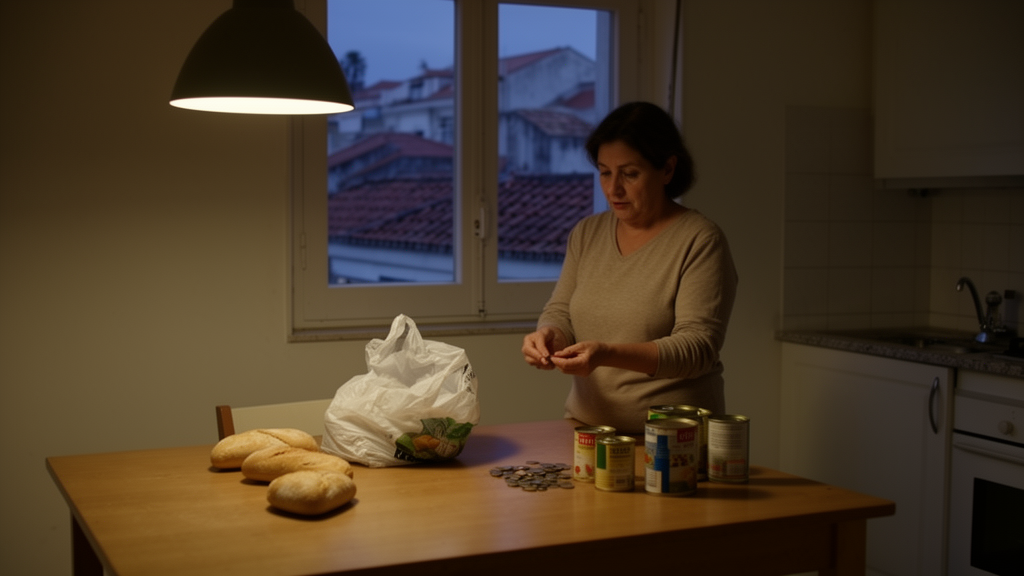
Food insecurity in Portugal rose from 13.8% of the population in 2019 to 16.3% in 2023, according to a new analysis of nationally representative survey data, and the sharpest pressures are falling on renters, young adults, lone parents and migrants. The study, published in Agriculture & Food Security, draws on the Portuguese component of the European Union Statistics on Income and Living Conditions (EU-SILC) to track how the cost-of-living crisis has reshaped household food access over five years. Its most striking result concerns housing: tenants paying market rent had significantly higher odds of moderate or severe food insecurity than homeowners, and tenants paying reduced rent faced nearly three times the risk, even after accounting for income, education, employment and household composition.
The research team, led by Susana Brissos and Vasco Ramos, analysed anonymised EU-SILC microdata covering 2019 to 2023, with annual samples ranging from roughly 15,500 to 18,900 households and up to 33,639 individuals in 2023. Since 2019, the Portuguese EU-SILC has included the eight-item Food Insecurity Experience Scale (FIES), a psychometric instrument developed by the FAO that captures constraints on food access over the previous twelve months. Households were classified using two approaches: a probabilistic Rasch-model assignment designed for cross-country comparability, and a discrete assignment based on raw scores that allows finer distinctions between mild, moderate and severe food insecurity. All analyses used cross-sectional household weights to ensure national representativeness, and the authors stress that, because the data are repeated cross-sections, the findings indicate associations rather than causal relationships.
The headline trend conceals a more nuanced pattern. Under the discrete assignment, most of the rise in food insecurity came from its mildest form, which grew from 10.0% of the population in 2019 to 12.3% in 2023, while moderate or severe food insecurity remained relatively stable over the period. Item-level responses reveal what that means in practice: the share of people reporting that they consumed only a few kinds of foods climbed from 10.4% in 2019 to 13.7% in 2023, and the inability to eat healthy, nutritious food rose from 7.1% to 7.8%. Meanwhile, the proportion reporting anxiety about running out of food actually fell slightly, from 8.0% to 7.4%. Among households classified as mildly food insecure, 79.1% reported reducing dietary variety as a coping strategy.
That ordering is unusual. Globally, the FIES item on worry is typically the first to be affirmed, but in the Portuguese data the items on reduced dietary diversity consistently appear earlier on the severity continuum, a pattern the Rasch modelling confirmed across the five-year series. The authors interpret this as anticipatory coping: households cut the variety and nutritional quality of their diets before overt anxiety or outright shortages arise, likely reflecting the rising prices of key components of healthier diets such as meat, fish, fruits and vegetables. They also note that the pattern may reflect culturally specific interpretations of what it means to worry about food access, a known challenge in translating and adapting the FIES across contexts.
While mild insecurity spread, the more acute forms also worsened by 2023. Under the probabilistic assignment, the prevalence of moderate or severe food insecurity fell slightly after 2019, rose during the COVID-19 pandemic in 2021, dipped in 2022, and then increased sharply to 4.8% in 2023, the highest level of the five-year period. The authors suggest that the recent inflationary crisis has had a stronger impact on severe food insecurity than the pandemic itself. The Portuguese context helps explain why: food and non-alcoholic beverage inflation reached 21.5% year-on-year in February 2023, and by January 2025 those prices stood 29.1% above their 2021 level. In the 2022/2023 household budget survey, housing accounted for roughly 39% of average household expenditure and food for about 13%.
Housing pressures loom large throughout the analysis. Between 2013 and 2023, housing costs in Portugal increased by 106% while nominal wages grew by only 26%, and between 2015 and 2025 housing prices rose 58% across the European Union but 147% in Portugal. In 2025, Lisbon was the EU city where households spent the highest share of income on rent, at 116%. Against this backdrop, the study’s regression results are pointed. Relative to owners without a mortgage, tenants paying market rent had 35% higher odds of moderate or severe food insecurity, while tenants in reduced-rent arrangements, often the most socially disadvantaged households, including many relocated from former slum areas into social housing, faced nearly three times the odds. Homeowners with a mortgage, by contrast, had 41% lower odds than outright owners. Households describing their housing costs as a heavy burden had about twice the odds of moderate or severe food insecurity compared with those reporting no burden.
The multivariate model, based on 2023 data and using the discrete assignment, identified a clear hierarchy of vulnerability. Young adults aged 18 to 34 had the highest prevalence among age groups at 5.1%, and lone-parent households with at least one child under 25 had 56% higher adjusted odds than couples without children, while one-person households had 41% higher odds. People born outside the EU or holding non-EU citizenship had substantially higher prevalence, at 6.4% and 6.9% respectively, and retained higher adjusted odds even after accounting for income, education and employment. Education showed a steep gradient, with higher education associated with 60% lower odds, and the unemployed had 43% higher odds than the employed. Regional differences were pronounced, with the highest prevalence in the Azores at 8.0%, followed by Madeira, the Lisbon metropolitan area and the Algarve.
Measures of financial strain emerged as the strongest correlates of all. Households unable to meet unexpected expenses had a prevalence of 11.7% versus 0.6% among those with such capacity, and adjusted odds more than four times higher. Those reporting difficulty making ends meet had 13.3% prevalence and adjusted odds of 13.39 relative to those managing easily, which the authors interpret as evidence that subjective measures capture dimensions of precarity, such as debt and fixed expenditure commitments, that income alone does not. Income still mattered: prevalence fell from 12.7% in the lowest quintile to 0.4% in the highest, and the bottom quintile had adjusted odds of 4.11 relative to the top. Notably, the authors highlight that moderate or severe food insecurity was not confined to the poorest households, with non-negligible prevalence among middle-income groups.
The study has limitations the authors acknowledge directly. The cross-sectional design prevents any assessment of individual trajectories into and out of food insecurity or causal claims about the sequence of events leading to hardship, and the overlapping shocks of the period, pandemic, inflation and housing crisis, complicate the isolation of independent effects. A methodological caveat concerns standard errors: because the software treated the survey weights as frequency weights rather than accounting for the complex survey design, confidence intervals are artificially narrow, so the precision and statistical significance of the odds ratios should be interpreted cautiously, even though the direction and relative magnitude of the estimates are unaffected. The authors also note that a measure of the share of disposable income devoted to housing costs was available but not used in the regression model, leaving room for future validation.
The policy implications the authors draw span three domains. On food, they point to fiscal measures such as reduced VAT on minimally processed, nutrient-dense foods, support for price stability of Mediterranean diet staples, and stronger short and local supply chains, alongside integrated local food governance including universal school meals and public procurement linked to local producers. On housing, they argue for expanding affordable housing supply, stabilising rental markets with predictable limits on in-tenancy rent increases, expanding targeted housing allowances, and reducing utility costs through energy-efficiency upgrades and social tariffs. On social protection, they recommend more responsive minimum-income schemes, accessible emergency support, dedicated housing and employment pathways for young adults, improved social protection access for non-EU migrants, and prioritisation of lone-parent households and people living alone in benefit design and housing allocation. Without interventions addressing the housing-food nexus, the authors warn, food insecurity in Portugal, and in other high-income countries facing similar affordability crises, is likely to deepen, with consequences for health, well-being and social cohesion.
Subject of Research: Trends in food insecurity and its association with housing tenure and financial strain in Portugal from 2019 to 2023
Article Title: Food insecurity during a cost‑of‑living crisis: trends and housing‑related vulnerability in Portugal (2019–2023)
Article References: Brissos, S., & Ramos, V. (2026). Food insecurity during a cost‑of‑living crisis: trends and housing‑related vulnerability in Portugal (2019–2023). Agriculture & Food Security, 15(1), Article 44. https://doi.org/10.1186/s40066-026-00628-6
Image Credits: AI Generated
DOI: 10.1186/s40066-026-00628-6
Keywords: food insecurity, Portugal, EU-SILC, housing affordability, cost-of-living crisis, FIES, renters, household financial strain, diet quality, social policy, moderate and severe food insecurity, housing tenure
News Source: Alan Morgan. (October 28, 2026). Research report: Food insecurity during a cost‑of‑living crisis: trends and housing‑related vulnerability in Portugal (2019–2023). Scienmag.