• HOME
  • NEWS
  • EXPLORE
    • CAREER
      • Companies
      • Jobs
    • EVENTS
    • iGEM
      • News
      • Team
    • PHOTOS
    • VIDEO
    • WIKI
  • BLOG
  • COMMUNITY
    • FACEBOOK
    • INSTAGRAM
    • TWITTER
Thursday, October 22, 2026
BIOENGINEER.ORG
No Result
View All Result
  • Login
  • HOME
  • NEWS
  • EXPLORE
    • CAREER
      • Companies
      • Jobs
        • Lecturer
        • PhD Studentship
        • Postdoc
        • Research Assistant
    • EVENTS
    • iGEM
      • News
      • Team
    • PHOTOS
    • VIDEO
    • WIKI
  • BLOG
  • COMMUNITY
    • FACEBOOK
    • INSTAGRAM
    • TWITTER
No Result
View All Result
Bioengineer.org
No Result
View All Result
Home NEWS Science News Cancer

313TE targets IL-13Rα2-positive tumors in preclinical testing

by
October 22, 2026
in Cancer
Reading Time: 2 mins read
0
313TE targets IL-13Rα2-positive tumors in preclinical testing

313TE targets IL-13Rα2-positive tumors in preclinical testing

Share on FacebookShare on TwitterShare on LinkedinShare on RedditShare on Telegram

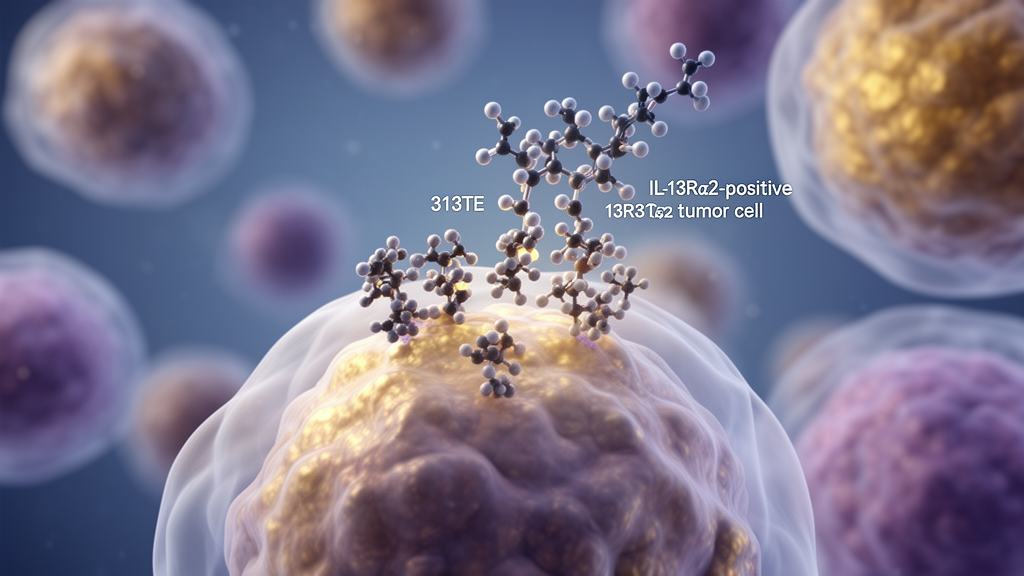
A novel T-cell engager designated 313TE produced anti-tumor activity against IL-13Rα2-positive tumor cells in laboratory experiments and mouse xenografts, according to a research article published in Cancer Immunology, Immunotherapy. The construct was designed around an IL-13E13Y scaffold to bridge cells expressing IL-13Rα2 and T cells through CD3, enabling the two cell types to interact directly.

IL-13Rα2 was reported to be overexpressed in a variety of solid tumors and to have restricted expression in normal tissues. The authors identified this distribution as a reason to investigate the receptor as a target for cancer therapy, while noting that progress in developing IL-13Rα2-directed treatments has been limited. Their study focused on 313TE, a bispecific construct intended to connect the target on tumor cells with CD3 on T cells.

In vitro, 313TE bound strongly to IL-13Rα2-positive cells and T cells. Once the construct had linked these cell types, it promoted T-cell-mediated cytotoxicity against the targeted tumor cells. The killing was IL-13Rα2-dependent, rather than occurring without regard to receptor expression. The engager also elicited immune-stimulatory cytokines, indicating that its activity in the cell assays extended beyond the direct measurement of tumor-cell destruction.

The researchers then tested 313TE in a xenograft tumor model. Treatment significantly delayed tumor growth and reduced tumor weight compared with the study’s control condition. The efficacy was described as strictly dependent on IL-13Rα2 expression, linking the observed anti-tumor effect to the presence of the engager’s intended target. These findings show that 313TE could recruit T cells to IL-13Rα2-positive tumor cells under experimental conditions and suppress tumor growth in the mouse model.

The evidence is preclinical: it comes from cell-based assays and a mouse xenograft model, not from a clinical study in people with cancer. The results therefore support 313TE as an experimental targeted immunotherapy and do not establish clinical benefit in patients. The article presents the construct as a promising strategy for further investigation of IL-13Rα2-positive solid tumors, while the reported work remains limited to laboratory and animal models.

Subject of Research: Preclinical testing of an IL-13Rα2-targeting T-cell engager for solid tumors

Article Title: A novel IL-13E13Y-based T cell engager, 313TE, promotes anti-tumor function against IL-13Rα2-positive tumor

Article References: Tang, L., Ma, A., Zong, L., & Zheng, M. (2026). A novel IL-13E13Y-based T cell engager, 313TE, promotes anti-tumor function against IL-13Rα2-positive tumor. Cancer Immunology, Immunotherapy. https://doi.org/10.1007/s00262-026-04564-z

Image Credits: AI Generated

DOI: 10.1007/s00262-026-04564-z

Keywords: IL-13Rα2, 313TE, T-cell engager, cancer immunotherapy, solid tumors, CD3, cytotoxicity, xenograft model, cancer immunology, novel, IL-13E13Y-based, cell

News Source: Nathaniel Bowman. (October 22, 2026). 313TE targets IL-13Rα2-positive tumors in preclinical testing. Scienmag.


Tags: 313TECancer ImmunologyCancer immunotherapyCD3cellcytotoxicityIL-13E13Y-basedIL-13Rα2novelsolid tumorsT-cell engagerxenograft model
Share12Tweet7Share2ShareShareShare1

Related Posts

Retrospective study tests time-specific HCC recurrence prediction after ablation

Retrospective study tests time-specific HCC recurrence prediction after ablation

October 22, 2026
Research report: Behavior Change Interventions to Promote Healthy Lifestyles Among Adolescent and Young Adult Childhood Cancer Survivors: A Scoping Review

Research report: Behavior Change Interventions to Promote Healthy Lifestyles Among Adolescent and Young Adult Childhood Cancer Survivors: A Scoping Review

October 22, 2026

First small trial finds minibeam radiotherapy promising for resistant surface cancers

October 22, 2026

Patient-derived CRC-X1 cell line supports colon cancer liver-metastasis research

October 22, 2026

POPULAR NEWS

  • Cyclosporine A Directly Binds CCL5 in SJS/TEN Study

    Cyclosporine A Directly Binds CCL5 in SJS/TEN Study

    29 shares
    Share 12 Tweet 7
  • 313TE targets IL-13Rα2-positive tumors in preclinical testing

    29 shares
    Share 12 Tweet 7
  • DCT and high-boost filtering improve grayscale multi-focus fusion in four-dataset study

    29 shares
    Share 12 Tweet 7
  • Retrospective study tests time-specific HCC recurrence prediction after ablation

    29 shares
    Share 12 Tweet 7

About

We bring you the latest biotechnology news from best research centers and universities around the world. Check our website.

Follow us

Recent News

Cyclosporine A Directly Binds CCL5 in SJS/TEN Study

313TE targets IL-13Rα2-positive tumors in preclinical testing

DCT and high-boost filtering improve grayscale multi-focus fusion in four-dataset study

Subscribe to Blog via Email

Enter your email address to subscribe to this blog and receive notifications of new posts by email.

Join 85 other subscribers
  • Contact Us

Bioengineer.org © Copyright 2023 All Rights Reserved.

Welcome Back!

Login to your account below

Forgotten Password?

Retrieve your password

Please enter your username or email address to reset your password.

Log In
No Result
View All Result
  • Homepages
    • Home Page 1
    • Home Page 2
  • News
  • National
  • Business
  • Health
  • Lifestyle
  • Science

Bioengineer.org © Copyright 2023 All Rights Reserved.