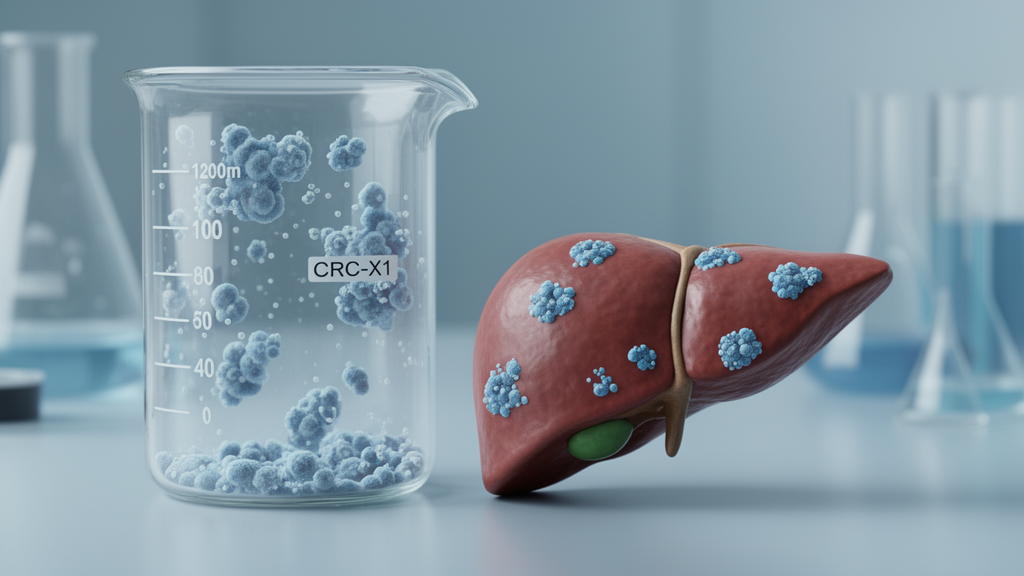
Researchers established CRC-X1, a patient-derived colon cancer cell line from liver-metastatic tissue, and characterized its growth, chromosomal profile, drug sensitivity and tumor-forming capacity. The new line was stably passaged through 59 generations, produced tumors in 60% of subcutaneous xenograft implantations in NCG mice, and showed a distinct response to two tested anticancer drugs: sensitivity to 5-fluorouracil and resistance to oxaliplatin. The experimental model was created in response to the scarcity of preclinical systems for colon cancer liver metastasis.
Investigators performed primary culture of fresh liver-metastatic tissue derived from colon cancer and established CRC-X1 as a cell line of Chinese origin. Its characterization combined short tandem repeat profiling, karyotype analysis, growth measurements, drug-sensitivity testing, xenograft implantation and immunohistochemical comparison with the original patient tumor tissue. Short tandem repeat profiling confirmed CRC-X1 as a novel cell line.
CRC-X1 could be maintained stably through the 59th generation, with a population doubling time of 60 hours. Karyotype analysis found that 90% of the cells had a near-triploid karyotype and 10% had a near-tetraploid karyotype. The representative karyotype was reported as 71,XXXX, der(5), inv(9), der(11), der(22).
These measurements document the line’s propagation characteristics and highly abnormal chromosome composition in the analyzed cells. In functional testing, subcutaneous implantation of CRC-X1 cells into NCG mice produced tumors in 60% of implantations, demonstrating tumor-forming capacity in that mouse model. Immunohistochemical staining of the resulting xenograft tumors was consistent with the staining observed in the original patient tumor tissue.
Drug-sensitivity testing further showed that CRC-X1 cells were sensitive to 5-fluorouracil, also called 5-FU, but resistant to oxaliplatin. Together, these findings establish CRC-X1 as an experimental cell model for investigating colon cancer liver metastasis and screening antitumor agents. The evidence is preclinical and confined to the cultured line, its drug-sensitivity profile, and tumor formation and tissue staining in NCG mice; it does not establish clinical effectiveness in patients.
Subject of Research: Preclinical characterization of a patient-derived colon cancer liver-metastasis cell line
Article Title: Establishment and characterization of a new colon cancer cell line from liver metastases, CRC-X1
Article References: Tang, H., Miao, X., Su, Y., Zhang, Y., Yu, C., Huang, W., Wang, C., Zhu, W., Ye, Z., Jin, F., Xu, T., Chen, L., Yang, Q., Ding, J., Hu, Z., Zhang, H., Zhou, W., Chai, C., & Xu, H. (2026). Establishment and characterization of a new colon cancer cell line from liver metastases, CRC-X1. BMC Cancer. https://doi.org/10.1186/s12885-026-16798-2
Image Credits: AI Generated
DOI: 10.1186/s12885-026-16798-2
Keywords: CRC-X1, colon cancer, liver metastasis, patient-derived cell line, xenograft model, drug sensitivity, 5-fluorouracil, oxaliplatin, karyotyping, preclinical research, Establishment, characterization
News Source: Nathaniel Bowman. (October 21, 2026). Patient-derived CRC-X1 cell line supports colon cancer liver-metastasis research. Scienmag.