• HOME
  • NEWS
  • EXPLORE
    • CAREER
      • Companies
      • Jobs
    • EVENTS
    • iGEM
      • News
      • Team
    • PHOTOS
    • VIDEO
    • WIKI
  • BLOG
  • COMMUNITY
    • FACEBOOK
    • INSTAGRAM
    • TWITTER
Wednesday, October 21, 2026
BIOENGINEER.ORG
No Result
View All Result
  • Login
  • HOME
  • NEWS
  • EXPLORE
    • CAREER
      • Companies
      • Jobs
        • Lecturer
        • PhD Studentship
        • Postdoc
        • Research Assistant
    • EVENTS
    • iGEM
      • News
      • Team
    • PHOTOS
    • VIDEO
    • WIKI
  • BLOG
  • COMMUNITY
    • FACEBOOK
    • INSTAGRAM
    • TWITTER
No Result
View All Result
Bioengineer.org
No Result
View All Result
Home NEWS Science News Biology

MSIPep prioritizes tumor peptides in leukemia and solid-tumor datasets

by
October 21, 2026
in Biology
Reading Time: 2 mins read
0
MSIPep prioritizes tumor peptides in leukemia and solid-tumor datasets

MSIPep prioritizes tumor peptides in leukemia and solid-tumor datasets

Share on FacebookShare on TwitterShare on LinkedinShare on RedditShare on Telegram

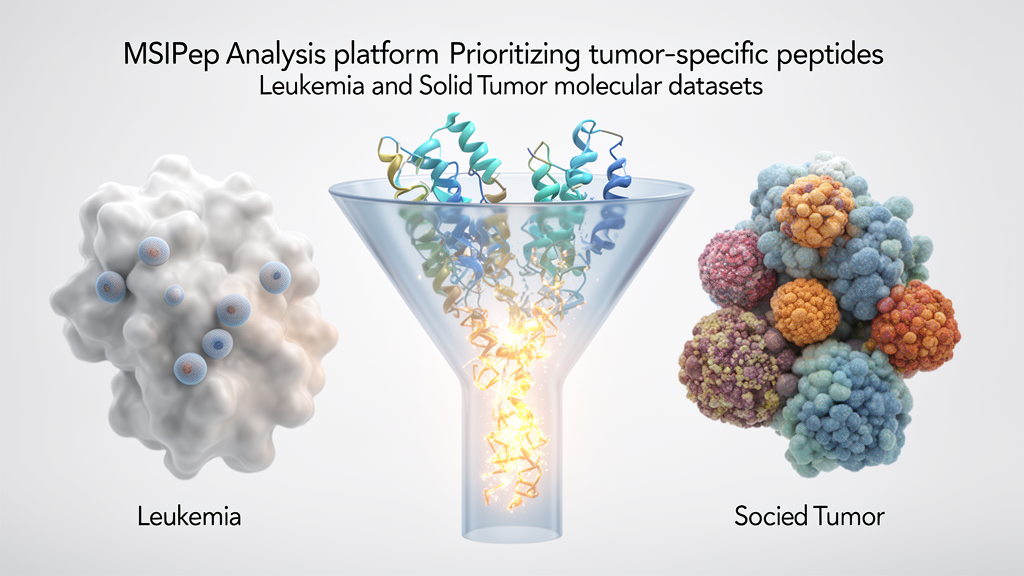
Researchers have developed and evaluated MSIPep, an open-source computational pipeline that combines immunopeptidomics, transcriptomics and deep learning to identify and prioritize candidate tumor peptides with predicted potential to elicit T-cell responses. Tests in acute myeloid leukemia datasets showed an improved ability to discover peptides with high predicted immunogenic potential, while separate analyses of high-grade serous ovarian carcinoma and triple-negative breast cancer datasets demonstrated the pipeline’s applicability to solid tumors.

Immunopeptidomics directly profiles peptides bound to human leukocyte antigens, or HLA molecules, capturing the antigen repertoire displayed on tumor-cell surfaces. The study’s authors identify several constraints in existing immunopeptidomics-based approaches to immunogenic peptide discovery: heavy reliance on sequence databases, dependence on matched normal controls and a lack of dedicated modules for predicting T-cell recognition. These limitations can restrict de novo peptide discovery, clinical applicability and the accuracy of immunogenicity prioritization, according to the research.

MSIPep is designed to address these gaps through an integrated analysis workflow. It combines database-based peptide searching with de novo sequencing strategies and supports both data-dependent acquisition, or DDA, and data-independent acquisition, or DIA, modes. The pipeline also applies false-discovery-rate control at multiple levels to improve the robustness of its results. Its source code is publicly available through a GitHub repository, and the developers provide a Docker container intended to support reproducible and scalable deployment.

For the prioritization stage, MSIPep incorporates ProTCR, an in-house deep-learning model developed to evaluate interactions between peptides and T-cell receptors. Rather than ranking candidates only by whether an HLA-bound peptide has been identified, the model provides a computational estimate of a peptide’s T-cell response potential. The combined framework therefore links identification of tumor-associated peptides with a receptor-interaction model intended to distinguish candidates with higher predicted immunogenicity, although that ranking remains a model-based estimate rather than a direct measurement of patient immune responses.

The evaluation used cancer datasets rather than a clinical trial. Acute myeloid leukemia applications highlighted MSIPep’s reported improvement in finding peptides with high predicted immunogenic potential, and analyses involving high-grade serous ovarian carcinoma and triple-negative breast cancer showed that the workflow could also be applied to solid-tumor data. These results position MSIPep as a reusable computational framework for narrowing large peptide-candidate spaces, but the supplied findings do not establish that prioritized peptides induce immune responses in people, validate them as cancer-vaccine targets or produce clinical benefit. The reported advance is therefore in the identification and computational prioritization of candidate immunogenic peptides across leukemia and solid-tumor datasets.

Subject of Research: Computational identification and prioritization of immunogenic tumor peptides

Article Title: MSIPep: A pipeline for immunogenic peptide identification and prioritization integrating immunopeptidomics and transcriptomics data

Article References: Liu, P., Zhang, S., Lu, M., Xu, M., Liu, Z., Chen, L., Xu, P., Tan, X., & Xie, L. (2026). MSIPep: A pipeline for immunogenic peptide identification and prioritization integrating immunopeptidomics and transcriptomics data. BMC Genomics. https://doi.org/10.1186/s12864-026-13481-5

Image Credits: AI Generated

DOI: 10.1186/s12864-026-13481-5

Keywords: MSIPep, immunopeptidomics, transcriptomics, cancer peptides, neoantigens, T-cell receptors, deep learning, mass spectrometry, acute myeloid leukemia, solid tumors, pipeline, immunogenic

News Source: Nathaniel Bowman. (October 21, 2026). MSIPep prioritizes tumor peptides in leukemia and solid-tumor datasets. Scienmag.


Tags: acute myeloid leukemiacancer peptidesdeep learningimmunogenicImmunopeptidomicsmass spectrometryMSIPepneoantigenspipelinesolid tumorsT-cell receptorsTranscriptomics
Share12Tweet7Share2ShareShareShare1

Related Posts

Epidemiological profile of HPV infection, associations with cervical lesions and vaginal microecological disorders, and nine-valent vaccine coverage in Northwest China: a 6-year retrospective study of 57,035 women

Epidemiological profile of HPV infection, associations with cervical lesions and vaginal microecological disorders, and nine-valent vaccine coverage in Northwest China: a 6-year retrospective study of 57,035 women

October 21, 2026
GLIS3 regulates astrocyte differentiation in human stem cells

GLIS3 regulates astrocyte differentiation in human stem cells

October 21, 2026

Fungal parasite selects against larger yellow dung flies

October 21, 2026

BioSIFTR infers gut microbiome functions from shallow sequencing

October 21, 2026

POPULAR NEWS

  • Epidemiological profile of HPV infection, associations with cervical lesions and vaginal microecological disorders, and nine-valent vaccine coverage in Northwest China: a 6-year retrospective study of 57,035 women

    Epidemiological profile of HPV infection, associations with cervical lesions and vaginal microecological disorders, and nine-valent vaccine coverage in Northwest China: a 6-year retrospective study of 57,035 women

    29 shares
    Share 12 Tweet 7
  • Retrospective blood protein models predict outcomes in 38 HPV16 cancer patients

    29 shares
    Share 12 Tweet 7
  • Real-time EV charging scheduler prioritizes emergencies and avoids stranded cars

    29 shares
    Share 12 Tweet 7
  • MSIPep prioritizes tumor peptides in leukemia and solid-tumor datasets

    29 shares
    Share 12 Tweet 7

About

We bring you the latest biotechnology news from best research centers and universities around the world. Check our website.

Follow us

Recent News

Epidemiological profile of HPV infection, associations with cervical lesions and vaginal microecological disorders, and nine-valent vaccine coverage in Northwest China: a 6-year retrospective study of 57,035 women

Retrospective blood protein models predict outcomes in 38 HPV16 cancer patients

Real-time EV charging scheduler prioritizes emergencies and avoids stranded cars

Subscribe to Blog via Email

Enter your email address to subscribe to this blog and receive notifications of new posts by email.

Join 85 other subscribers
  • Contact Us

Bioengineer.org © Copyright 2023 All Rights Reserved.

Welcome Back!

Login to your account below

Forgotten Password?

Retrieve your password

Please enter your username or email address to reset your password.

Log In
No Result
View All Result
  • Homepages
    • Home Page 1
    • Home Page 2
  • News
  • National
  • Business
  • Health
  • Lifestyle
  • Science

Bioengineer.org © Copyright 2023 All Rights Reserved.