In-depth coverage of the state-of-the-art of the synthesis, manufacturing, modelling and key applications of porous materials in four volumes
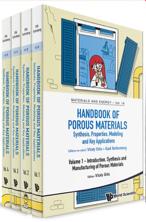
Credit: World Scientific
It might seem strange that making holes in something increases its value and application, but this is exactly the case with porous materials. Porous ceramics, metals, carbons, and polymers play a crucial role in almost every aspect of modern daily life. They are essential for water and wastewater treatment, industrial separations, and oil recovery. But they are also used in nearly every type of battery, in fuel cells and supercapacitors, and in geothermal applications. Closer to home, porous materials are used in wine- and beer-making, milk and cheese production, and the clarification of fruit juices, as well as in bio-artificing and medical devices. Wherever you look, porous materials are extremely important.
It’s been over 20 years since the last comprehensive reference work on porous materials was published. Now, in a new and highly relevant four-volume handbook, editors-in-chief Vitaly Gitis and Gadi Rothenberg combine the expertise of 37 scientists from all over the world to create the whole story of porous materials: from the fundamentals of design, synthesis and industrial manufacturing, through state-of-the-art molecular simulation and surface characterisation methods, and all the way to a host of applications.
Intended for students, researchers and engineers in academia and industry, this handbook explains both methods and applications, covering the latest experimental and computational techniques. Companies and institutes who are involved in the energy transition, a highly relevant subject today, will find here all the facts and reliable sources on the applications of porous materials for energy conversion and storage. Similarly, engineering students and graduates who are working on sustainable separations and novel materials will benefit from both the clearly explained fundamentals and the case studies of real-life industrial examples.
Rothenberg and Gitis have been collaborating since they met as PhD students in Jerusalem in the late 1990s. The idea of writing a comprehensive book on porous materials surfaced a few years ago, when they were finalising their graduate textbook on Ceramic Membranes. “By the time the membranes textbook and course were complete, we realised how important porous materials are for so many industrial sectors”, says Rothenberg, “but also that there was no up-to-date reference work on the subject. The problem was that Porous Materials is such a wide area, that could not cover it ourselves. Instead, we reached out to our international network and organised in 2018 a meeting in Amsterdam with the top researchers and engineers in the fields of materials synthesis, characterisation, manufacturing and modelling porous materials, and as well as experts in industrial separations and energy conversion and storage. With everyone around the table, we laid out the proposition of writing a comprehensive handbook in the coming three years…”
Academic and industrial experts from all around the globe joined the effort to provide a must-have set of comprehensive chapters that cover different aspects of generation, characterization, and application of historical and modern-day porous materials. Los Alamos National Laboratory, the University of Manchester, Rutgers University, the University of Amsterdam, the Technion, and the University of California Riverside, are a few of research institutes that host the scholars who contribute to the handbook. With 1500 pages, 400 figures and illustrations, and nearly 3000 up-to-date references over 4 volumes, the Handbook of Porous Materials: Synthesis, Properties, Modeling and Key Applications is a treasure of knowledge for years to come.
Handbook of Porous Materials retails for an introductory offer price (valid till Aug 31, 2021) of US$1250 / £1100 (hardcover set) as well as electronic formats for libraries. To order or know more about the book, visit http://www.
About the Editors-in-Chief
Vitaly Gitis is Professor of Energy Engineering at Ben-Gurion University of the Negev in Israel, where he teaches courses on chemistry, separation processes, and alternative energy sources. His research interests embrace granular and membrane filtration separation processes, multi-layered ceramic membranes, wastewater treatment processes, and colloidal chemistry. Gitis has published over 70 peer-reviewed papers in international journals, co-authored the textbook Ceramic Membranes – New Opportunities and Practical Applications, and invented two patents. Since joining BGU he has mentored over 40 graduate students. He serves on several scientific and management committees, including the IWA Specialist Group on Particle Separation. In 2010 he was appointed as Marie Curie Visiting Professor at the University of Amsterdam, and in 2018 he was appointed as Visiting Professor at University of Adelaide.
Gadi Rothenberg is Professor and Chair of Heterogeneous Catalysis and Sustainable Chemistry the University of Amsterdam, The Netherlands, where he teaches courses on catalysis and workshops on scientific writing and innovation. His research interests include clean energy, biomass conversion, and creating value from waste. Rothenberg has published two books and over 200 papers in peer-reviewed journals, invented 16 patents, and co-founded the companies Sorbisense, Yellow Diesel and Plantics. The impact of his work is reflected in several distinctions, including the European Commission Marie Curie Excellence Award, the Paul Rylander Award from the Organic Reactions Catalysis Society, and the “lecturer of the year” award by the UvA chemistry students. In 2017 he was appointed as Senior Visiting Scholar at Fudan University in Shanghai, and in 2018 he was appointed as Lady Davis Visiting Professor at the Hebrew University in Jerusalem. Since January 2020 he is also the Technical Director CO2 and Circular Economy of the Shanghai Institute for CleanTech Innovation.
About World Scientific Publishing Co.
World Scientific Publishing is a leading international independent publisher of books and journals for the scholarly, research and professional communities. World Scientific collaborates with prestigious organisations like the Nobel Foundation and US National Academies Press to bring high quality academic and professional content to researchers and academics worldwide. The company publishes about 600 books and over 140 journals in various fields annually. To find out more about World Scientific, please visit http://www.
For more information, contact Amanda at [email protected].
Media Contact
Amanda Yun
[email protected]
Original Source
https:/