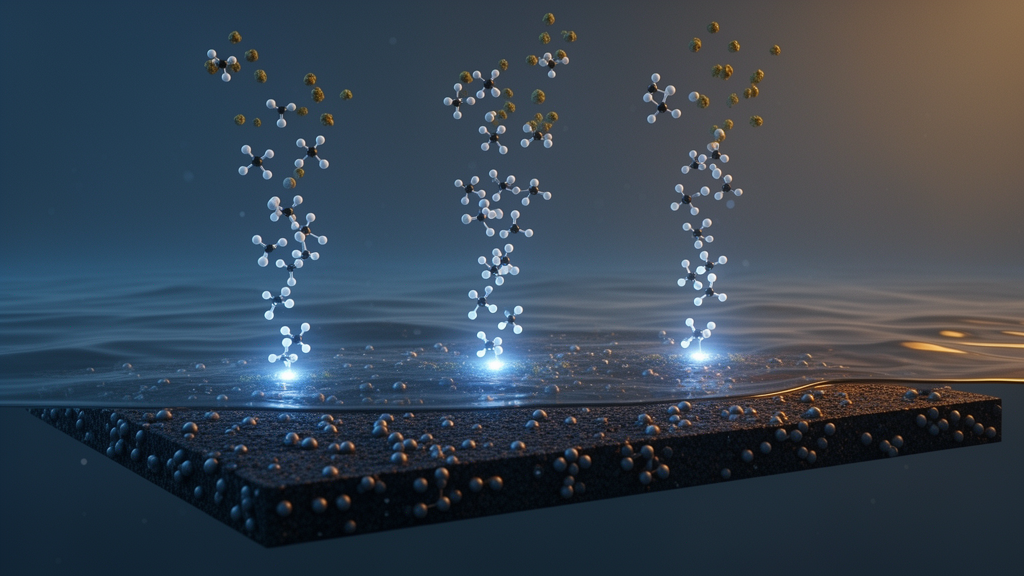
Chemists have built a catalyst that does two jobs at once: it strips antibiotics and other emerging contaminants out of water while converting the electrons pulled from those pollutants into hydrogen peroxide, a clean chemical fuel. The material, described in Carbon Research, is a zinc single-atom catalyst anchored to graphitic carbon nitride, and its secret lies in an unusual coordination geometry in which each zinc atom is bonded to two nitrogen and two oxygen atoms rather than the symmetric four-nitrogen arrangement typical of many single-atom catalysts.
The research team, led by Yaru Li and Chun Hu, synthesized the catalyst, dubbed ZnSA-CN, by dispersing carbon nitride in ethanol, adding a zinc nitrate solution, and pyrolyzing the mixture at 400 degrees Celsius under argon. The nitrate precursor supplied the oxygen atoms that break the symmetry of the zinc coordination environment. Characterization confirmed that zinc sits as isolated atoms on the carbon nitride matrix at a loading of just 0.261 weight percent, with no zinc-zinc bonding detectable in extended X-ray absorption fine structure measurements.
That asymmetric Zn–N2O2 coordination turned out to be the pivotal design feature. Density functional theory calculations showed that the valence-electron distribution of ZnSA-CN is more strongly polarized than that of pristine carbon nitride or a hypothetical symmetric Zn–N4 variant, with electrons enriched around the oxygen atoms and the zinc centers. Kelvin probe force microscopy backed this up experimentally: the surface potential difference of ZnSA-CN exceeded that of plain carbon nitride, a direct signature of surface charge polarization induced by the single zinc atoms.
Polarization matters because it changes how the catalyst interacts with both light and pollutants. The zinc atoms narrowed the material’s bandgap from 2.83 to 2.71 electronvolts and shifted its absorption edge from 444 to 475 nanometers, extending the range of visible light the catalyst can harvest. Transient photocurrent measurements, electrochemical impedance spectroscopy, and photoluminescence spectra all pointed in the same direction: photogenerated electrons and holes separate and migrate more efficiently in ZnSA-CN than in the undoped support, and time-resolved photoluminescence showed the charge carriers live longer before recombining.
The second half of the synergy comes from the pollutants themselves. When ciprofloxacin, a widely used fluoroquinolone antibiotic, adsorbs onto the catalyst, it acts as a molecular modifier. The adsorbed antibiotic pushed the light absorption edge of the catalyst further out to 482 nanometers and increased the surface potential difference from 222 to 258 millivolts in the dark, amplifying the electronic polarization that the zinc atoms had already created. Theoretical calculations showed ciprofloxacin binds to ZnSA-CN with an adsorption energy of −1.319 electronvolts, stronger than its binding to pristine carbon nitride or the symmetric Zn–N4 structure, and the adsorbed molecules further enhanced charge delocalization across the catalyst surface.
Under illumination with a 420 to 780 nanometer light source, the consequences were substantial. ZnSA-CN degraded ciprofloxacin with an apparent rate constant of 0.061 per minute, 2.2 times faster than pristine carbon nitride, and produced hydrogen peroxide at up to 5.8 millimoles per hour per gram of catalyst in air. The catalyst removed more than 95 percent of ciprofloxacin, tetracycline, rhodamine B, and norfloxacin within 60 minutes, demonstrating broad applicability across different classes of emerging contaminants.
Quenching experiments and electron paramagnetic resonance spectroscopy traced the degradation pathway. Superoxide radicals and singlet oxygen were detected, but hydroxyl radicals were absent, and scavenger tests showed that these reactive oxygen species barely contributed to ciprofloxacin removal. Instead, direct electron transfer dominated: adsorbed ciprofloxacin molecules donate electrons through the catalyst, the electrons cleave the antibiotic into organic radicals, and molecular oxygen captured at the zinc sites accepts those electrons, being reduced to hydrogen peroxide through a two-step single-electron pathway. Mulliken charge analysis quantified the advantage of the asymmetric geometry: oxygen adsorbed on ZnSA-CN captured 0.5700 electrons from ciprofloxacin, compared with 0.5010 for the symmetric Zn–N4 structure and 0.1920 for pristine carbon nitride.
The hydrogen peroxide is not merely a byproduct. External hydrogen peroxide added to the reaction mixture had negligible effect on degradation, indicating that the peroxide generated on the catalyst is stored on the surface as a clean energy carrier rather than decomposed. Because the electrons that reduce oxygen come from the pollutants themselves, the process harvests the chemical energy embedded in the contaminants, partially offsetting the energy demand of water treatment. The authors frame this as coupling wastewater recycling to energy conversion, addressing environmental pollution and energy scarcity in a single photocatalytic step.
Practical robustness was tested under conditions that typically defeat photocatalysts. Performance varied only weakly across pH values, although strongly alkaline conditions at pH 10.97 did suppress both degradation and peroxide production, and common anions such as chloride, sulfate, nitrate, and bicarbonate had insignificant effects, with chloride showing the strongest but still modest inhibition. Humic acid, the natural organic matter that fouls many treatment processes, caused minimal inhibition. In municipal wastewater and raw drinking water, more than 99 percent of ciprofloxacin was removed within 60 minutes, and the organic matter in those real water matrices actually boosted hydrogen peroxide yields by serving as additional electron donors.
Stability held up over five consecutive cycles, with ciprofloxacin degradation remaining above 95 percent and peroxide production steady at roughly 5.8 millimoles per hour per gram. Inductively coupled plasma analysis found the zinc loading essentially unchanged after cycling, at 0.259 versus 0.261 weight percent, and X-ray diffraction and microscopy confirmed the crystal structure and lamellar morphology survived intact. A laboratory-scale life cycle assessment comparing the system with Fenton-based treatments found the ZnSA-CN process environmentally friendlier than conventional homogeneous Fe/PMS systems, owing to lower energy consumption and chemical inputs during catalyst preparation, though the authors note that further reducing catalyst consumption would improve sustainability. The work suggests that tuning the coordination symmetry of single-atom catalysts, and treating pollutants as electron donors rather than mere targets, could reshape how photocatalytic water purification is designed.
Subject of Research: A zinc single-atom photocatalyst with asymmetric Zn–N2O2 coordination that degrades emerging contaminants in water while producing hydrogen peroxide
Article Title: Direct charge transfer mediated by asymmetrically coordinated Zn–N2O2 sites in graphitic carbon nitride toward water purification with hydrogen peroxide photosynthesis
Article References: Li, Y., Zhong, Y., Zhang, P., Zhang, X., Cao, Z., Wang, Y., Li, F., & Hu, C. (2026). Direct charge transfer mediated by asymmetrically coordinated Zn–N2O2 sites in graphitic carbon nitride toward water purification with hydrogen peroxide photosynthesis. Carbon Research, 5(1), Article 52. https://doi.org/10.1007/s44246-026-00281-5
Image Credits: AI Generated
DOI: 10.1007/s44246-026-00281-5
Keywords: photocatalysis, zinc single-atom catalyst, graphitic carbon nitride, hydrogen peroxide, water purification, emerging contaminants, ciprofloxacin, charge polarization, electron transfer, oxygen reduction, antibiotic pollution, life cycle assessment
News Source: Bethany Barker. (October 29, 2026). Zinc Single Atoms Turn Water Pollutants Into Hydrogen Peroxide Fuel. Scienmag.