


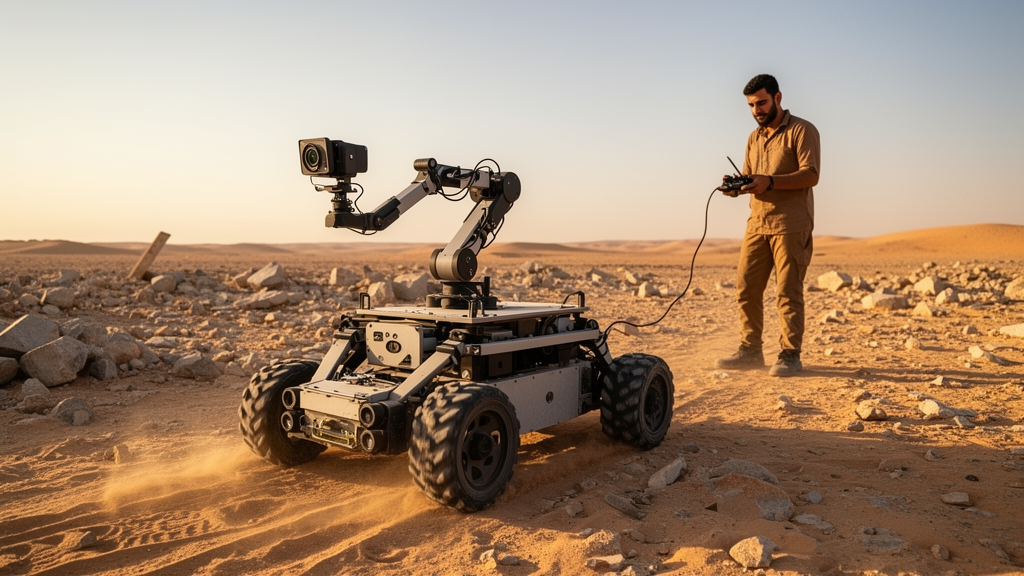
A teleoperated ground vehicle built for under 1,000 US dollars in materials has completed field trials in Zawiya City, Libya, demonstrating reliable radio control at 600 metres, waypoint navigation within a two-metre acceptance radius, and a 95 percent grasp-and-place success rate for lightweight objects. The prototype, described in an open-access paper in Discover Vehicles, was designed and assembled by a small university team entirely from commodity components obtainable locally, and it was characterised on level compacted earth at a single site. Its developers are explicit that the results establish prototype feasibility, not operational readiness, and that the platform must not be deployed to a live hazard area on the strength of this evidence.
The motivation is stark. Post-conflict zones frequently retain large quantities of buried landmines and unexploded ordnance long after fighting ends, and in Libya the consequences of successive armed conflicts since 2011 include extensive contamination across agricultural land, roads and residential areas. Human deminers face acute physical risk, and manual clearance is inherently slow against the scale of contamination. Robotic ground vehicles have long attracted interest as support tools for explosive ordnance disposal, because a robot that can approach a suspect object while the operator remains at a safe standoff distance reduces the probability of casualties. Purpose-built platforms, however, carry sophisticated sensor arrays at costs prohibitive for most affected countries, while simple remote-controlled vehicles lack the manipulation, navigation and situational-awareness functions needed for a complete support mission.
The Libyan team framed its contribution as an engineering systems problem rather than an algorithmic one. The individual subsystems used—Arduino microcontroller control, GPS and compass heading, NRF24L01 radio telemetry, first-person-view video, an LC-oscillator metal detector and hobby-grade servo manipulation—are each mature and well documented. What is not well documented, the authors argue, is their behaviour in combination on a single high-current mobile platform, and the specific failure mechanisms that emerge from that combination. Existing low-cost unmanned ground vehicle reports typically integrate two or three subsystems in benign indoor or campus environments and rarely report what broke, why, and what design change fixed it.
The resulting vehicle, named Libya-Diffuser, integrates six subsystems: a four-wheel skid-steer mobile base, distributed dual-microcontroller processing, navigation and hazard-detection sensing, a five-degree-of-freedom manipulator, a dual-channel communication stack and a water-based fire suppression unit. The aluminium chassis measures roughly 150 by 50 by 50 centimetres and the fully equipped vehicle weighs about 30 kilograms, including three 12-volt, 7-ampere-hour sealed lead-acid batteries storing 252 watt-hours. Each wheel is driven by a dedicated 12-volt geared motor through an H-bridge controller, with layered protection against miswiring, sustained stall and short circuits. Two Arduino Mega 2560 boards divide the processing load between vehicle and operator station, chosen because they provide the required hardware PWM channels, analogue inputs and serial ports while costing 90 Libyan dinars per board and needing no operating-system administration in the field.
Control runs through three modes. A handheld remote transmits 32-byte command packets at 10 hertz over a 2.4 GHz NRF24L01 link with automatic retransmission; a Bluetooth path paired with a custom Android application serves bench testing and short-range rehearsals; and a supervised GPS waypoint mode lets the operator upload up to five waypoints, which the vehicle reaches using a haversine bearing calculation compared against magnetometer heading. Command latency was not instrumented, and heading corrections update only at the 1 hertz GPS fix rate, which the authors identify as the principal source of weaving between waypoints. Compass calibration before each field session records hard-iron offsets while the robot rotates through a full circle, a necessary step because motor currents and chassis steel can otherwise introduce heading errors of 20 degrees or more.
Field trials at the Zainp Al-Tiap School site quantified each subsystem. The radio link showed packet loss below 1 percent at 100 metres, below 2 percent at 300 metres and just under 5 percent at 600 metres, with control becoming intermittent beyond 650 metres and unusable at 700 metres; 600 metres was therefore taken as the maximum usable range. The 600-milliwatt FPV camera delivered clear video to 700 metres line-of-sight, exceeding the control envelope, so the operator retains visual feedback at the boundary of control. The waypoint course of three waypoints on level ground met its two-metre acceptance radius on every run, though the vehicle has no obstacle perception whatsoever—a gap invisible on open level ground but immediately disabling in rubble.
The manipulator, driven by six MG996R-class servos, grasped representative objects of 100 to 150 grams and relocated them to an elevation of about 15 centimetres under video guidance, succeeding in 19 of 20 trials after brief operator familiarisation. The authors caution that with only twenty trials the Wilson 95 percent confidence interval spans 76.4 to 99.1 percent, meaning the underlying success rate could plausibly be as low as roughly three in four; twenty trials establish feasibility, not reliability. The single failure was object slippage during wrist rotation, a gripper-surface limitation rather than a control failure. The arm cannot lift, rotate, disrupt or relocate any munition, and no such capability is claimed; its payload bounds it to clearing light debris from sightlines, repositioning the camera or detector head, and retrieving small non-hazardous items.
The custom metal detector, a Colpitts-type LC oscillator with a 50-turn coil on a 40-millimetre former, gave consistent indication at 10 to 15 centimetres of vertical separation from steel, copper and aluminium targets, with no false activation during 30 minutes of continuous scanning. The authors are emphatic about the limits: no detection probability or false-negative rate can be estimated from this protocol, soil mineralisation was not characterised, no comparison against a commercial detector was made, and the subsystem is described as a close-range metallic-object indicator, not a mine detector. It cannot estimate depth, classify material or discriminate ordnance from battlefield debris—the discrimination problem that dominates real clearance operations. Similarly, the 3-litre fire suppression unit, whose jet reaches roughly 2 metres, extinguished small controlled solid-fuel test fires within 3 to 5 seconds but was never characterised against vegetation, fuel or secondary-ignition scenarios.
Perhaps the most transferable finding concerns subsystem interactions that no individual specification predicted. Motor back-EMF on a shared supply corrupted I²C and UART traffic, fixed topologically by separating servo and logic rails from the motor rail through independent step-down converters. The magnetometer, placed near the front drive motors, produced hard-iron bias large enough to render heading unusable until relocated to the rear of the chassis. The NRF24L01 modules proved sensitive to supply ripple until 10-microfarad decoupling capacitors were added. In each case the subsystem operated within its own specification and the failure emerged from integration, leading the authors to conclude that on this class of platform, operational reliability is governed primarily by power-supply topology and physical sensor placement rather than by control-algorithm refinement.
The total prototype expenditure was 4,048 Libyan dinars, approximately 830 US dollars, with an estimated replication cost of 3,620 dinars, about 742 dollars, excluding labour and maintenance. The limitations section is unusually candid: all trials occurred at a single site under one set of conditions, most results derive from single sessions without uncertainty estimates, no reliability or endurance characterisation was performed, current draw was never instrumented so the 252 watt-hour budget cannot be converted to operating duration, the communication link is unencrypted and unauthenticated, and no safety case or failure-mode analysis exists. The platform provides no obstacle perception, no threat classification and no positional accuracy adequate for mine-action reporting standards. Within those bounds, the work contributes a cost-per-capability data point and integration lessons for field robotics under severe resource constraints, positioning the vehicle strictly as an aid to a trained operator whose judgement remains authoritative—and not, under any incremental improvement of this architecture, as a clearance system.
Subject of Research: Field characterisation of a low-cost teleoperated ground vehicle prototype for remote inspection support in post-conflict mine action in Libya
Article Title: Design, integration and field characterisation of a low-cost teleoperated ground vehicle prototype for remote inspection support in post-conflict mine action: a Libyan case study
Article References: Bensaoud, O., Hammoda, Y., & Barakat, M. (2026). Design, integration and field characterisation of a low-cost teleoperated ground vehicle prototype for remote inspection support in post-conflict mine action: a Libyan case study. Discover Vehicles, 2(1), Article 38. https://doi.org/10.1007/s44465-026-00042-z
Image Credits: AI Generated
DOI: 10.1007/s44465-026-00042-z
Keywords: teleoperation, unmanned ground vehicle, humanitarian demining, post-conflict Libya, low-cost robotics, field trials, GPS waypoint navigation, metal detection, robotic manipulator, fire suppression, prototype feasibility, resource-constrained engineering
News Source: Denise Maddox. (October 29, 2026). Low-cost teleoperated robot prototype tested for post-conflict mine inspection in Libya. Scienmag.



