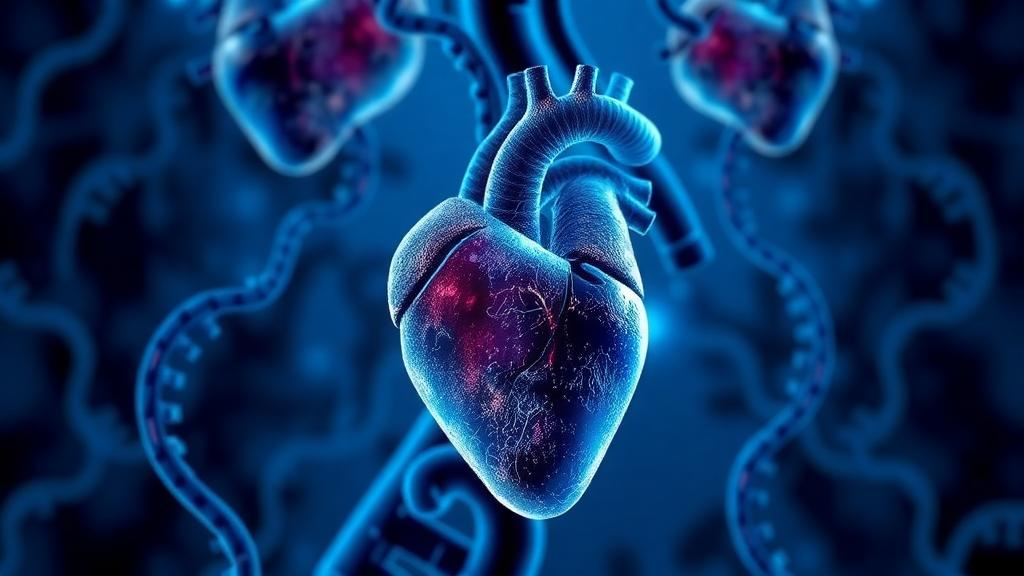
A single transcription factor, long known for its role in sculpting skeletal muscle, has now emerged as a central guardian of the heart. In a study published in PLOS Genetics, researchers report that ZBED6, a DNA-binding protein first identified as a master regulator of muscle growth, acts as a powerful brake on pathological cardiac hypertrophy — the abnormal thickening of the heart muscle that precedes heart failure. When ZBED6 is lost, the authors show, the heart enlarges, its pumping chambers stiffen, and a previously hidden molecular cascade involving the genes MEOX1 and the ERK1/2 signaling pathway drives the damage by disrupting autophagy, the cell’s internal recycling system.
Pathological cardiac hypertrophy is one of the most consequential maladaptations in medicine. Unlike the beneficial enlargement seen in athletes, whose hearts grow stronger in response to exercise, pathological hypertrophy arises from chronic stress such as hypertension, valve disease, or genetic mutations. The heart’s muscle cells, called cardiomyocytes, respond to sustained pressure overload by growing larger and thicker, initially compensating for the added workload. Over time, however, this remodeling distorts the heart’s architecture, impairs its ability to relax and fill with blood, and sets the stage for arrhythmias, fibrosis, and ultimately heart failure — a condition that remains among the leading causes of death worldwide. Understanding the transcriptional networks that decide whether the heart adapts gracefully or spirals into disease has therefore been a major goal of cardiovascular biology.
The research team, led by Xiao Zhang, Xiaopeng Liu, and colleagues, began with a clue from their earlier work: ZBED6 had been characterized as a key suppressor of skeletal muscle hypertrophy, raising the question of whether it played a similar role in the heart. Their first finding was clinical and striking. In myocardial tissue samples taken from patients with cardiac hypertrophy, ZBED6 was markedly reduced. This observation suggested that the protein’s decline might not be a bystander effect of disease but a contributing factor — a hypothesis the team then tested rigorously in animal models.
The decisive experiment came from pigs, whose cardiovascular systems closely resemble those of humans in size, anatomy, and physiology. When the researchers generated ZBED6-deficient pigs, the animals developed cardiac hypertrophy accompanied by diastolic dysfunction, meaning their hearts could not properly relax and fill between beats. Diastolic dysfunction is a hallmark of a common and difficult-to-treat form of heart failure, and its presence in the engineered pigs provided strong evidence that ZBED6 loss is sufficient to produce a clinically meaningful cardiac disease state, not merely a subtle molecular change.
To trace the mechanism, the team turned to integrative genomics. By combining transcriptomic profiling — which measures which genes are active — with ChIP-seq, a technique that maps where a transcription factor binds across the genome, they identified MEOX1 as a direct negative target of ZBED6. In other words, ZBED6 physically binds to regulatory regions of the MEOX1 gene and suppresses its expression. When ZBED6 is absent, this repression is lifted, and MEOX1 levels rise. The ChIP-seq data thus established a direct molecular link between the two proteins, ruling out indirect explanations for the correlation.
The consequences of MEOX1 upregulation proved to be far-reaching. The researchers found that elevated MEOX1 activates ERK1/2 signaling, a well-known intracellular pathway that transmits growth and stress signals from the cell surface to the nucleus. ERK1/2 has long been implicated in cardiac remodeling, but the new study places it downstream of a specific transcriptional switch, giving the pathway a defined position in the hierarchy of hypertrophy control. Critically, the team connected ERK1/2 activation to autophagy dysfunction. Autophagy is the process by which cells digest and recycle damaged proteins and organelles, and in cardiomyocytes it serves as an essential quality-control mechanism. The study shows that the ZBED6–MEOX1–ERK1/2 axis impairs this recycling system, and that the resulting autophagy failure is what drives the cardiomyocytes to enlarge pathologically.
Two lines of intervention evidence cemented the causal chain. First, when the researchers knocked down MEOX1 in ZBED6-deficient cardiomyocytes, ERK1/2 phosphorylation — the chemical modification that activates the pathway — dropped, and the hypertrophic growth of the cells was mitigated. Second, pharmacological inhibition of ERK1/2 restored autophagy and alleviated hypertrophy in ZBED6-depleted cardiomyocytes. Together, these experiments demonstrate that MEOX1 and ERK1/2 are not merely correlated with the disease process but are functionally required for it, and that the damage can be reversed by intervening at either node of the pathway.
The significance of the work lies in the assembly of these pieces into a coherent axis. ZBED6, a transcriptional repressor, normally holds MEOX1 in check; MEOX1, when unleashed, activates ERK1/2; ERK1/2, when activated, disrupts autophagy; and autophagy dysfunction pushes cardiomyocytes into pathological growth. Each step in this chain was verified independently, from the reduction of ZBED6 in human patient tissue to the rescue of diseased cells by pathway inhibition. The authors describe this as a previously unrecognized regulatory axis, and their collective findings define it as a potential therapeutic target for pathological cardiac hypertrophy.
The therapeutic implications are considerable. Current treatments for hypertrophic heart disease address symptoms and downstream consequences — lowering blood pressure, slowing heart rate, or managing heart failure once it develops — but few strategies target the transcriptional programs that initiate the maladaptive remodeling. A pathway that can be pharmacologically modulated at the ERK1/2 node, or potentially upstream at MEOX1, offers a more fundamental point of attack. The fact that ERK1/2 inhibitors already exist as a drug class, developed originally for oncology, suggests that repurposing or adapting such compounds for cardiac indications could be explored, although the pathway’s roles in other tissues would demand careful evaluation of safety and specificity.
The choice of the pig as a model organism also strengthens the translational relevance of the findings. Rodent models of cardiac disease have historically been invaluable but imperfect predictors of human cardiac physiology, and discrepancies between mouse and human heart biology have complicated drug development. Pigs, with hearts comparable in size and function to human organs, bridge that gap, and the demonstration that ZBED6 deficiency produces hypertrophy and diastolic dysfunction in this species lends weight to the conclusion that the same axis operates in humans — particularly given the concordant reduction of ZBED6 observed in patient myocardial tissue. As research moves from this foundational characterization toward therapeutic exploration, the ZBED6–MEOX1–ERK1/2 axis stands as a newly charted route into the molecular heart of a devastating disease, one that may eventually allow clinicians to intervene before the heart’s compensatory growth becomes its own undoing.
Subject of Research: The role of the ZBED6–MEOX1–ERK1/2 signaling axis in pathological cardiac hypertrophy and autophagy dysfunction
Article Title: ZBED6 deficiency drives pathological cardiac hypertrophy through MEOX1–ERK1/2–dependent autophagy dysfunction
Article References: Zhang, X., Liu, X., Pan, R., Liu, H., Xiao, J., Leng, X., Zhang, H., Pan, D., Duan, S., & Wu, J. (2026). ZBED6 deficiency drives pathological cardiac hypertrophy through MEOX1–ERK1/2–dependent autophagy dysfunction. PLOS Genetics, 22(10), e1012329. https://doi.org/10.1371/journal.pgen.1012329
Image Credits: AI Generated
DOI: 10.1371/journal.pgen.1012329
Keywords: ZBED6, cardiac hypertrophy, MEOX1, ERK1/2 signaling, autophagy, heart failure, diastolic dysfunction, transcription factor, cardiomyocytes, PLOS Genetics, ChIP-seq, therapeutic target
News Source: Juliet Wilcox. (October 10, 2026). ZBED6 Loss Fuels Pathological Heart Enlargement Through a Newly Mapped Gene Switch. Scienmag.