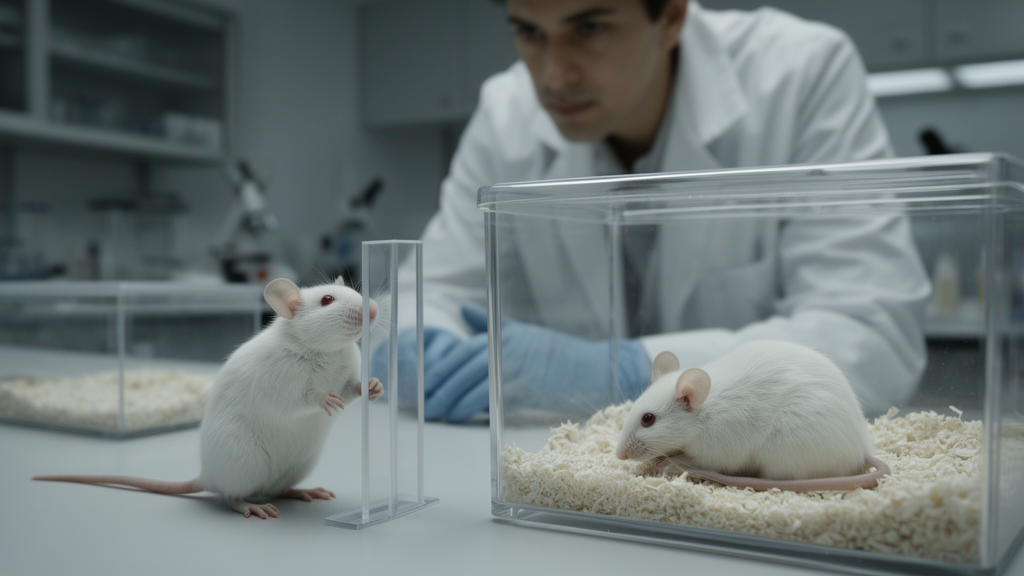
Two of the most widely used animal models of social stress may not be interchangeable after all. A new study published in Behavioral and Brain Functions directly compared chronic social defeat stress (CSDS), in which mice are physically attacked by aggressive resident mice, with vicarious defeat stress (VDS), in which mice merely witness a conspecific being defeated, and found that the two paradigms produce overlapping but clearly distinct behavioral and molecular consequences in the hippocampus. The authors conclude that VDS is a distinct stressor in its own right rather than a simple substitute for CSDS, and that its overall impact is milder.
The research team, led by Xin-Ran Sun and colleagues at the Institute of Medicinal Plant Development of the Chinese Academy of Medical Sciences, worked with 68 specific pathogen-free male C57BL/6N mice aged seven to eight weeks, together with 17 male CD-1 mice aged 30 to 35 weeks that served as resident aggressors. After five days of acclimatization, the C57BL/6N mice were randomly assigned to four groups of 17 animals each: control, CSDS, VDS, and a VDS-intruder group used only as defeat targets and excluded from all subsequent analyses. Twelve mice per group underwent behavioral testing and biochemical or molecular assays, while five mice per group were reserved for perfusion and histological examination.
The stress procedures lasted 14 days. In the CSDS paradigm, each intruder mouse was placed daily into the home cage of a resident CD-1 aggressor and subjected to direct physical aggression for 10 minutes, after which the two animals were housed in the same cage separated by a perforated transparent divider that allowed continuous visual, auditory, and olfactory contact for 24 hours. To maintain intensity and unpredictability, each intruder faced a different resident aggressor every day. In the VDS paradigm, witness mice were never physically attacked; instead, during the same 10-minute window they observed a conspecific intruder being defeated through the perforated divider, and were then housed opposite the resident aggressor for 24 hours, again with a different aggressor each day.
Behavioral testing began 24 hours after the final stress exposure and spanned seven assays: the social interaction test, open field test, elevated plus maze, novelty-suppressed feeding test, light/dark box test, sucrose preference test, and tail suspension test. Both CSDS and VDS mice showed significant social avoidance, reduced open-arm exploration in the elevated plus maze, prolonged feeding latency in the novelty-suppressed feeding test, and increased immobility in the tail suspension test. In the social interaction test, however, the reduction in time spent in the interaction zone was significantly greater in CSDS mice than in VDS mice, indicating that the direct defeat experience produced a stronger social withdrawal effect even where both paradigms reached significance.
The clearest behavioral divergence emerged in the remaining assays. Only CSDS mice showed reduced center-zone activity in the open field test, fewer transitions and less time in the light compartment of the light/dark box, and lower sucrose preference, a readout of anhedonia-like behavior. In the sucrose preference test, VDS mice did not differ from controls at all, while CSDS mice were significantly lower than both controls and VDS mice. The authors interpret this pattern as evidence that CSDS produced more extensive and severe behavioral abnormalities, affecting a broader range of anxiety-related exploratory domains and the full depression-like profile, whereas VDS reliably induced social avoidance, anxiety-like responses in the elevated plus maze and novelty-suppressed feeding test, and behavioral despair in the tail suspension test.
Physiological measures told a similar story. CSDS mice began losing body weight on day 4 of stress exposure and remained significantly lighter than controls at all subsequent time points, whereas VDS mice did not diverge from controls until day 20. Food intake during the stress period did not differ among groups, suggesting the weight loss was not attributable to reduced consumption. Both stress groups showed an increased spleen index compared with controls, a canonical readout of peripheral immune activation, with a larger increase in CSDS mice, although the direct comparison between the two stress groups did not reach statistical significance.
To probe the molecular underpinnings, the team performed label-free quantitative proteomics on hippocampal tissue from four randomly selected animals per group. Database searching identified 2,984 protein groups, of which 953 with quantitative abundance information in at least 70 percent of samples were retained. Using thresholds of p < 0.05 and a log2 fold change above 0.585, CSDS mice exhibited 38 differentially expressed protein groups, 28 upregulated and 10 downregulated, while VDS mice exhibited 32, 24 upregulated and 8 downregulated. Strikingly, only 11 of these proteins overlapped between the two paradigms, accounting for 18.6 percent of all unique differentially expressed proteins. Principal component analysis showed clear separation among the three groups, with CSDS samples diverging more from controls than VDS samples did.
Functional enrichment analyses sharpened the contrast. In CSDS mice, differentially expressed proteins were enriched for ATP metabolism, glycolysis and gluconeogenesis, protein processing in the endoplasmic reticulum, mitochondrial energy metabolism, pyruvate metabolism, neurodegenerative disease pathways including Alzheimer’s disease, and immune-related pathways, with protein-protein interaction clusters centered on energy metabolism and protein folding. VDS-associated proteins instead pointed to regulation of synaptic plasticity, neurotransmitter receptor trafficking, learning and memory, the postsynaptic density, GABAergic synapse and long-term depression pathways, RHO GTPase-related signaling, neuronal communication, DNA repair, and TP53-related regulatory pathways. Biochemical assays confirmed that both paradigms depleted hippocampal ATP, impaired antioxidant defenses, with decreased total antioxidant capacity, reduced SOD and GSH-PX activities, lower GSH and elevated MDA in both serum and hippocampus, and increased pro-inflammatory cytokine mRNA expression of IL-1β, TNF-α and IL-6, with CSDS changes generally more severe.
Several molecular readouts split cleanly along paradigm lines. In inflammatory signaling, CSDS robustly upregulated inducible nitric oxide synthase while suppressing the anti-inflammatory cytokines TGF-β and IL-10, whereas VDS increased IL-10 without significantly affecting iNOS or TGF-β. In tryptophan-kynurenine metabolism, TRP and KYN rose in both groups, but only CSDS mice showed the downstream shift toward the neurotoxic branch, with increased 3-hydroxykynurenine and quinolinic acid and decreased neuroprotective kynurenic acid; VDS left these downstream metabolites unchanged. Neurotransmitter profiling showed that CSDS reduced dopamine, serotonin, norepinephrine and glutamate, while VDS decreased dopamine, norepinephrine and GABA. The authors suggest that direct physical defeat preferentially weakens hippocampal excitatory glutamatergic neurotransmission, whereas vicarious stress mainly impairs GABAergic inhibitory transmission. Lactate added another divergence: VDS mice showed significantly elevated lactate in both serum and hippocampus, while CSDS mice showed a non-significant numerical decrease in hippocampal lactate accompanied by a large effect size.
Synaptic marker analysis by immunohistochemistry in the CA1, CA3 and dentate gyrus subregions of the dorsal hippocampus showed that both paradigms reduced the PSD95-positive area fraction and increased α-synuclein staining, with the PSD95 reduction significantly more pronounced in CSDS mice in the dentate gyrus. Taken together, the authors argue that VDS should be treated as a distinct stressor with its own mechanisms, milder in overall intensity than CSDS, and that researchers should choose between the two paradigms according to the specific biological question at hand, whether the focus is energy metabolism and inflammation, where CSDS effects dominate, or synaptic signaling and receptor regulation, where VDS leaves its own characteristic imprint.
Subject of Research: Comparative effects of chronic social defeat stress and vicarious defeat stress on behavior and hippocampal biology in male mice
Article Title: Vicarious defeat stress (VDS) is not a simple substitute for chronic social defeat stress (CSDS): a comparative study on behavioral and molecular mechanisms in both stress-induced anxiety- and depression-like behaviors
Article References: Sun, X.-R., Chen, Y.-X., Zhang, X.-J.-L., Jiang, N., Liu, X.-M., Chang, Q., & Pan, R.-L. (2026). Vicarious defeat stress (VDS) is not a simple substitute for chronic social defeat stress (CSDS): a comparative study on behavioral and molecular mechanisms in both stress-induced anxiety- and depression-like behaviors. Behavioral and Brain Functions, 22(1), Article 41. https://doi.org/10.1186/s12993-026-00360-y
Image Credits: AI Generated
DOI: 10.1186/s12993-026-00360-y
Keywords: chronic social defeat stress, vicarious defeat stress, hippocampus, proteomics, anxiety-like behavior, depression-like behavior, tryptophan-kynurenine metabolism, neuroinflammation, energy metabolism, neurotransmitters, PSD95, animal models
News Source: Glenn Wilkins. (October 28, 2026). Witnessing Defeat Is Not the Same as Suffering It: Mouse Study Shows Two Stress Models Diverge. Scienmag.