• HOME
  • NEWS
  • EXPLORE
    • CAREER
      • Companies
      • Jobs
    • EVENTS
    • iGEM
      • News
      • Team
    • PHOTOS
    • VIDEO
    • WIKI
  • BLOG
  • COMMUNITY
    • FACEBOOK
    • INSTAGRAM
    • TWITTER
Wednesday, October 28, 2026
BIOENGINEER.ORG
No Result
View All Result
  • Login
  • HOME
  • NEWS
  • EXPLORE
    • CAREER
      • Companies
      • Jobs
        • Lecturer
        • PhD Studentship
        • Postdoc
        • Research Assistant
    • EVENTS
    • iGEM
      • News
      • Team
    • PHOTOS
    • VIDEO
    • WIKI
  • BLOG
  • COMMUNITY
    • FACEBOOK
    • INSTAGRAM
    • TWITTER
No Result
View All Result
Bioengineer.org
No Result
View All Result
Home NEWS Science News Technology

Voids and grain structure jointly weaken nanocrystalline steel in simulations

by
October 28, 2026
in Technology
Reading Time: 2 mins read
0
Voids and grain structure jointly weaken nanocrystalline steel in simulations

Voids and grain structure jointly weaken nanocrystalline steel in simulations

Share on FacebookShare on TwitterShare on LinkedinShare on RedditShare on Telegram

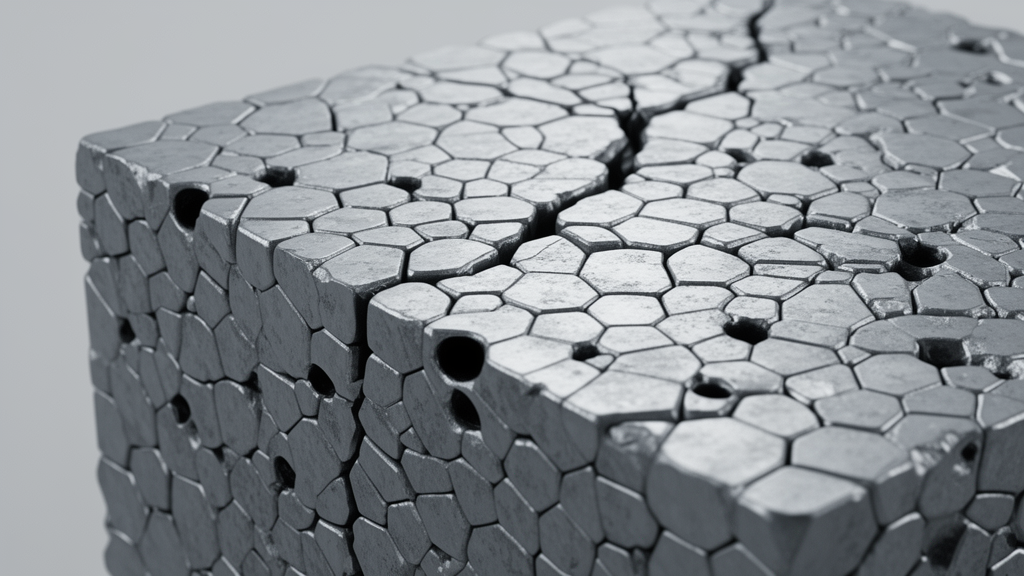
Nanovoids and grain morphologies introduced by laser powder bed fusion can substantially weaken an idealized nanocrystalline steel, according to a simulation and machine-learning study published in Discover Materials on 27 October 2026. Researchers led by Mahshad Fani, Oluwatimilehin Akinloye, Yingtao Liu, and Shuozhi Xu combined molecular statics simulations with a deep neural network surrogate model and a gradient-boosting comparison model to probe the ultimate hydrostatic tensile strength (UHTS) of a body-centered-cubic Fe80Cr16Ni4 ternary solid solution, an idealized chemistry inspired by the Fe–Cr–Ni matrix of 17-4 PH stainless steel.

The team constructed 180 atomistic structures by systematically varying four parameters: grain morphology, with equiaxed and columnar grains; grain size, spanning 10, 12.5, 15, 17.5, and 20 nanometers; void shape, either spherical or irregular; and void location, either in the grain interior or at a grain boundary. Porosity was held fixed at 0.5 percent across all samples, isolating the effects of geometry and placement rather than the amount of missing material.

The simulations showed that the mere presence of a void reduced UHTS by 17.8 to 34.8 percent relative to void-free baselines. The highest mean strength values appeared near a grain size of 17.5 nanometers, within the grain-size range associated with previously reported Hall–Petch to inverse Hall–Petch crossover behavior. In columnar nanocrystals, voids sitting at grain boundaries reduced UHTS by 3.6 to 11.0 percent more than voids located within grain interiors, indicating that boundary placement carries an extra strength penalty in that morphology. Equiaxed nanocrystals, by contrast, were insensitive to void location.

Void shape mattered only in a specific setting: within grain-boundary-associated equiaxed nanocrystals, irregular voids yielded 2.4 to 5.3 percent lower UHTS than spherical voids of the same porosity. To rank the importance of the different parameters, the researchers applied SHAP analysis to their model outputs. Void presence emerged as the dominant descriptor, accounting for 51.8 percent of the explained influence, followed by grain morphology and grain size, with void location and void shape acting as secondary factors. According to the authors, this ranking confirms that grain and void characteristics jointly govern hydrostatic strength in these Fe80Cr16Ni4 nanocrystals.

The study is a computational analysis of an idealized model chemistry rather than a test of printed 17-4 PH components, and the article is being shared early as a peer-reviewed, accepted manuscript that remains subject to further edits before the final version of record.

Subject of Research: Machine-learning-guided atomistic simulations of void and grain effects on the strength of nanocrystalline Fe80Cr16Ni4 steel

Article Title: Atomistic and machine-learning analysis of void and grain effects on the strength of nanocrystalline 17-4 PH steel with simplified chemistry

Article References: Fani, M., Akinloye, O., Liu, Y., & Xu, S. (2026). Atomistic and machine-learning analysis of void and grain effects on the strength of nanocrystalline 17-4 PH steel with simplified chemistry. Discover Materials. https://doi.org/10.1007/s43939-026-01047-x

Image Credits: AI Generated

DOI: 10.1007/s43939-026-01047-x

Keywords: nanocrystalline steel, 17-4 PH stainless steel, molecular statics, deep neural network, SHAP analysis, grain boundaries, nanovoids, laser powder bed fusion, Hall-Petch, hydrostatic strength, Fe80Cr16Ni4, machine learning

News Source: Denise Maddox. (October 28, 2026). Voids and grain structure jointly weaken nanocrystalline steel in simulations. Scienmag.


Tags: 17-4 PH stainless steeldeep neural networkFe80Cr16Ni4grain boundariesHall-Petchhydrostatic strengthlaser powder bed fusionMachine Learningmolecular staticsnanocrystalline steelnanovoidsSHAP analysis
Share12Tweet7Share2ShareShareShare1

Related Posts

Fijian bure houses digitally preserved in 3D for heritage and disaster resilience

Fijian bure houses digitally preserved in 3D for heritage and disaster resilience

October 28, 2026
Shape grammar rules decode traditional Mosul house design

Shape grammar rules decode traditional Mosul house design

October 28, 2026

In simulations, agentic AI flies drones that inspect typhoon damage without human pilots

October 28, 2026

AI’s ‘illusion of agency’ may quietly reshape how young children build real autonomy, experts warn

October 28, 2026

POPULAR NEWS

  • HIV-1 in Zunyi shows high genetic diversity and pretreatment drug resistance

    HIV-1 in Zunyi shows high genetic diversity and pretreatment drug resistance

    29 shares
    Share 12 Tweet 7
  • HbA1c Tracks Blood Sugar, Not Muscle Health, in Type 2 Diabetes

    29 shares
    Share 12 Tweet 7
  • Flooding and Heat Leave Mothers in Nigeria Distressed, Children Vulnerable

    29 shares
    Share 12 Tweet 7
  • Corneal digital twins move from simplified shapes to patient-specific simulations

    29 shares
    Share 12 Tweet 7

About

We bring you the latest biotechnology news from best research centers and universities around the world. Check our website.

Follow us

Recent News

Five-year survival reaches 73.2% in population-based study of soft tissue sarcomas

Counseling Training Boosts Midwives’ Skills Talking About Sex With Postmenopausal Women

Kambin’s Triangle Route for Vertebroplasty Shows Shorter Operations in Retrospective Study

Subscribe to Blog via Email

Enter your email address to subscribe to this blog and receive notifications of new posts by email.

Join 85 other subscribers
  • Contact Us

Bioengineer.org © Copyright 2023 All Rights Reserved.

Welcome Back!

Login to your account below

Forgotten Password?

Retrieve your password

Please enter your username or email address to reset your password.

Log In
No Result
View All Result
  • Homepages
    • Home Page 1
    • Home Page 2
  • News
  • National
  • Business
  • Health
  • Lifestyle
  • Science

Bioengineer.org © Copyright 2023 All Rights Reserved.