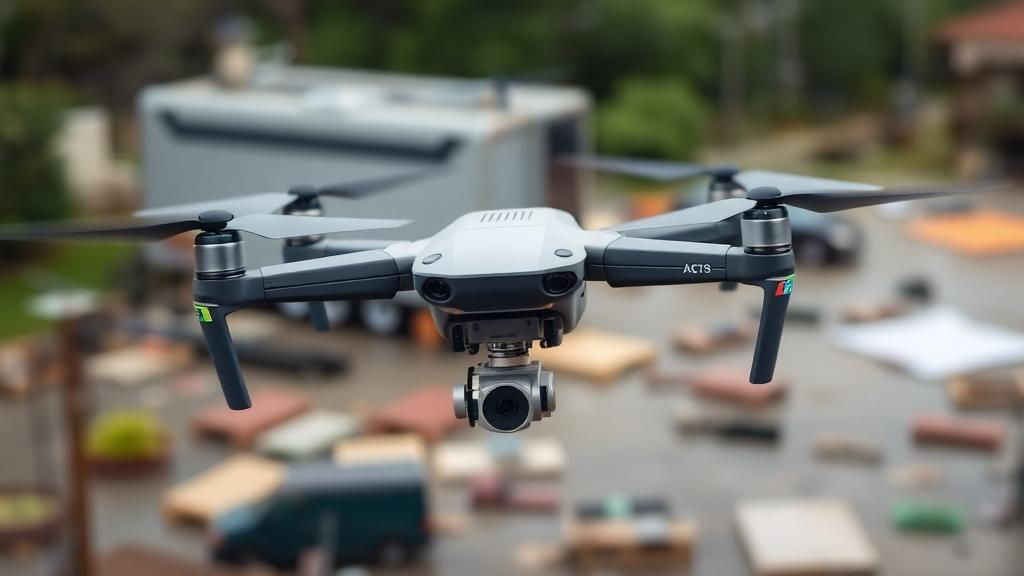
A new study published in AI in Civil Engineering proposes a way to shrink that wait dramatically: an unmanned aerial vehicle that does not wait for a human pilot, does not follow a fixed flight plan, and instead reasons about its own mission while it flies. The system, called AAUIAS (Agentic AI and UAV-enabled Autonomous Inspection and Assessment System), was evaluated in high-fidelity simulations of a typhoon-struck urban district in Hong Kong, where it reduced overall inspection time by 34.5 to 40.2 percent relative to conventional teleoperated and pre-programmed approaches.
The research team, led by Liupengfei Wu with colleagues including Linna Geng, Jin Xue, Yangyang Qian, Zhengzhe Liu and Ibrahim Yahaya Wuni, argues that the missing ingredient in current drone-based disaster inspection is not better cameras or faster drones, but genuine agency. Today’s operational UAVs, the authors note, fall into two camps: teleoperated aircraft flown in real time by a human operator, and automated drones that trace pre-programmed flight paths. Both digitize data collection, but neither can autonomously interpret what it sees, reprioritize its mission when it discovers something alarming, or replan around a newly fallen obstacle without human intervention.
To close that gap, the researchers built a three-layered conceptual framework that formally connects perception, cognition and action into a single closed loop. The perception layer fuses data from onboard optical cameras, LiDAR and thermal infrared imagers into a real-time, multimodal model of the inspection space. The cognition layer, the heart of the system, contains three tightly coupled modules: a World Model Manager that maintains a dynamic three-dimensional semantic map of the environment, an Autonomous Damage Assessor that detects and prioritizes structural damage, and a Mission Planner and Executive that generates optimal inspection paths and replans them the moment new obstructions or high-priority damage sites appear. The action layer then translates those cognitive decisions into precise flight commands, sensor pointing directives and mission-level actions such as switching from optical imaging to LiDAR scanning.
What makes the system genuinely agentic rather than merely autonomous, the authors contend, is goal-directed reasoning combined with closed-loop decision-making. Instead of reacting to predefined triggers, such as stopping when an obstacle is detected, the system maintains an internal representation of its mission objectives, for example inspecting high-priority damage first and returning with remaining battery. When a newly detected crack is classified as critical, the mission planner automatically reprioritizes the remaining waypoints, even if that means deviating from the originally optimal path. The system also exhibits what the researchers call contextual agency: when confronted with ambiguous or unfamiliar damage, it proactively captures supplementary images from multiple angles before deferring to human input.
The prototype was built on a custom multirotor platform with a carbon-fibre airframe, a Pixhawk 6C flight controller running PX4 firmware, a gimbal-stabilized Zenmuse H20T payload combining a 20 megapixel optical camera, a radiometric thermal imager and a 1,000 meter laser rangefinder, and a Livox Mid-70 LiDAR for three-dimensional reconstruction in GPS-denied conditions. Onboard computation runs on an NVIDIA Jetson AGX Orin module with 64 GB of RAM and 275 TOPS of AI computing power, executing real-time sensor fusion, SLAM and lightweight damage detection models. The platform carries a 6S 22,000 mAh LiPo battery providing an estimated 45 minutes of flight time under standard inspection conditions, and its electronics are housed in an IP54-rated case for protection against moisture and dust.
The damage assessment model itself is a ResNet-50 convolutional neural network trained on a dataset of 12,847 images generated with generative AI to simulate realistic post-typhoon inspection scenarios. The synthetic images cover cracks, spalling, collapse, roof damage and intact structures, replicating UAV captures at altitudes from 10 to 35 meters under varied lighting conditions, and were based on real-world scenarios observed in three typhoon-affected districts of Hong Kong, Sai Kung, Tseung Kwan O and Eastern District, following Super Typhoon Saola in September 2023 and Typhoon Koinu in October 2023. Detected damage is assigned a priority score on a four-level scale, from Critical to Low, defined in alignment with the Hong Kong Building Code and ISO 13822:2010, with the location of damage on structural versus non-structural elements weighted most heavily. A six millimeter crack on a load-bearing column is classified as critical, while the same crack on a non-structural partition wall is rated high priority.
Because deploying multiple autonomous UAVs in a real post-typhoon scene would entail substantial cost, logistical complexity and safety risk, the team validated the system in a Gazebo and ROS 2 simulation of a densely built Hong Kong neighbourhood, complete with partially collapsed buildings, debris, damaged rooftops, falling objects and moving emergency personnel. The simulation was designed to be high fidelity: sensor models include realistic noise characteristics, the physics engine simulates wind gusts of up to 20 meters per second using a Dryden turbulence model, and simulated sensor outputs were validated against real-world post-typhoon data from Super Typhoon Saola, achieving a structural similarity index of 0.89 plus or minus 0.04 for optical imagery and a root mean square error of 0.12 meters for LiDAR point clouds.
Across 50 simulated post-typhoon inspections covering areas from 5,000 to 20,000 square meters, the agentic approach achieved average inspection times of 25.3 plus or minus 9.5 minutes, compared with 39.0 plus or minus 14.4 minutes for pre-programmed grid flight and 46.6 plus or minus 23.2 minutes for teleoperation, with both differences statistically significant. In area coverage efficiency, the system operated at 468.4 plus or minus 68.6 square meters per minute, substantially outperforming the teleoperated baseline of 274.6 plus or minus 77.1 and the pre-programmed baseline of 300.5 plus or minus 16.2. In dynamic response testing, missions included an average of 6.5 dynamic obstacles and 1.8 newly detected high-priority targets; the system achieved an average obstacle avoidance success rate of 0.775, versus 0.625 for teleoperation and 0.200 for the pre-programmed method, and replanned in an average of 6.6 seconds after obstacle detection, an improvement of 61.6 percent over teleoperation and 84.4 percent over manual replanning for the pre-programmed approach.
The system also demonstrated intelligent task sequencing. It inspected an average of 69.4 percent of critical damage sites first, compared with 37.6 percent for teleoperation and just 3.8 percent for the pre-programmed grid approach, and it located the first critical site at 19.2 percent of the mission duration, a 50.3 percent reduction relative to the grid baseline and 47.4 percent relative to teleoperation. On a composite adaptability score, the system attained 77.2 plus or minus 24.0, a 241.6 percent improvement over the pre-programmed grid and 46.2 percent over teleoperation. The authors emphasize that all of these results come from simulation under controlled conditions, and that real-world validation remains a critical prerequisite before any operational deployment.
The researchers also acknowledge further limitations. The damage assessment model was trained entirely on synthetically generated data, so performance on genuine disaster imagery requires further validation, and domain adaptation or fine-tuning on real-world samples may prove necessary. The approach may not support extended mission durations due to computational and power constraints, its generalizability to other disaster types remains unexamined, and questions of human oversight, ethical governance and multi-agent coordination in heterogeneous teams are left to future work. The system does, however, include a three-level autonomy framework that balances autonomous execution with human supervision, requesting operator input when classification confidence falls below 0.7, when GPS signal is lost for more than 30 seconds, when battery level drops below 15 percent, or when obstacle trajectory ambiguity is high. If the vision holds, the authors suggest, UAVs could evolve from passive data collectors into proactive, intelligent collaborators in disaster response, giving first responders actionable damage maps faster than ever before.
Subject of Research: An agentic AI and aerial robotics system for autonomous post-typhoon structural inspection and damage assessment, validated in simulation.
Article Title: Autonomous post-typhoon structural inspection and damage assessment: an agentic AI and aerial robotics-enabled model
Article References: Wu, L., Geng, L., Xue, J., Qian, Y., Liu, Z., & Wuni, I. Y. (2026). Autonomous post-typhoon structural inspection and damage assessment: an agentic AI and aerial robotics-enabled model. AI in Civil Engineering, 5(1), Article 23. https://doi.org/10.1007/s43503-026-00107-8
Image Credits: AI Generated
DOI: 10.1007/s43503-026-00107-8
Keywords: agentic AI, UAV, typhoon, structural inspection, damage assessment, autonomous drones, simulation, disaster response, path replanning, Hong Kong, robotics, cyber-physical systems
News Source: Denise Maddox. (October 28, 2026). In simulations, agentic AI flies drones that inspect typhoon damage without human pilots. Scienmag.