


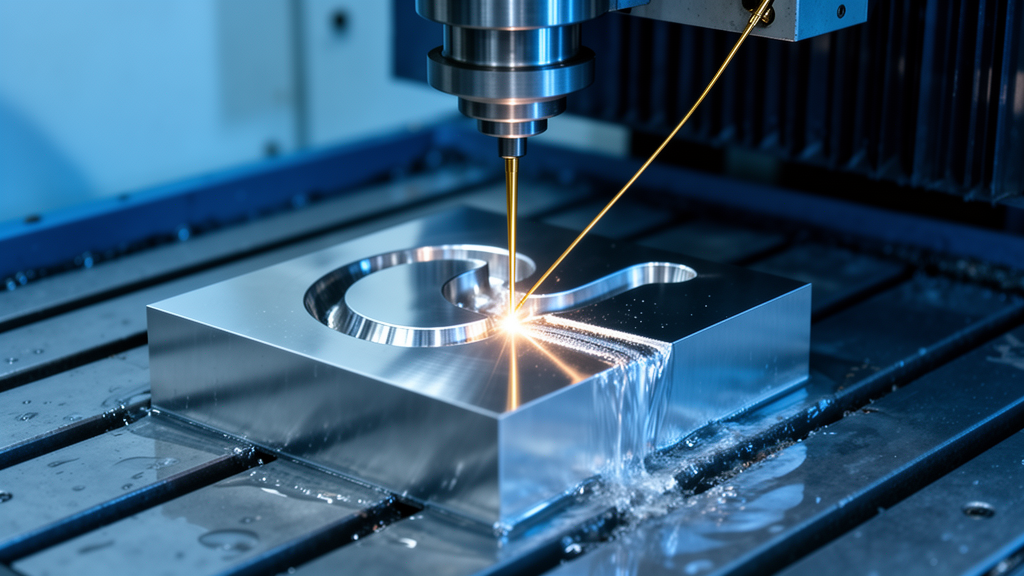
Engineers have long struggled to machine Haynes 230, a nickel-chromium-tungsten-molybdenum superalloy prized for its oxidation resistance and thermal stability in gas turbines and combustion systems. The alloy’s severe deformation-induced hardening and abrasive carbide phases wreck conventional cutting tools, and until now its behavior under wire electrical discharge machining, a non-contact thermal cutting process, had never been systematically investigated. A new open-access study published in Discover Mechanical Engineering on 20 October 2026 by Gurnam Singh, Neel Kanth Grover, and Vivek Aggarwal establishes the first comprehensive machinability baseline for this alloy, combining a 52-run statistical experimental design with scanning electron microscopy and energy-dispersive X-ray spectroscopy to validate the results at the microstructural level.
The research team machined 5-millimeter-thick slices cut from a 25 by 25 millimeter Haynes 230 bar on an Electronica Sprint-cut ELPULS 40A DLX wire EDM machine, using a 0.25-millimeter zinc-coated brass wire electrode and deionized water held at 24 to 26 degrees Celsius as the dielectric medium. Six process variables were varied across the 52-run central composite design: pulse-on time, pulse-off time, peak current, spark-gap voltage, wire feed rate, and wire tension. The responses measured were cutting rate in millimeters per minute and surface roughness in micrometers, with roughness assessed using a Mitutoyo SJ-500 profilometer and composite microhardness tested under a 500-gram load.
Statistical analysis of variance revealed that spark-gap voltage and pulse-on time overwhelmingly govern both productivity and surface quality. Spark-gap voltage accounted for roughly 43 percent of the variation in cutting rate and 34 percent of the variation in surface roughness, while pulse-on time contributed about 24 percent and 27 percent respectively. Pulse-off time contributed 17.61 percent to cutting rate and 6.28 percent to roughness. Peak current, wire feed rate, and wire tension exerted statistically negligible effects within the investigated ranges. The quadratic regression models achieved coefficients of determination of 0.9934 for cutting rate and 0.9884 for surface roughness, and confirmatory trials showed prediction errors consistently within plus or minus 5 percent.
The interaction plots expose a fundamental productivity-versus-quality trade-off rooted in plasma physics. At a low spark-gap voltage of 31 volts, raising pulse-on time from 0.5 to 1.5 microseconds lifted the cutting rate from roughly 1.1 to over 2.6 millimeters per minute, because the narrow spark gap concentrates discharge energy into a smaller plasma volume, intensifying melting and vaporization of the workpiece. At 69 volts, the wider gap spreads the same energy over a larger discharge volume, cutting plasma energy density and reducing material removal efficiency. The highest cutting rates, peaking at an experimental 3.19 millimeters per minute, occurred at low gap voltages of 31 to 39 volts, high pulse-on times of 1.20 to 1.32 microseconds, and short pulse-off times near 20 microseconds.
Surface quality followed the inverse logic. The smoothest finish, a minimum experimental roughness of 0.85 micrometers, was achieved at low pulse-on times of 0.68 to 0.78 microseconds, moderate-to-high pulse-off times of 31 to 42 microseconds, and high gap voltages of 60 to 69 volts. Long pulses at low gap voltage produced roughness approaching 2.9 micrometers, driven by intensified localized melting and restricted debris evacuation. The authors attribute this to Haynes 230’s low thermal conductivity and high hot strength, which generate a large molten volume that exceeds the dielectric’s flushing capacity, leaving resolidified material, deep craters, and micro-cracks on the surface.
Because maximizing cutting rate directly worsens surface finish, the team applied a desirability function approach to find a balanced operating window, weighting both objectives equally. The multi-response optimum, confirmed over five replicate validation runs with an overall desirability of 0.60, delivered a cutting rate of 1.80 millimeters per minute and a surface roughness of 1.66 micrometers, against predictions of 1.86 and 1.55 respectively, with relative errors of 3.23 and 7.10 percent. That cutting rate is approximately 2.77 times higher than the minimum-roughness setting while keeping thermal damage within acceptable industrial limits, a compromise the authors argue is representative of practical roughing-and-skimming regimes used in aerospace manufacturing.
Cross-sectional electron microscopy then tied these macroscopic outcomes to subsurface metallurgy. Under the cutting-rate-optimized condition, a thick recast layer averaging 10.57 micrometers formed, porous and heavily micro-cracked, with deep craters and re-deposited debris globules. Under the surface-roughness-optimized condition the layer thinned to about 2.39 micrometers with a nearly defect-free morphology, and under the multi-response window it settled at 4.85 micrometers with micro-cracks confined to superficial zones. Notably, cross-sections showed thermal micro-cracking remained contained within the resolidified layer, with no fissures penetrating into the parent matrix within the resolution limits of the micrographs, though heat-affected zone depth was not quantified in this study.
Energy-dispersive spectroscopy revealed dramatic elemental redistribution inside the recast layer. Nickel, the matrix’s dominant constituent, was depleted by roughly 42 weight percent under maximum-cutting-rate conditions, while chromium fell to about 2 to 4 weight percent and cobalt nearly vanished. In contrast, tungsten enriched to approximately 15 weight percent and molybdenum to about 1.8 weight percent under the multi-response condition, reflecting selective vaporization of lower-boiling-point elements during discharge followed by rapid non-equilibrium solidification that freezes the compositional gradients in place. Oxygen uptake reached about 19 weight percent under the highest-energy condition due to dielectric decomposition, and zinc transferred from the coated wire climbed to roughly 3 weight percent, incorporated through a vaporization-condensation mechanism that conventional ultrasonic cleaning cannot remove.
Composite microhardness rose from a bulk baseline of approximately 427 HV to peaks of about 534 HV under the cutting-rate-optimized condition, 467 HV under the multi-response window, and 435 HV under the surface-optimized setting. The authors attribute this hardening to ultra-rapid solidification, grain refinement described by the Hall-Petch relationship, and solid-solution strengthening from entrapped tungsten, molybdenum, and zinc, though they caution that SEM-EDS alone cannot confirm specific carbide or intermetallic phases, recommending X-ray diffraction, transmission electron microscopy, and electron backscatter diffraction for future phase identification. They also flag that residual zinc in the recast layer poses a theoretical liquid metal embrittlement risk during elevated-temperature service above 600 degrees Celsius, making secondary finishing such as acid pickling or electropolishing essential before high-temperature deployment.
The study’s significance extends beyond a single alloy. By correlating validated macroscopic input boundaries with process-induced metallurgical evolution, the work provides a foundational framework for high-integrity wire EDM of Haynes 230 components such as combustor liners and transition ducts, and offers a comparative benchmark for post-processing additively manufactured superalloys, where residual stresses and columnar grain structures may alter crack behavior. The authors note their empirical models are valid only within the investigated parameter domain and recommend future work on plasma thermal modeling, wire wear dynamics, machined-surface fatigue testing, and machine-learning-assisted adaptive control to push the process toward real-time industrial deployment.
Subject of Research: Statistical modeling and multi-response optimization of wire electrical discharge machining of the Haynes 230 superalloy, validated through microstructural characterization
Article Title: Statistical modeling and multi response optimization of wire electrical discharge machining of Haynes 230 with validation through microstructural characterization
Article References: Singh, G., Grover, N. K., & Aggarwal, V. (2026). Statistical modeling and multi response optimization of wire electrical discharge machining of Haynes 230 with validation through microstructural characterization. Discover Mechanical Engineering, 5(1), Article 200. https://doi.org/10.1007/s44245-026-00351-3
Image Credits: AI Generated
DOI: 10.1007/s44245-026-00351-3
Keywords: wire electrical discharge machining, Haynes 230, superalloy, response surface methodology, desirability function optimization, recast layer, surface roughness, cutting rate, microhardness, SEM-EDS, aerospace manufacturing, spark-gap voltage
News Source: Denise Maddox. (October 28, 2026). Wire EDM unlocks Haynes 230 superalloy machining with optimized cutting rate and surface finish. Scienmag.



