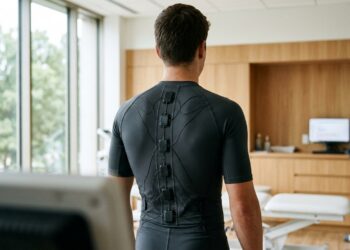
People who view wearable sports technology more favorably also tend to report stronger commitment to sport and greater awareness of healthy living, according to a cross-sectional study of 1,277 fitness center attendees published in BMC Digital Health. The research, conducted by Dilek Yıldırım Gürkan, Oğuz Gürkan, and Rukiye Çakmak, examined how perceptions of wearable technological sports products relate to two psychological constructs considered central to sustained physical activity: sports commitment, which reflects intention to continue sport participation, psychological investment, and persistence, and healthy life awareness, which describes tendencies to recognize, value, and incorporate health-protective and health-promoting behaviors into daily life.
The study recruited individuals aged 18 to 55 who had regularly attended fitness centers in Yozgat city center for at least one year, using convenience sampling. Data were collected face to face with a Personal Information Form, the Perception of Use of Wearable Technological Sports Products Scale, the Healthy Life Awareness Scale, and the Sports Commitment Scale. The wearable technology scale contains 30 items across six subdimensions—perceived benefit, fashion and aesthetics, functionality, intention to continue use, social comparison, and facilitating conditions—rated on a five-point Likert scale, with higher scores indicating more positive perceptions. Cronbach’s alpha reached 0.97 for this scale in the present sample, 0.89 for the healthy life awareness measure, and 0.96 for the 15-item single-factor sports commitment version used.
Correlation analysis revealed that sports commitment and healthy life awareness were moderately to strongly and positively correlated, with a coefficient of r = 0.60 (p < 0.001). Wearable technology perception showed weaker but statistically significant positive correlations with healthy life awareness (r = 0.28; p < 0.001) and sports commitment (r = 0.23; p < 0.001). These coefficients indicate that favorable views of wearable devices coexist with stronger sport- and health-related orientations, although the associations are modest in magnitude and the design cannot establish which direction any influence might run.
Multiple linear regression sharpened the picture. A model entering healthy life awareness and sports commitment together was statistically significant (F = 60.19, p < 0.001) but explained only about 8 percent of the variance in wearable technology perception (adjusted R² = 0.08). Within that model, healthy life awareness carried a standardized coefficient of β = 0.23 (B = 0.67; 95% CI, 0.48–0.85; p < 0.001), while sports commitment contributed β = 0.09 (B = 0.15; 95% CI, 0.04–0.26; p = 0.006). Both constructs were independently and positively associated with perception of wearable technology use, meaning each relationship held after accounting for the other.
A second regression model tested sociodemographic and lifestyle characteristics. It was also statistically significant (F = 5.640, p < 0.001) but explained just 2.6 percent of the variance, indicating limited explanatory power. After adjustment for the other variables, participants without a psychiatric diagnosis scored on average 4.74 points higher on wearable technology perception than those with a diagnosis, regular exercisers scored 5.08 points higher than non-regular exercisers, and participants whose income exceeded their expenditure scored 6.23 points higher than those whose income fell short of it. The authors frame these characteristics as external contextual factors within the Technology Acceptance Model, the framework proposing that perceived usefulness and ease of use shape technology adoption and continued use.
Group comparisons added further texture. Wearable technology perception differed significantly across age groups (p = 0.022), with participants aged 21 to 29 scoring higher than those aged 30 to 55, while healthy life awareness and sports commitment did not differ by age. Men scored higher than women on both wearable technology perception and sports commitment, but healthy life awareness showed no gender difference. Participants who exercised regularly—defined independently of fitness center attendance as planned, structured exercise at least two days per week for 45 to 60 minutes per session—and those physically active at least three days per week scored higher on all three measures. Participants without a chronic disease also scored higher on all three, whereas psychiatric diagnosis status was associated only with wearable technology perception.
One striking pattern concerns the distinction between gym attendance and actual exercise behavior. Although every participant had attended fitness centers for at least a year, many did not report engaging in regular structured exercise. The authors interpret this as evidence that membership or attendance does not necessarily ensure behavioral continuity, since frequency, motivation, purpose of attendance, and adherence can vary widely. Regular exercisers in the sample reported higher healthy life awareness, sports commitment, and wearable technology perception, suggesting an association between sustained exercise behavior and both cognitive and behavioral outcomes even among long-term facility users.
The authors caution that the findings should not be read as proof that wearable devices cause greater commitment or health awareness. Because the data were cross-sectional, causal relationships between perceived use of wearable technologies, sports commitment, and healthy life awareness cannot be established, and longitudinal studies are needed to clarify the direction and temporal nature of the associations. The study also relied on self-reported measures, which may be subject to social desirability and recall biases, and it was conducted in a single province with convenience sampling, potentially limiting generalizability. The researchers did not examine specific types or brands of wearable products, leaving open how device features might shape perceptions.
Statistically, the modest variance explained by both regression models signals that perception of wearable technology use is likely tied to additional psychological, social, environmental, and technological factors not measured here. The authors also note that because physical activity frequency was captured in only two categories, the findings should not be interpreted as evidence of a graded or dose–response relationship. Within these constraints, the study contributes evidence that even among recreationally active populations with long-term gym attendance, regular structured exercise remains an important correlate of sport- and health-related outcomes.
From a digital health and public health standpoint, the authors suggest that wearable technologies may serve as complementary tools for supporting sustained participation in physical activity and health-oriented behaviors, rather than independent determinants of those behaviors. They propose that health professionals, particularly nurses, could consider such devices in counseling, education, and follow-up practices aimed at promoting physical activity, with interventions tailored to users’ perceptions, socioeconomic resources, health status, and exercise patterns. The monitoring, feedback, and goal-setting functions of wearables may support motivation and self-regulation, but the study’s design means any such supportive role remains an interpretation compatible with the observed associations rather than a demonstrated effect.
Subject of Research: Cross-sectional associations between perceptions of wearable technological sports products, sports commitment, and healthy life awareness among fitness center attendees
Article Title: Perception of use of wearable technological sports products and its associations with sports commitment and healthy life awareness
Article References: Yıldırım Gürkan, D., Gürkan, O., & Çakmak, R. (2026). Perception of use of wearable technological sports products and its associations with sports commitment and healthy life awareness. BMC Digital Health, 4(1), Article 57. https://doi.org/10.1186/s44247-026-00292-7
Image Credits: AI Generated
DOI: 10.1186/s44247-026-00292-7
Keywords: wearable technology, sports commitment, healthy life awareness, fitness centers, cross-sectional study, digital health, physical activity, Technology Acceptance Model, exercise behavior, public health, self-monitoring, regression analysis
News Source: Denise Maddox. (November 5, 2026). Wearable Sports Tech Perceptions Linked to Sports Commitment and Health Awareness. Scienmag.