• HOME
  • NEWS
  • EXPLORE
    • CAREER
      • Companies
      • Jobs
    • EVENTS
    • iGEM
      • News
      • Team
    • PHOTOS
    • VIDEO
    • WIKI
  • BLOG
  • COMMUNITY
    • FACEBOOK
    • INSTAGRAM
    • TWITTER
Wednesday, October 7, 2026
BIOENGINEER.ORG
No Result
View All Result
  • Login
  • HOME
  • NEWS
  • EXPLORE
    • CAREER
      • Companies
      • Jobs
        • Lecturer
        • PhD Studentship
        • Postdoc
        • Research Assistant
    • EVENTS
    • iGEM
      • News
      • Team
    • PHOTOS
    • VIDEO
    • WIKI
  • BLOG
  • COMMUNITY
    • FACEBOOK
    • INSTAGRAM
    • TWITTER
  • HOME
  • NEWS
  • EXPLORE
    • CAREER
      • Companies
      • Jobs
        • Lecturer
        • PhD Studentship
        • Postdoc
        • Research Assistant
    • EVENTS
    • iGEM
      • News
      • Team
    • PHOTOS
    • VIDEO
    • WIKI
  • BLOG
  • COMMUNITY
    • FACEBOOK
    • INSTAGRAM
    • TWITTER
No Result
View All Result
Bioengineer.org
No Result
View All Result
Home NEWS Science News Cancer

Vitamin D and immune cells stimulate bone marrow disease

Bioengineer by Bioengineer
February 8, 2019
in Cancer
Reading Time: 3 mins read
0
IMAGE
Share on FacebookShare on TwitterShare on LinkedinShare on RedditShare on Telegram

IMAGE

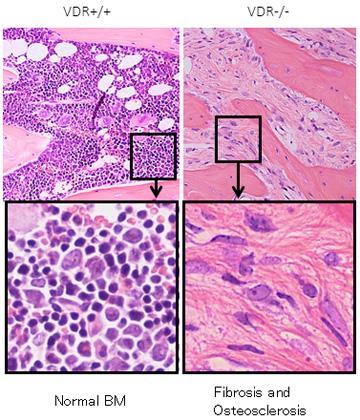
(right column) The bone marrow of mice with vitamin D receptors knocked out is occupied by spindle-shaped…
view more 


The bone marrow disease myelofibrosis is stimulated by excessive signaling from vitamin D and immune cells known as macrophages, reveals a Japanese research team. These findings could help to develop alternative treatments that do not target problem genes. The team was led by Research Fellow Kanako Wakahashi and Junior Associate Professor Yoshio Katayama (Kobe University Graduate School of Medicine) and the findings were published on February 4 in the online edition of Blood.

There are three types of blood cell: white blood cells, red blood cells, and platelets. All three types are created from hematopoietic stem cells located in the bone marrow. Myelofibrosis causes an abnormal increase in the cells that produce collagen fibers called fibroblasts. The bone marrow becomes filled with these fibers, preventing the body from producing blood cells as normal. This condition can make it hard to control other diseases, and bone hardening (osteosclerosis) also occurs. Myelofibrosis occurs in blood tumors called myeloproliferative neoplasms, which are caused by genetic mutations of hematopoietic stem cells.

The research team focused on the relationship between blood and bone. Vitamin D is a hormone that regulates calcium, and the team had already shown that vitamin D receptors control the location of hematopoietic cells in the bone marrow. In this study, the team performed a bone marrow (with vitamin D receptors) transplant for a mouse model without vitamin D receptors (this means it has a high concentration of vitamin D in the body) to create a myelofibrosis model. By analyzing this model, they found that hematopoietic stem cells were strongly stimulated by vitamin D signaling and grew into immune system cells called macrophages. These pathological macrophages stimulated young osteoblasts (cells that create bone) to induce myelofibrosis and bone hardening (figure 1). The cells known as fibroblasts are thought to be these young osteoblasts. By giving these mice a low vitamin D diet and suppressing the macrophages, the team was able to largely prevent the onset of myelofibrosis.

The team also examined mouse models with the same genetic disorder as myelofibrosis patients (JAK2V61F transgenic mice). These mice presented similar symptoms to myelofibrosis patients, displaying both fibrosis and bone hardening. They treated the mice by rearing them on a low vitamin D diet, blocking vitamin D receptor signals (removing the vitamin D receptor gene in blood cells) and suppressing macrophages. This proved to be extremely effective in preventing bone marrow fibrosis (figure 2).

The results show that pathological macrophages produced by vitamin D receptor signaling play an important role in the development of myelofibrosis (figure 3). Clinical treatment uses inhibitors to target the causative genes of myeloproliferative tumors, but this is not always effective in treating myelofibrosis. Professor Katayama comments: “The only permanent cure for this disease is hematopoietic stem cell transplant, but this method is unsuitable for many elderly patients. These new findings may help to develop a treatment method for the elderly targeting the vitamin D pathway and macrophages.”

###

Media Contact
Eleanor Wyllie
[email protected]

Original Source

http://www.kobe-u.ac.jp/research_at_kobe_en/NEWS/news/2019_02_08_01.html

Related Journal Article

http://dx.doi.org/10.1182/blood-2018-09-876615

Tags: BiologycancerCell BiologyHematologyMedicine/HealthMetabolism/Metabolic Diseases
Share12Tweet8Share2ShareShareShare2

Related Posts

The Hidden Cost of Cancer Care: When Treatment Steals Patients' Time

The Hidden Cost of Cancer Care: When Treatment Steals Patients’ Time

October 7, 2026
Real-World Data Show Trastuzumab Deruxtecan Extends Survival in HER2-Low Metastatic Breast Cancer

Real-World Data Show Trastuzumab Deruxtecan Extends Survival in HER2-Low Metastatic Breast Cancer

October 6, 2026

NIH Pioneer Award Backs Scientist Building Cancer Therapies That Evolve Alongside Tumors

October 6, 2026

One in Five Lymphoma Patients on R-CHOP Suffers Febrile Neutropenia, Real-World Analysis Finds

October 6, 2026
Please login to join discussion

POPULAR NEWS

  • Alloys That Shrink Their Own Grains: New PIX Mechanism Refines Metals With Heat Alone

    Alloys That Shrink Their Own Grains: New PIX Mechanism Refines Metals With Heat Alone

    29 shares
    Share 12 Tweet 7
  • Endurance Exercise Reshapes the Liver in Males and Females Through Distinct Molecular Routes

    29 shares
    Share 12 Tweet 7
  • Single Transcription Factor PU.1 Rapidly Converts Fibroblasts into Macrophage-Lineage Cells

    29 shares
    Share 12 Tweet 7
  • New Scale Measures How Ready Nurse Educators Really Are for the AI Era

    29 shares
    Share 12 Tweet 7

About

We bring you the latest biotechnology news from best research centers and universities around the world. Check our website.

Follow us

Recent News

Alloys That Shrink Their Own Grains: New PIX Mechanism Refines Metals With Heat Alone

Endurance Exercise Reshapes the Liver in Males and Females Through Distinct Molecular Routes

Single Transcription Factor PU.1 Rapidly Converts Fibroblasts into Macrophage-Lineage Cells

Subscribe to Blog via Email

Success! An email was just sent to confirm your subscription. Please find the email now and click 'Confirm' to start subscribing.

Join 85 other subscribers
  • Contact Us

Bioengineer.org © Copyright 2023 All Rights Reserved.

Welcome Back!

Login to your account below

Forgotten Password?

Retrieve your password

Please enter your username or email address to reset your password.

Log In
No Result
View All Result
  • Homepages
    • Home Page 1
    • Home Page 2
  • News
  • National
  • Business
  • Health
  • Lifestyle
  • Science

Bioengineer.org © Copyright 2023 All Rights Reserved.