• HOME
  • NEWS
  • EXPLORE
    • CAREER
      • Companies
      • Jobs
    • EVENTS
    • iGEM
      • News
      • Team
    • PHOTOS
    • VIDEO
    • WIKI
  • BLOG
  • COMMUNITY
    • FACEBOOK
    • INSTAGRAM
    • TWITTER
Saturday, May 16, 2026
BIOENGINEER.ORG
No Result
View All Result
  • Login
  • HOME
  • NEWS
  • EXPLORE
    • CAREER
      • Companies
      • Jobs
        • Lecturer
        • PhD Studentship
        • Postdoc
        • Research Assistant
    • EVENTS
    • iGEM
      • News
      • Team
    • PHOTOS
    • VIDEO
    • WIKI
  • BLOG
  • COMMUNITY
    • FACEBOOK
    • INSTAGRAM
    • TWITTER
  • HOME
  • NEWS
  • EXPLORE
    • CAREER
      • Companies
      • Jobs
        • Lecturer
        • PhD Studentship
        • Postdoc
        • Research Assistant
    • EVENTS
    • iGEM
      • News
      • Team
    • PHOTOS
    • VIDEO
    • WIKI
  • BLOG
  • COMMUNITY
    • FACEBOOK
    • INSTAGRAM
    • TWITTER
No Result
View All Result
Bioengineer.org
No Result
View All Result
Home NEWS Science News Biology

UTEP awarded $1.3 million to research how neural circuits regulate specific cognitive functions

Bioengineer by Bioengineer
July 13, 2020
in Biology
Reading Time: 2 mins read
0
IMAGE
Share on FacebookShare on TwitterShare on LinkedinShare on RedditShare on Telegram

IMAGE

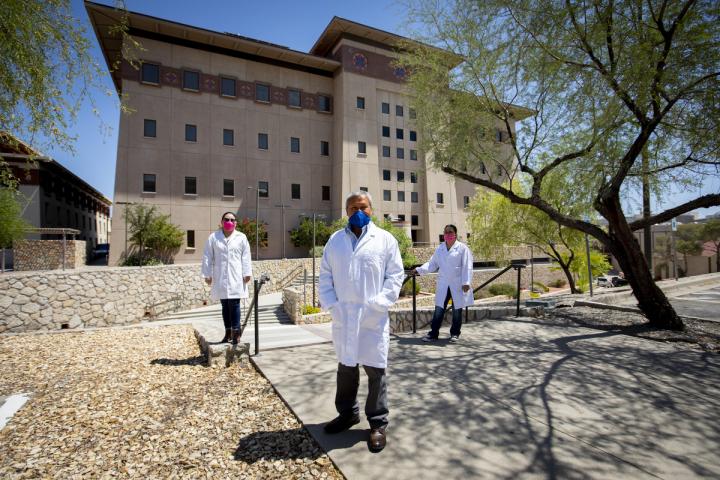
Credit: Ivan Pierre Aguirre / UTEP Communications

EL PASO, Texas – The University of Texas at El Paso was awarded $1.3 million from the National Institutes of Health to shed light on how the combined function of neural circuits impacts specific behaviors in humans.

Leading the research in UTEP’s Department of Biological Sciences is Manuel Miranda-Arango, Ph.D., associate professor of biological sciences. Miranda’s laboratory in UTEP’s Border Biomedical Research Center (BBRC) investigates localization and function of nerve cells containing glycine transporters and the efficacy of communication among them and with other nerve cells in the nervous system.

“I can’t think of a more deserving faculty member for this research award and I am very excited for the studies he has planned to improve, assess and address some fundamentally important questions regarding central brain function,” said Robert A. Kirken, Ph.D., dean of the College of Science. “The result of his work will undoubtedly translate into improved human health care.”

Miranda said the study will seek to identify and characterize glycinergic neurons in the basal ganglia, a brain area that participates in initiation of voluntary movements and cognitive functions such as emotion, vision and some forms of memory.

“To address this question, we will use several genetic, physiological and biochemical approaches combined with traditional histochemical analysis to demonstrate the presence of glycinergic neurons in areas of the basal ganglia,” Miranda said.

The project will investigate the nerve cells of the mammalian nervous system that utilize the gamma aminobutyric acid (GABA) and glycine as inhibitory chemicals to modulate nerve cell activity and consequently many functions of the human body. Although the location and function of neurons containing the chemical GABA is relatively well-studied, the properties of neurons using the chemical glycine as a message remains poorly defined in the central nervous system.

“The results should provide evidence of the precise location of novel inhibitory glycinergic neurons and their connections to other brain areas,” Miranda said. “This work will contribute to a better understanding of the basic basal ganglia architecture and how the combined function of different neural circuits regulate specific behavior.”

The University of Texas at El Paso is one of the largest and most successful Hispanic-serving institutions in the country, with a student body that is over 80% Hispanic. It enrolls more than 25,000 students in 167 bachelor’s, master’s and doctoral programs in 10 colleges and schools. With more than $100 million in total annual research expenditures, UTEP is ranked in the top 5% of research institutions nationally and fifth in Texas for federal research expenditures at public universities.

###

Media Contact
Victor H. Arreola
[email protected]

Original Source

http://www.utep.edu/newsfeed/campus/utep-awarded-1.3m-to-research-how-neural-circuits-regulate-specific-cognitive-functions.html

Tags: Medicine/HealthneurobiologyNeurochemistryPhysiology
Share12Tweet8Share2ShareShareShare2

Related Posts

Single mother must adapt swiftly — the survival of her colony depends on it — Biology

Single mother must adapt swiftly — the survival of her colony depends on it

May 15, 2026
Why Are Nearly Everyone Right-Handed? It Might Be Linked to How We Learned to Walk — Biology

Why Are Nearly Everyone Right-Handed? It Might Be Linked to How We Learned to Walk

May 15, 2026

Excessive Neuronal Activity Initiates Severe Autoimmune Brain Disorder

May 15, 2026

Precision Anti-Aging Strategies Focus on Eliminating Harmful Senescent Cells While Preserving Beneficial Ones

May 15, 2026
Please login to join discussion

POPULAR NEWS

  • Research Indicates Potential Connection Between Prenatal Medication Exposure and Elevated Autism Risk

    843 shares
    Share 337 Tweet 211
  • New Study Reveals Plants Can Detect the Sound of Rain

    730 shares
    Share 291 Tweet 182
  • Salmonella Haem Blocks Macrophages, Boosts Infection

    62 shares
    Share 25 Tweet 16
  • Breastmilk Balances E. coli and Beneficial Bacteria in Infant Gut Microbiomes

    58 shares
    Share 23 Tweet 15

About

We bring you the latest biotechnology news from best research centers and universities around the world. Check our website.

Follow us

Recent News

New Actinomycin Derivatives Target Malaria More Selectively

Mobile App Enhances Exercise for Older Adults’ Cognition

Botulinum Toxin Reduces Urinary Retention Post-Hemorrhoidopexy

Subscribe to Blog via Email

Enter your email address to subscribe to this blog and receive notifications of new posts by email.

Join 82 other subscribers
  • Contact Us

Bioengineer.org © Copyright 2023 All Rights Reserved.

Welcome Back!

Login to your account below

Forgotten Password?

Retrieve your password

Please enter your username or email address to reset your password.

Log In
No Result
View All Result
  • Homepages
    • Home Page 1
    • Home Page 2
  • News
  • National
  • Business
  • Health
  • Lifestyle
  • Science

Bioengineer.org © Copyright 2023 All Rights Reserved.