• HOME
  • NEWS
  • EXPLORE
    • CAREER
      • Companies
      • Jobs
    • EVENTS
    • iGEM
      • News
      • Team
    • PHOTOS
    • VIDEO
    • WIKI
  • BLOG
  • COMMUNITY
    • FACEBOOK
    • INSTAGRAM
    • TWITTER
Thursday, June 25, 2026
BIOENGINEER.ORG
No Result
View All Result
  • Login
  • HOME
  • NEWS
  • EXPLORE
    • CAREER
      • Companies
      • Jobs
        • Lecturer
        • PhD Studentship
        • Postdoc
        • Research Assistant
    • EVENTS
    • iGEM
      • News
      • Team
    • PHOTOS
    • VIDEO
    • WIKI
  • BLOG
  • COMMUNITY
    • FACEBOOK
    • INSTAGRAM
    • TWITTER
  • HOME
  • NEWS
  • EXPLORE
    • CAREER
      • Companies
      • Jobs
        • Lecturer
        • PhD Studentship
        • Postdoc
        • Research Assistant
    • EVENTS
    • iGEM
      • News
      • Team
    • PHOTOS
    • VIDEO
    • WIKI
  • BLOG
  • COMMUNITY
    • FACEBOOK
    • INSTAGRAM
    • TWITTER
No Result
View All Result
Bioengineer.org
No Result
View All Result
Home NEWS Science News Health

UBC Okanagan engineers make injectable tissues a reality

Bioengineer by Bioengineer
April 25, 2019
in Health
Reading Time: 3 mins read
0
IMAGE
Share on FacebookShare on TwitterShare on LinkedinShare on RedditShare on Telegram

New device encases delicate cells into protective microgels
IMAGE

Credit: Nathan Skolski, UBC Okanagan

A simple injection that can help regrow damaged tissue has long been the dream of physicians and patients alike. A new study from researchers at UBC Okanagan moves that dream closer to reality with a device that makes encapsulating cells much faster, cheaper and more effective.

“The idea of injecting different kinds of tissue cells is not a new one,” says Keekyoung Kim, assistant professor of engineering at UBC Okanagan and study co-author. “It’s an enticing concept because by introducing cells into damaged tissue, we can supercharge the body’s own processes to regrow and repair an injury.”

Kim says everything from broken bones to torn ligaments could benefit from this kind of approach and suggests even whole organs could be repaired as the technology improves.

The problem, he says, is that cells on their own are delicate and tend not to survive when injected directly into the body.

“It turns out that to ensure cell survival, they need to be encased in a coating that protects them from physical damage and from the body’s own immune system,” says Mohamed Gamal, doctoral student in biomedical engineering and study lead author. “But it has been extremely difficult to do that kind of cell encapsulation, which has until now been done in a very costly, time consuming and wasteful process.”

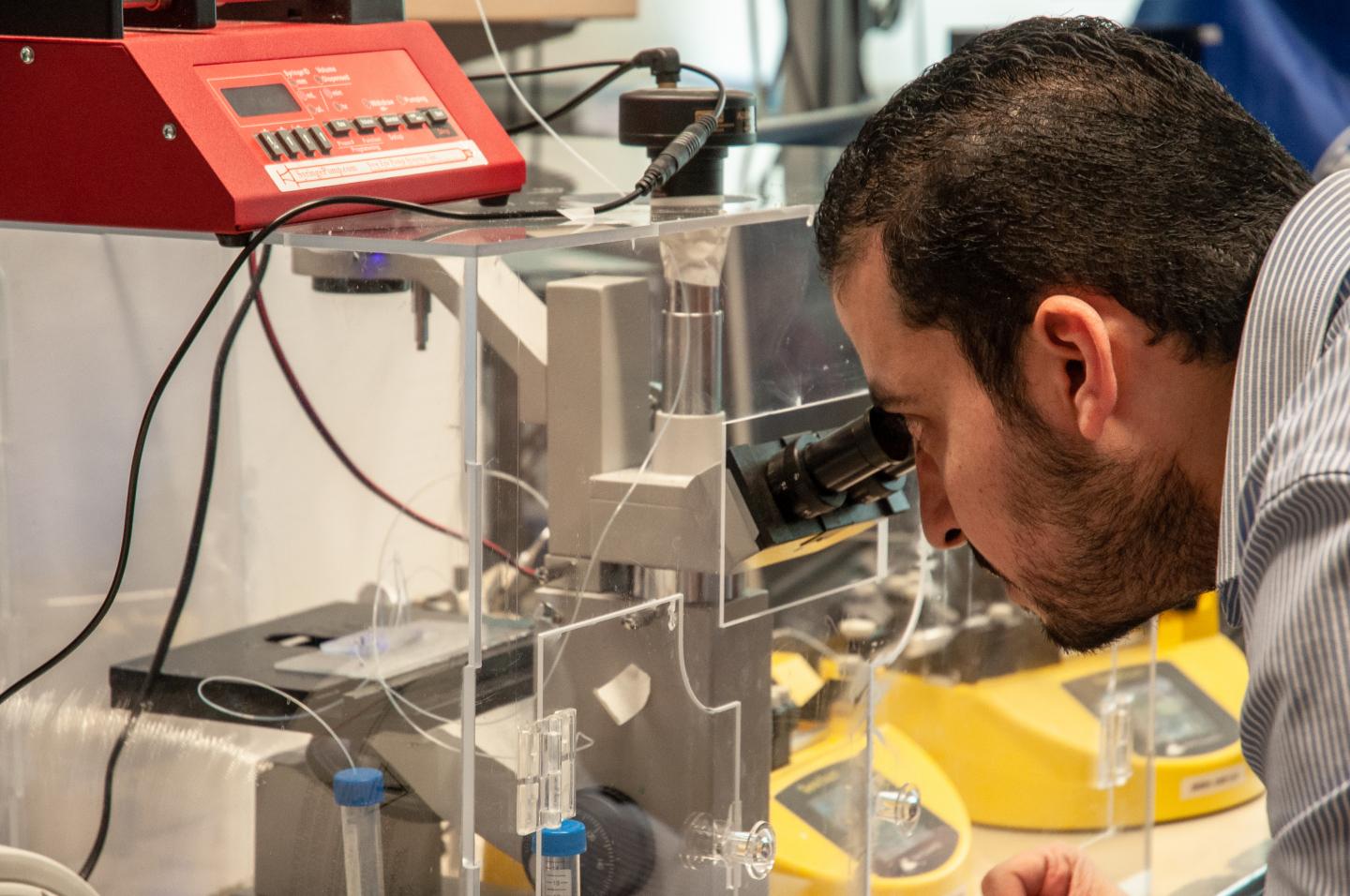
Kim and Gamal have solved that problem by developing an automated encapsulation device that encases many cells in a microgel using a specialized blue laser and purifies them to produce a clean useable sample in just a few minutes. The advantage of their system is that over 85 per cent of the cells survive and the process can be easily scaled up.

“Research in this area has been hampered by the cost and lack of availability of mass-produced cell encapsulated microgels,” says Kim. “We’ve solved that problem and our system could provide thousands or even tens of thousands of cell-encapsulated microgels rapidly, supercharging this field of bioengineering.”

In addition to developing a system that’s quick and efficient, Gamal says the equipment is made up of readily available and inexpensive components.

“Any lab doing this kind of work could set up a similar system anywhere from a few hundred to a couple of thousand dollars, which is pretty affordable for lab equipment,” says Gamal.

The team is already looking at the next step, which will be to embed different kinds of stem cells–cells that haven’t yet differentiated into specific tissue types–into the microgels alongside specialized proteins or hormones called growth factors. The idea would be to help the stem cells transform into the appropriate tissue type once they’re injected.

“I’m really excited to see where this technology goes next and what our encapsulated stem cells are capable of.”

###

The study was published in the journal Lab on a Chip with funding from the Natural Sciences and Engineering Research Council of Canada and the Canadian Foundation for Innovation.

Media Contact
Nathan Skolski
[email protected]

Original Source

https://news.ok.ubc.ca/2019/04/25/ubc-okanagan-engineers-make-injectable-tissues-a-reality

Related Journal Article

http://dx.doi.org/10.1039/C9LC00073A

Tags: Biomedical/Environmental/Chemical EngineeringBiotechnologyMedicine/HealthMicrobiologyPhysiologyRehabilitation/Prosthetics/Plastic Surgery
Share13Tweet8Share2ShareShareShare2

Related Posts

Post-COVID Surge: Obesity Inequalities in England Widen, with Sharpest Rise Among Young Adults

June 25, 2026

Asian Working Group Revises Sarcopenia Criteria 2019-2025

June 25, 2026

AI-Powered Platform Advances Structure-Based Drug Discovery

June 25, 2026

BALatrine Reduces Helminth Infections: Central Java Trial

June 24, 2026
Please login to join discussion

POPULAR NEWS

  • Saying Goodbye to PGY-6: Pediatric Fellowship Realities

    103 shares
    Share 41 Tweet 26
  • Multi-Hospital Study Reveals Long Covid Burden Is Twice as High as Current Estimates

    92 shares
    Share 36 Tweet 23
  • Detection of EDCs in Breast Milk and Infant Urine Up to Six Months Highlights Early Exposure Risks

    77 shares
    Share 31 Tweet 19
  • New Drug Candidate Developed at McMaster Shows Potential for Treating Brain Cancer

    58 shares
    Share 23 Tweet 15

About

We bring you the latest biotechnology news from best research centers and universities around the world. Check our website.

Follow us

Recent News

New UK Study Reveals Plant-Based Alternatives Have Twice the Additives Compared to Animal Products

FDA Approves New Treatment for HR+, HER2+ Advanced Breast Cancer Following Promising Results from the PATINA Trial by Alliance Foundation

New Study Uncovers Key Factors Driving Water Chemistry in Nanoscale Environments

Subscribe to Blog via Email

Enter your email address to subscribe to this blog and receive notifications of new posts by email.

Join 82 other subscribers
  • Contact Us

Bioengineer.org © Copyright 2023 All Rights Reserved.

Welcome Back!

Login to your account below

Forgotten Password?

Retrieve your password

Please enter your username or email address to reset your password.

Log In
No Result
View All Result
  • Homepages
    • Home Page 1
    • Home Page 2
  • News
  • National
  • Business
  • Health
  • Lifestyle
  • Science

Bioengineer.org © Copyright 2023 All Rights Reserved.