One in eight patients living with type 2 diabetes who receive follow-up care at Asella Referral and Teaching Hospital in Ethiopia shows signs of diabetic retinopathy, according to a hospital-based cross-sectional study published in Discover Endocrinology and Metabolism. Among 428 randomly selected adults attending the hospital’s diabetes clinic, 53 participants, or 12.4 percent, had diabetic retinopathy, with a 95 percent confidence interval of 9.4 to 15.9 percent. The finding adds to a still-thin body of evidence on how common this sight-threatening complication is among type 2 diabetes patients in Ethiopia, and it identifies several modifiable behavioral and clinical factors linked to the condition.
Diabetic retinopathy is a microvascular complication of diabetes and a major cause of impaired vision in people aged 20 to 74 years. The International Diabetes Federation estimated that more than 100 million people worldwide had the condition in 2020 and projected a rise of more than 50 percent by 2045. Ethiopia carries a substantial share of this burden: the country’s diabetes prevalence is estimated at more than five million people, among the highest in Africa, accompanied by a high proportion of undiagnosed diabetes. Previous Ethiopian studies covering patients with both type 1 and type 2 diabetes reported retinopathy rates ranging from 4.7 percent to 36.3 percent, figures the researchers caution may under-represent the true scale given poor health care seeking behavior and low awareness of the disease.
The new study focused specifically on type 2 diabetes, the form that accounts for most Ethiopian diabetes cases, and deliberately included self-care and behavioral variables that earlier work had overlooked, such as medication adherence, alcohol consumption, physical exercise, dyslipidemia and proteinuria. The research team conducted the study at the hospital’s chronic follow-up clinic, which serves a total of 2,800 patients with type 2 diabetes, between 11 December 2023 and 12 January 2024. Adults aged 18 or older on follow-up were eligible, while critically ill patients and those with type 1 or gestational diabetes were excluded.
Participants were selected by systematic random sampling with a sampling interval of seven, and the final sample of 428 was calculated using Epi Info version 7 with 80 percent power, a finite population correction and a 10 percent allowance for nonresponse. Data came from chart reviews using a checklist and an interviewer-administered questionnaire translated into the local Afaan Oromo language and back-translated into English. The tool was pretested on 5 percent of the sample size at Adama Hospital Medical College, and completed records were randomly cross-checked against patients’ medical files each day.
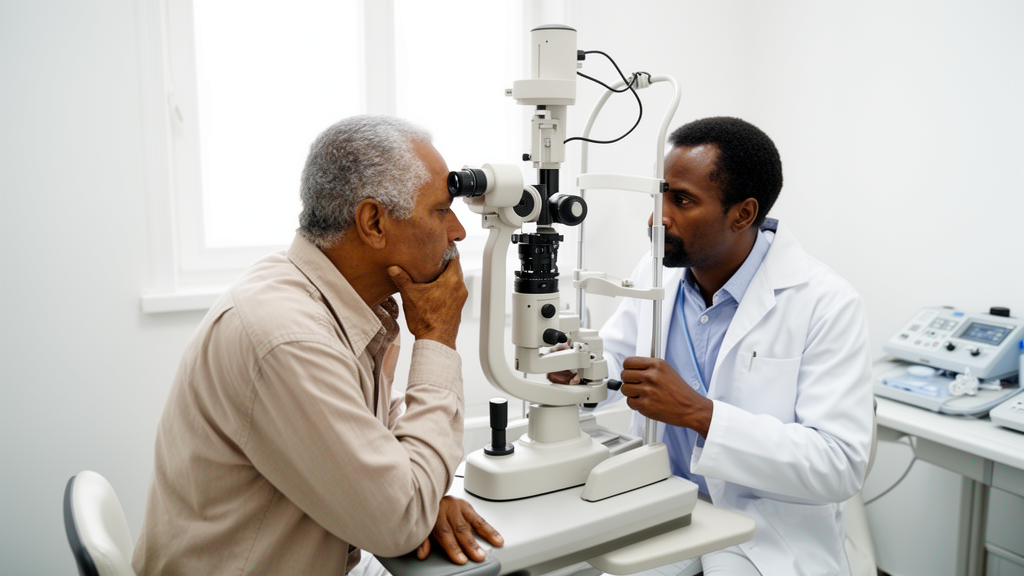
Diagnosis of retinopathy rested on a careful eye examination rather than self-report. Trained ophthalmologists performed dilated fundus examinations using slit lamp biomicroscopy with a 90D condensing lens after dilating the pupil with 1 percent tropicamide. They assessed the presence of microaneurysms, intraretinal hemorrhages, venous beadings, intraretinal microvascular anomalies and neovascularization, then classified patients as having diabetic retinopathy or not according to the Early Treatment of Diabetic Retinopathy Study guidelines. Medication adherence was measured with the Morisky Medication Adherence Scale, with moderate and poor scores grouped together as poor adherence in the regression analysis.
The participant profile reflected a middle-aged, predominantly male clinic population. Of the 428 participants, 241, or 56.3 percent, were male, and 163, or 38.1 percent, were aged 45 to 55 years. Two-thirds, 283 participants, came from urban areas. Clinically, 160 participants, or 37.4 percent, had hypertension, about half of whom had controlled blood pressure; 175, or 41 percent, had dyslipidemia, defined by elevated total cholesterol, LDL cholesterol or triglycerides or low HDL cholesterol; 293 were on statins; and 164, or 38.3 percent, were overweight. Poor glycemic control, based on a fasting blood sugar outside the 70 to 126 mg/dl range at the last follow-up, applied to 296 participants, or 69.2 percent. Nearly half, 211 participants, had at least one diabetes complication other than retinopathy, with diabetic neuropathy the most common at 83 cases.
Behaviorally, only 37 participants, or 8.6 percent, reported a history of smoking and just four were current smokers; 47, or 11 percent, had consumed alcohol in the previous six months. Regular exercise, defined as at least 30 minutes of vigorous physical activity on three or more days per week apart from routine work, was reported by a subset of participants, and 326 participants, or 76.2 percent, showed good medication adherence.
In multivariable logistic regression adjusted for other variables, four factors remained significantly associated with diabetic retinopathy at the 0.05 level. Patients with dyslipidemia had 2.538 times higher odds of retinopathy than those without it, with a 95 percent confidence interval of 1.190 to 5.412. Poor medication adherence carried 3.706 times higher odds compared with good adherence, with a confidence interval of 1.730 to 7.940. Having another diabetes complication raised the odds 2.537-fold, with a confidence interval of 1.10 to 5.850. Conversely, patients who exercised regularly had 95.2 percent lower odds of retinopathy, an adjusted odds ratio of 0.048 with a confidence interval of 0.004 to 0.565. The authors note that this exercise estimate lacks precision, given the very wide interval, and urge cautious interpretation.
The 12.4 percent prevalence sits below most international comparisons cited in the paper, including Northwest Ethiopia at 36.3 percent, Indonesia at 43.1 percent, Malaysia at 39.3 percent, Iran at 37.8 percent, Saudi Arabia at 19.7 percent, the United Kingdom at 18 percent and Northern Ethiopia at 16 percent, while matching a Spanish figure of 12.3 percent and exceeding a Danish rate of 6.8 percent. The authors attribute the variation to differences in baseline comorbidity status, the mix of diabetes complications, and the fact that retinopathy was diagnosed by professionals with different levels of expertise across studies, from optometry nurses to vitreoretinal subspecialists, which could affect how the diagnosis was ascertained. The dyslipidemia association echoes findings from Taiwan, Malaysia, China and Thailand and a 2023 meta-analysis linking triglyceride and cholesterol levels to retinopathy, though studies in Korea and Brazil found no such association and one Saudi Arabian study reported dyslipidemia as protective, an inconsistency the authors say requires further investigation. The adherence finding aligns with work at Jimma University Hospital in southwest Ethiopia and a 2021 meta-analysis, while the exercise result is consistent with a meta-analysis showing 6 percent lower odds among exercising patients.
The study’s limitations matter for how the results should be read. Glycemic control was assessed with a single fasting blood glucose measurement rather than hemoglobin A1c, which may not capture long-term glycemic status. Self-care and behavioral variables were self-reported and vulnerable to social desirability bias. The single-center, cross-sectional design cannot establish causality and limits generalizability beyond this hospital population. As an observational association study, it identifies factors that travel together with retinopathy, not proven causes or protective interventions. The authors recommend regular screening of patients with dyslipidemia and other diabetes complications to detect retinopathy early, along with strengthened patient education promoting medication adherence and exercise, and they call for future multicenter studies using hemoglobin A1c testing and imaging technologies such as optical coherence tomography.
Subject of Research: Prevalence and associated factors of diabetic retinopathy among type 2 diabetes patients in Ethiopia
Article Title: Diabetic retinopathy and its associated factors among patients with type 2 diabetes at Asella Referral hospital, Ethiopia: a hospital based cross-sectional study
Article References: Bedada, K. T., Tolla, K. S., Regesu, A. H., Abore, K. W., Chinkey, F. D., Tekle, N. F., Gebre, R. T., Tilahun, R. B., Tilahun, R. A., Sinshaw, S. S., Lechebo, T. A., & Alemneh, Z. T. (2026). Diabetic retinopathy and its associated factors among patients with type 2 diabetes at Asella Referral hospital, Ethiopia: a hospital based cross-sectional study. Discover Endocrinology and Metabolism, 2(1), Article 4. https://doi.org/10.1007/s44417-026-00016-5
Image Credits: AI Generated
DOI: 10.1007/s44417-026-00016-5
Keywords: diabetic retinopathy, type 2 diabetes, Ethiopia, cross-sectional study, dyslipidemia, medication adherence, physical exercise, diabetes complications, prevalence, ophthalmology, global health, Diabetic
News Source: Ophelia Keating. (October 29, 2026). Twelve percent of Ethiopian type 2 diabetes patients show diabetic retinopathy. Scienmag.