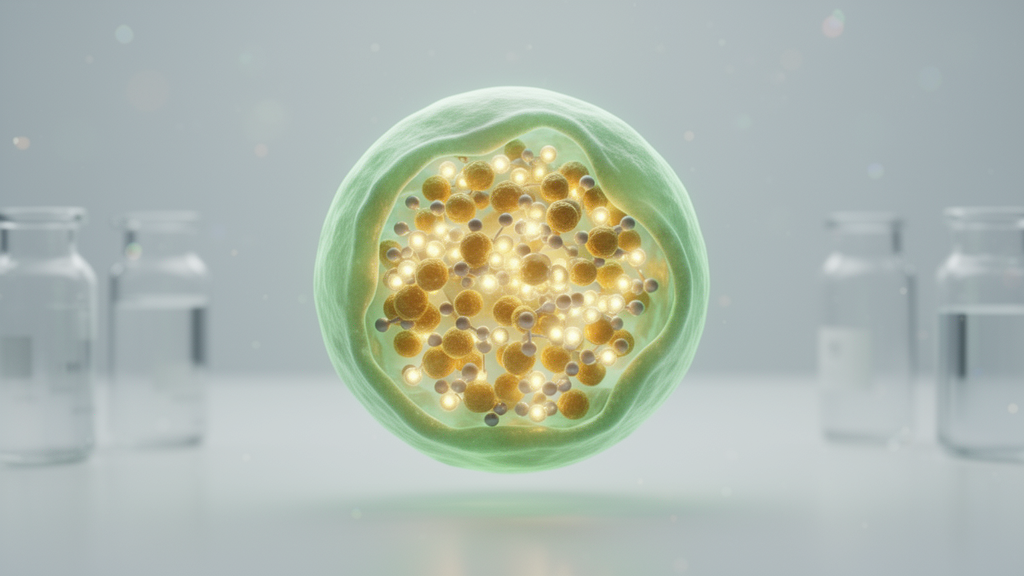
Curcumin, the golden pigment of turmeric, has one stubborn flaw: whenever chemists try to lock it into complexes that might boost its biological activity, the products tend to fall apart. The most fragile of these is rosocyanine, a curcumin-borate complex that has spent more than a century serving mainly as a colorimetric probe for detecting boron in soil, food, and water. Now a research team writing in the journal Bioscience Nanotechnology reports that this inherently unstable molecule can be stabilized inside a sustainable tannic acid-polyvinylpyrrolidone nanocarrier, opening the door to systematic studies of its antioxidant, antimicrobial, and optical properties.
The synthesis itself is deliberately simple and green. Eleven milligrams of curcumin and 26 milligrams of boric acid were dissolved in 95% ethanol and briefly heated in a boiling water bath, turning the solution clear orange as the reaction began. Adding 170 milligrams of tannic acid, an abundant natural polyphenol classified by the U.S. FDA as Generally Recognized as Safe, shifted the color to dark red, signaling completion of the complex. The mixture was then added dropwise to a polyvinylpyrrolidone solution under stirring, allowing the polymer to wrap the aggregate into nanoparticles. Unlike earlier rosocyanine preparations that relied on hazardous solvents such as dichloromethane and sulfuric acid along with time-consuming titrations, this route uses only food-grade-compatible reagents and runs in minutes.
Confirming that rosocyanine had actually formed inside the particles required several independent techniques. Liquid chromatography coupled with time-of-flight mass spectrometry detected a peak at 745.24 m/z, matching the molecular weight of rosocyanine, at a retention time of 10.02 minutes. Boron-11 nuclear magnetic resonance showed peaks consistent with tetrahedral boron in the six-membered bicyclic curcumin-borate complex, alongside signals from boric acid and secondary borate-tannic acid species. Ultraviolet-visible spectroscopy revealed a characteristic absorption peak near 520 nanometers, and fluorescence emission centered around 620 nanometers appeared under 530-nanometer excitation. Notably, the encapsulated complex fluoresced roughly six times more intensely than the free complex, about 110,000 counts per second versus 18,000, because the free molecule leaks and hydrolyzes back to curcumin in water.
The physical architecture of the particles was mapped with electron microscopy and light scattering. Scanning electron micrographs showed predominantly spherical primary particles centered near 50 nanometers for the encapsulated complex and 67 nanometers for the free complex, with the polymer shell apparently slowing particle growth by acting as a hydrogen-bond acceptor. In solution, dynamic light scattering gave hydrodynamic diameters of 218 nanometers for the encapsulated complex, 173 nanometers for the free complex, and 141 nanometers for an encapsulated boric acid control, with zeta potentials of -29, -40, and -38 millivolts respectively. The polydispersity index of 0.36 for the encapsulated product indicated moderate polydispersity with some swelling and aggregation, a limitation the authors acknowledge.
Computational modeling supplied a molecular explanation for why the assembly holds together. Density functional theory calculations at the B97D3/def2TZVP level showed that binding between rosocyanine and tannic acid is dominated by dispersion-driven pi-pi stacking, with centroid spacings of 3.62 angstroms between the stacked polyphenols and a binding energy of -25.6 kilocalories per mole, strong enough to make association thermodynamically favorable in solution. Electron density difference maps revealed accumulation of electron density on the heteroaromatic core of rosocyanine and the adjoining galloyl rings of tannic acid, a signature of parallel stacked geometry.
Molecular dynamics simulations extended this picture over time. In a 300-nanosecond trajectory mimicking the ethanol synthesis step, two of four tannic acid molecules captured the rosocyanine molecule, with center-of-mass separations dropping below 20 and 15 angstroms and aggregation beginning around 130 nanoseconds. The radius of gyration of the aggregate stabilized between 27.48 and 37.16 angstroms, while the solvent-accessible surface area fell from about 11,300 to below 8,500 square angstroms, reflecting expulsion of solvent and a hydrophobic shielding effect. When the aggregate was transferred to water with ten-unit polyvinylpyrrolidone chains for a further 100 nanoseconds, the polymer shell tracked the motion of the core tightly, and pairwise interaction energies showed that Lennard-Jones dispersion forces, not electrostatics, dominate the assembly: van der Waals interactions averaged about -42 kilocalories per mole within the core and -78 kilocalories per mole between the shell and the tannic acid interface.
Encapsulation efficiency was modest but functional. Curcumin loading reached 28%, lower than the 88% reported for similar curcumin nanoparticle protocols, while boron loading was 7.7% for the encapsulated complex, 7.5% for the free complex, and 11% for the encapsulated boric acid control, measured by inductively coupled plasma optical emission spectroscopy. The boron figure corresponds to an excess of boron beyond the 2:1 curcumin-to-boron stoichiometry of rosocyanine, consistent with the tannic acid-borate ester signal seen in the NMR spectrum. Release of curcumin into phosphate-buffered saline was slow and sustained: by day seven, roughly 4.8% had escaped the encapsulated particles compared with about 6.6% from the free complex.
Stability, the central problem this work set out to solve, improved markedly. After four months of storage at -20 degrees Celsius, the absorbance of the encapsulated particles at both 425 and 530 nanometers was unchanged from freshly prepared samples. Over seven days in solution, the encapsulated complex showed a 19% increase in curcumin absorbance in water and 92% in ethanol, versus 31% and 157% for the free complex, indicating slower hydrolysis. In sodium-buffered saline, phosphate-buffered saline, and nutrient broth, the encapsulated formulation held its rosocyanine signature absorbance to within -14%, -23%, and -7% respectively, while degradation was pronounced in ethanol and Luria broth for both formulations. The authors state this is the first report of rosocyanine stabilization via nanocarrier encapsulation.
With a stable platform in hand, the team profiled biological activity. In DPPH and ABTS radical scavenging assays, all nanoparticle formulations, including controls, outperformed free curcumin, showing roughly 20% scavenging at 500 parts per billion, about 30% at 1 part per million, and 70% at 3 parts per million, an effect the authors attribute largely to the tannic acid content, which the Folin-Ciocalteu assay confirmed as elevated total polyphenolic content reaching 466 parts per million gallic acid equivalents at the highest concentration. Against the plant pathogen Xanthomonas perforans, the causal agent of bacterial spot of tomato, the minimum bactericidal concentration was 250 parts per million for the encapsulated complex and 200 for the free complex, with free curcumin inhibiting growth at all tested concentrations. Cytotoxicity testing on human dermal fibroblasts, murine macrophages, and SH-SY5Y neuroblastoma cells showed that encapsulation reduced toxicity: at 27.5 parts per million, fibroblast viability was 42.5% for the encapsulated complex versus 8.9% for the free complex, and both formulations remained largely benign up to about 3.4 parts per million. Under oxidative stress induced by hydrogen peroxide, low sub-part-per-million doses of both formulations raised macrophage viability above baseline, though the peroxide dose alone did not reduce viability in this setup.
The optical behavior of the stabilized complex suggests applications beyond biology. Illuminating a thin film with a 532-nanometer laser wrote a visible zig-zag pattern that persisted under fluorescence microscopy, a proof-of-concept for optical data storage, albeit an irreversible one. Under a solar simulator, both free and encapsulated solutions warmed by roughly 6 and 5 degrees Celsius over three hours compared with about 2 degrees for water, demonstrating photothermal conversion that the authors suggest could, with optimization, position these systems as candidates for photothermal therapy. The complex also changed color across basic pH values from 9 to 14, shifting from red through green, turquoise, blue, violet, and gray, hinting at use as a safer alternative to indicators such as phenolphthalein. The authors caution that these applications remain proofs of concept, that the in vitro cell findings cannot yet be extrapolated to clinical benefit, and that future work will explore photothermal therapy, data storage, and crop health management in depth.
Subject of Research: Stabilization of the curcumin-borate complex rosocyanine using tannic acid-polyvinylpyrrolidone nanoparticles and evaluation of its biological and physicochemical properties
Article Title: Assessment of biological and physicochemical properties of curcumin-borate complexes-loaded nanoparticles
Article References: Mohammad, U., Pereira, J., Banerjee, A., Deinys, M. M., Diracca, G., Lloyd, A., Demosthene, B., Zou, S., Tétard, L., & Santra, S. (2026). Assessment of biological and physicochemical properties of curcumin-borate complexes-loaded nanoparticles. Bioscience Nanotechnology, 2(1), Article 19. https://doi.org/10.1186/s44331-026-00027-5
Image Credits: AI Generated
DOI: 10.1186/s44331-026-00027-5
Keywords: curcumin, rosocyanine, borate complex, nanocarrier, tannic acid, polyvinylpyrrolidone, green nanotechnology, antioxidant, antimicrobial, photothermal conversion, drug delivery, molecular dynamics
News Source: Gregory Coleman. (October 29, 2026). Turmeric-Boron Complex Stabilized in Green Nanocarrier for First Time. Scienmag.