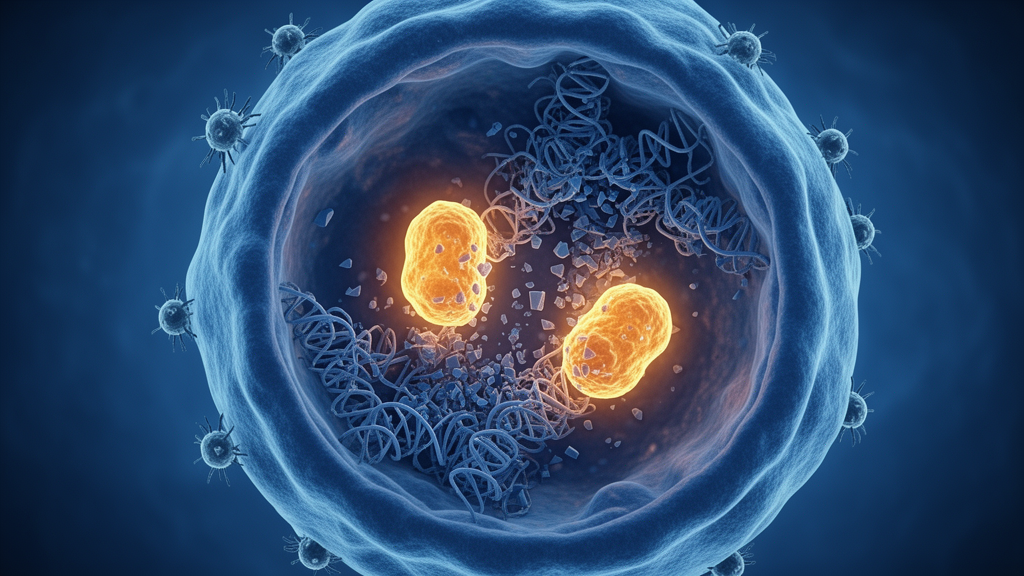
Two relatively obscure enzymes that help cells copy their DNA without catastrophe are stepping into the spotlight of cancer research. A new pan-cancer analysis published in Cell Death Discovery has mapped, across 33 tumor types, the behavior of tousled-like kinases 1 and 2, known as TLK1 and TLK2, and concluded that these evolutionarily conserved serine/threonine kinases are far more than housekeeping proteins. They appear to shape how tumors accumulate mutations, how they repair damaged DNA, and, strikingly, how they sculpt the immune landscape around themselves to avoid destruction. The work, led by Fushu Luo and Changwu Wu of Xiangya Hospital at Central South University together with colleagues at Hunan Cancer Hospital, positions the two kinases simultaneously as prognostic biomarkers and as candidate drug targets in precision oncology.
The tousled-like kinases take their name from the tousled phenotype observed in mutant Arabidopsis plants, and they have long been known to participate in DNA replication, chromatin assembly, and the cellular response to DNA damage. What remained unclear was how their molecular profiles vary across the full spectrum of human cancers and whether that variation carries clinical weight. To answer this, the research team integrated multi-omics data from The Cancer Genome Atlas, or TCGA, and the Genotype-Tissue Expression project, GTEx, covering 33 distinct cancer types. This design allowed them to compare tumor expression against matched normal tissue, track genetic alterations, and correlate kinase activity signatures with survival, genomic instability metrics, and immune infiltration patterns in a single coherent framework.
The first major finding is that TLK1 and TLK2, despite their close family relationship, behave very differently depending on the cancer. Their expression patterns diverge across tumor types, and their association with patient prognosis is cancer-type-specific rather than universal. This distinction matters because it cautions against treating the pair as interchangeable. Genetic alterations in both genes were frequently observed across the cohort, and those alterations correlated significantly with multiple canonical markers of genomic instability, including tumor mutation burden, microsatellite instability, and homologous recombination deficiency. In practical terms, tumors leaning on TLK signaling appear to be the ones tolerating, and perhaps accumulating, the kind of DNA-level chaos that drives malignancy and shapes treatment response.
Correlation alone rarely settles a biological question, so the team turned to functional experiments in cancer cell lines. When the researchers knocked down TLK1 or TLK2, the consequences were immediate and severe: DNA damage rose markedly, cellular proliferation faltered, and the cells underwent apoptosis. Interestingly, the two kinases were not redundant. TLK2 exhibited a more prominent role in DNA repair processes, suggesting that it carries a disproportionate share of the genome-maintenance workload. This kind of mechanistic separation is exactly what drug developers look for, because it implies that inhibitors could be tuned to disrupt repair machinery in tumors that depend on it most, a strategy already validated by the clinical success of PARP inhibitors in homologous recombination-deficient cancers.
Perhaps the most provocative portion of the study concerns the tumor microenvironment. TLK1 and TLK2 expression were both negatively correlated with immune and stromal scores, a pattern typically seen in tumors that keep immune cells at arm’s length. Digging deeper with computational deconvolution of immune cell composition, the researchers found that kinase expression was positively associated with resting CD4-positive T cells and macrophages but negatively associated with CD8-positive T cells and activated natural killer cells, the two cell populations most responsible for killing tumor cells. In other words, high TLK signaling coincided with an immune infiltrate that looks present but disarmed, dominated by bystander and suppressive populations rather than cytotoxic effectors.
Additional functional immune analyses sharpened this picture in an unexpected way. TLK1 and TLK2 expression correlated positively with immune exclusion signatures and with infiltration by myeloid-derived suppressor cells, or MDSCs, but not with the classical markers of T-cell exhaustion that have dominated immunotherapy research for the past decade. This is a meaningful distinction. Exhausted T cells are present in the tumor but functionally worn out, and checkpoint inhibitors can sometimes revive them. Excluded T cells, by contrast, never reach the tumor in force. The implication is that TLK-high tumors may resist immunotherapy not by tiring out their attackers but by building a physical and cellular barrier that keeps those attackers outside, with MDSCs acting as gatekeepers.
To confirm that these computational associations reflect real biology, the team performed multiplex immunohistochemistry on colorectal cancer tissue, and the results resolved the two kinases into strikingly divergent phenotypes. Tumors with high TLK1 showed reduced T cell infiltration, consistent with the immune exclusion signature seen in the pan-cancer data. Tumors with high TLK2 told a different story: they were enriched for regulatory T cells, the Tregs that actively suppress antitumor immunity, and showed upregulation of CD39, an ectoenzyme that degrades extracellular ATP into immunosuppressive adenosine. TLK1-high tumors, in short, wall out the immune system, while TLK2-high tumors invite in cells that shut it down. Two kinases, two distinct mechanisms of immune evasion.
The clinical payoff of this work lies in prediction. The authors report that TLK1 and TLK2 expression demonstrated predictive utility for responses to chemotherapy and immunotherapy across several malignancies. If validated prospectively, a simple measurement of kinase expression could help oncologists decide which patients are likely to benefit from checkpoint blockade and which might do better with alternative regimens, or with combinations designed to overcome the specific immune barrier a tumor has built. For TLK2-high tumors with Treg enrichment and CD39 upregulation, for example, pairing a TLK inhibitor with agents targeting adenosine signaling or Treg depletion becomes a testable, mechanistically grounded hypothesis.
None of this means a TLK-targeted drug is imminent. Kinase inhibitors must clear formidable hurdles of selectivity, and the functional experiments here were conducted in cell lines rather than in patients, so the causal chain from kinase inhibition to immune reactivation in living tumors remains to be demonstrated. The study is also, at its core, an observational atlas: it establishes robust associations across thousands of tumors and supports them with mechanistic experiments, but it does not yet show that blocking TLK1 or TLK2 in humans improves outcomes. What it does provide is a comprehensive, multi-omics rationale for pursuing those experiments, complete with biomarker hypotheses that can be tested in existing trial cohorts and tissue archives.
Still, the broader message is hard to ignore. Genomic instability and immune evasion are usually studied as separate chapters of cancer biology, yet this analysis ties them together through a single pair of DNA-repair kinases whose overexpression appears to let tumors both accumulate mutations and hide the resulting neoantigens from cytotoxic lymphocytes. As sequencing of tumors becomes routine and pan-cancer datasets grow, enzymes like TLK1 and TLK2 that sit at the junction of these processes are likely to attract increasing attention from translational researchers. For now, the tousled-like kinases have earned a place on the shortlist of targets that could link the integrity of the genome to the visibility of the tumor, and that link may prove to be one of the more consequential therapeutic openings in precision oncology.
Subject of Research: Pan-cancer roles of the TLK1 and TLK2 kinases in genomic instability, DNA repair, and tumor immune modulation
Article Title: A pan-cancer analysis of TLK1 and TLK2: genomic instability, immunomodulation, and therapeutic implications
Article References: Luo, F., Tan, J., Liu, Q., Wei, L., Liu, P., & Wu, C. (2026). A pan-cancer analysis of TLK1 and TLK2: genomic instability, immunomodulation, and therapeutic implications. Cell Death Discovery. https://doi.org/10.1038/s41420-026-03290-w
Image Credits: AI Generated
DOI: 10.1038/s41420-026-03290-w
Keywords: TLK1, TLK2, tousled-like kinases, pan-cancer analysis, genomic instability, DNA damage response, tumor microenvironment, immune exclusion, myeloid-derived suppressor cells, regulatory T cells, immunotherapy biomarkers, precision oncology
News Source: Nathaniel Bowman. (October 9, 2026). Tousled-Like Kinases TLK1 and TLK2 Emerge as Pan-Cancer Drivers of Genomic Instability and Immune Evasion. Scienmag.