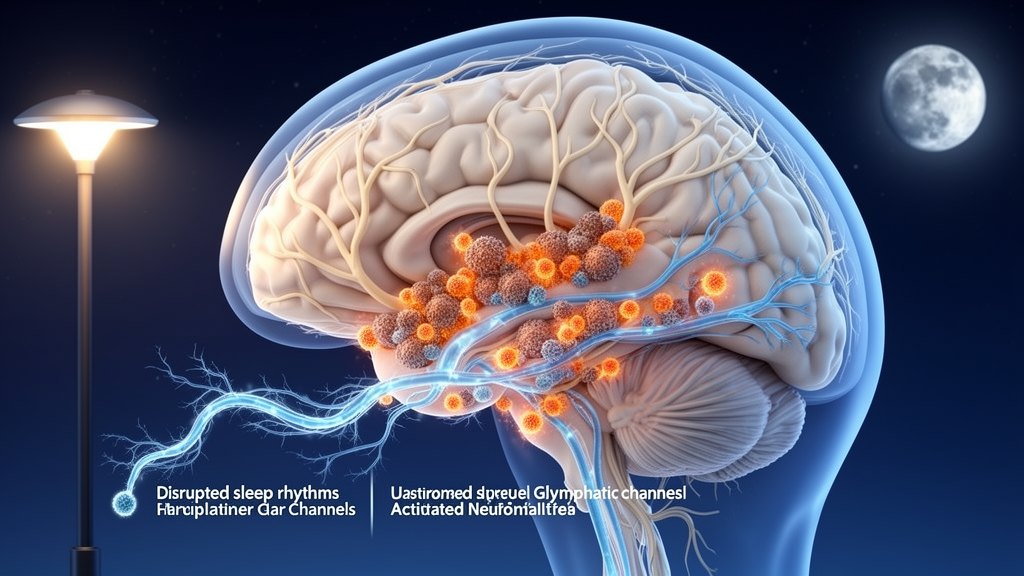
A conceptual review proposes that neurodegenerative disease may involve a collapse of biological timing across the brain, linking disruption of the molecular circadian clock with persistent neuroinflammation and impaired glymphatic clearance. The review, published in Molecular Biology Reports , synthesizes translational and in-vivo studies to describe a bidirectional relationship among these systems. It is not a new clinical study or an intervention trial, and the proposed feedback cycle is presented as a framework for further investigation rather than as a demonstrated mechanism in patients.
Under physiological conditions, the review says intrinsic circadian machinery helps maintain microglia in a relatively quiescent, surveillant state. In this model, molecular timing influences immune-cell behavior and the movement of cerebrospinal fluid and interstitial fluid, while the glymphatic system participates in clearing substances from neural tissue. The proposed connection is therefore broader than a single pathway: clock activity helps coordinate neuroimmunity and fluid clearance, and pathological changes in either system may feed back into the other.
The authors focus on what may happen when this temporal coordination is lost through aging or sleep fragmentation. Loss of circadian gating may promote a hyper-reactive microglial phenotype and sustained release of pro-inflammatory cytokines. Those inflammatory mediators may disrupt astrocytic anchoring complexes and contribute to depolarization of aquaporin-4 channels.
Reduced polarization could, in turn, impair cerebrospinal fluid–interstitial fluid exchange, potentially contributing to the accumulation of neurotoxic aggregates such as amyloid-beta and tau. The review frames this sequence as a possible self-reinforcing process rather than a conclusively established causal chain. Accumulated proteins and inflammatory mediators may also feed back to suppress core clock-gene expression across neural networks, weakening the timing signals that normally help regulate immune reactivity and glymphatic function.
This network perspective shifts attention from localized cellular damage toward the collapse of timing across interacting systems. Circadian dysfunction can influence glial behavior and glymphatic dynamics, while inflammation and protein accumulation may alter clock activity in return. The concept does not establish that disrupted timing is the sole cause of neurodegeneration, nor does it demonstrate that restoring sleep timing alone would prevent disease.
Rather, it identifies a set of reciprocal relationships that may connect molecular clock failure, chronic neuroinflammation, reduced clearance and the accumulation of pathological proteins. The review highlights melatonin as a possible multi-target “resynchronizer” and argues for chronotherapeutic interventions in neurodegenerative disease. Melatonin is proposed as a compound that might modulate molecular clocks, reduce microglial reactivity and support sleep-dependent glymphatic clearance.
The supplied evidence does not show that melatonin slows neurodegenerative progression in patients, and the review does not establish it as a clinical treatment. As a conceptual synthesis, the review’s main contribution is to connect chronobiology, neuroimmunity and glymphatic biology into a testable model of neurodegeneration as a network-wide disruption of biological timing.
Subject of Research: A conceptual review of circadian timing, neuroinflammation and glymphatic dysfunction in neurodegenerative disease
Article Title: The interplay between chronobiology, neuroinflammation, and the glymphatic system in neurodegenerative diseases
Article References: Akar, A., Erbil, G., Aykora, D., & Uzun, M. (2026). The interplay between chronobiology, neuroinflammation, and the glymphatic system in neurodegenerative diseases. Molecular Biology Reports, 53(1), Article 1481. https://doi.org/10.1007/s11033-026-12670-5
Image Credits: AI Generated
DOI: 10.1007/s11033-026-12670-5
Keywords: chronobiology, circadian rhythms, neuroinflammation, glymphatic system, neurodegeneration, microglia, aquaporin-4, molecular clock, sleep fragmentation, melatonin, interplay, between
News Source: Cassandra Pierce. (October 25, 2026). The interplay between chronobiology, neuroinflammation, and the glymphatic system in neurodegenerative diseases. Scienmag.