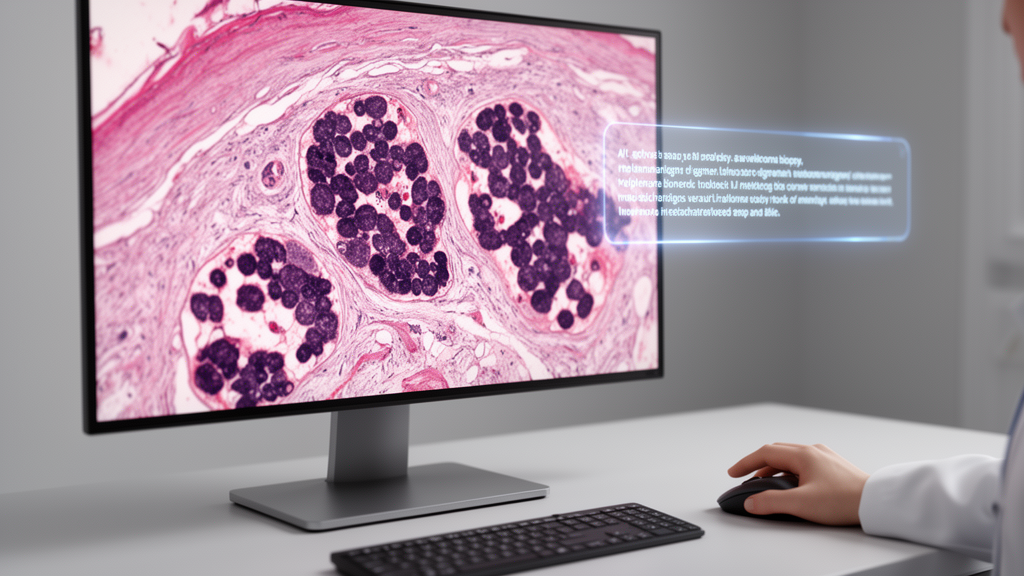
Researchers have developed a new artificial intelligence method, called TedMIL, that combines text-based guidance with image analysis to classify melanoma more precisely from whole slide images, including prediction of fluorescence in situ hybridization (FISH) status.
The method, described in Diagnostic Pathology, is a text-driven form of multiple instance learning (MIL), a machine learning approach widely used for analyzing whole slide images in pathology. According to the authors, existing MIL methods rely on visual features alone, which they say leaves the models without macroscopic prior-driven guidance and limits their ability to capture the intrinsic representations of melanoma.
TedMIL addresses this with two components. The first, Text Injected Re-embedding (TIR), re-embeds the feature representations used by the MIL framework by injecting macroscopic semantic information into morphological features. This step draws on pathological priors, large language models, and gated feature fusion.
The second component, Text-Image Matching (TIM), refines the final class output probabilities through a cross-modal affinity quantification mechanism based on normalized feature space distance.
In the reported melanoma identification task, TedMIL achieved an area under the curve (AUC) of 97.9% and an accuracy of 93.4% on the test set, which the authors describe as demonstrating impressive discriminative capability.
On the more demanding fine-grained three-class classification task, the model improved accuracy by 2.8 percentage points, AUC by 2.2 percentage points, and F1-score by 3.0 percentage points compared with state-of-the-art MIL baselines, according to the paper.
Qualitative visualizations reported in the study further suggest that text guidance leads to more spatially coherent attention patterns that better align with diagnostically relevant morphological regions, offering a possible explanation for the performance gains.
The authors conclude that the proposed text-driven MIL could realize more intrinsic pathological representations and achieve efficient fine-grained classification of melanoma. The work was published as an open access article on 28 September 2026, and the data were accessed for research purposes between 25 October 2025 and 24 October 2026 in accordance with the approved study protocol.
Subject of Research: A text-driven multiple instance learning model for fine-grained melanoma classification and FISH status prediction from whole slide images.
Article Title: TedMIL: Text-Driven Multiple Instance Learning for Fine-Grained Pathological Classification with Melanoma-FISH Status Prediction
Article References: He, Q., Peng, J., Song, X., Fan, J., Song, Z., Zhang, Y., Guan, T., Fu, F., He, Y., & Su, J. (2026). TedMIL: Text-Driven Multiple Instance Learning for Fine-Grained Pathological Classification with Melanoma-FISH Status Prediction. Diagnostic Pathology. https://doi.org/10.1186/s13000-026-01831-6
Image Credits: AI Generated
DOI: 10.1186/s13000-026-01831-6
Keywords: TedMIL, multiple instance learning, melanoma, whole slide images, FISH, computational pathology, text-image matching, fine-grained classification, AUC, Diagnostic Pathology, Text-Driven, Multiple
News Source: Nathaniel Bowman. (October 29, 2026). Text-guided AI model sharpens melanoma classification from whole slide images. Scienmag.