• HOME
  • NEWS
  • EXPLORE
    • CAREER
      • Companies
      • Jobs
    • EVENTS
    • iGEM
      • News
      • Team
    • PHOTOS
    • VIDEO
    • WIKI
  • BLOG
  • COMMUNITY
    • FACEBOOK
    • INSTAGRAM
    • TWITTER
Thursday, June 25, 2026
BIOENGINEER.ORG
No Result
View All Result
  • Login
  • HOME
  • NEWS
  • EXPLORE
    • CAREER
      • Companies
      • Jobs
        • Lecturer
        • PhD Studentship
        • Postdoc
        • Research Assistant
    • EVENTS
    • iGEM
      • News
      • Team
    • PHOTOS
    • VIDEO
    • WIKI
  • BLOG
  • COMMUNITY
    • FACEBOOK
    • INSTAGRAM
    • TWITTER
  • HOME
  • NEWS
  • EXPLORE
    • CAREER
      • Companies
      • Jobs
        • Lecturer
        • PhD Studentship
        • Postdoc
        • Research Assistant
    • EVENTS
    • iGEM
      • News
      • Team
    • PHOTOS
    • VIDEO
    • WIKI
  • BLOG
  • COMMUNITY
    • FACEBOOK
    • INSTAGRAM
    • TWITTER
No Result
View All Result
Bioengineer.org
No Result
View All Result
Home NEWS Science News Chemistry

Test center to bring tidal technology on stream at high speed

Bioengineer by Bioengineer
March 19, 2019
in Chemistry
Reading Time: 3 mins read
0
IMAGE
Share on FacebookShare on TwitterShare on LinkedinShare on RedditShare on Telegram

IMAGE

Credit: Fergus Cuthill

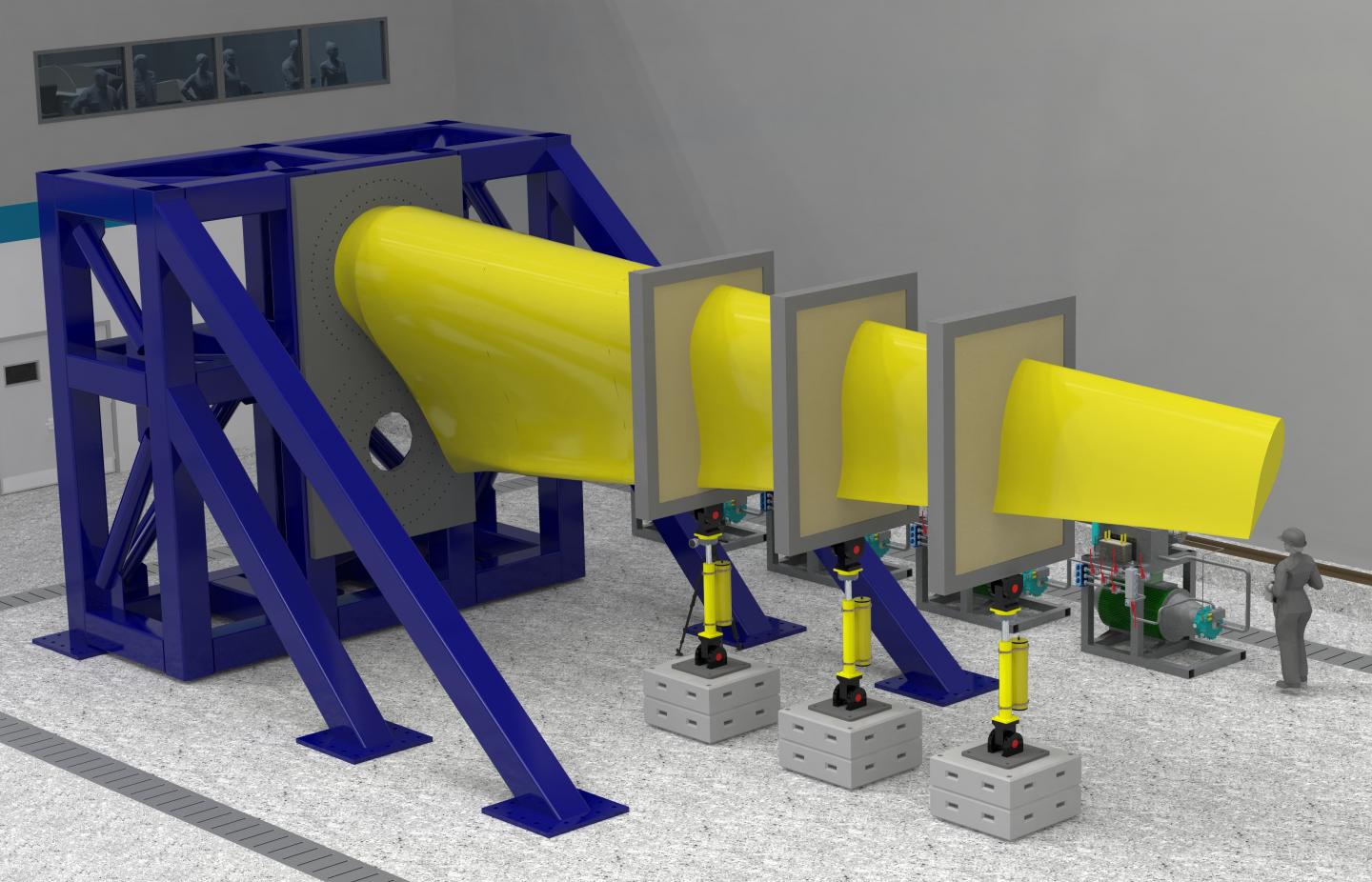
A £2.4 million engineering research facility will seek to speed the development of materials and structures for tidal energy, transport and other industries.

The FASTBLADE facility will test new materials within full scale structures such as tidal blades, plane components and bridge sections.

It will be built by the University of Edinburgh and commercial partner Babcock International at Rosyth in Fife, Scotland.

FASTBLADE will be the first facility in the world designed to carry out large-scale accelerated testing of tidal blades. Testing will use complex forces that simulate real environments, limiting the risks for product developers.

Engineering researchers will use an efficient hydraulic technology – developed by University spin-off company Artemis Intelligent Power – which enables structures to be tested significantly faster and using less energy compared with existing technologies. The system will recover energy between load cycles, reducing the cost of testing.

FASTBLADE’s first clients will include tidal stream developers. Tidal blades made of composite materials need to be designed to withstand high fatigue loads in harsh ocean conditions for up to 20 years.

Pioneering measurement systems will enable developers to learn from test datasets to understand damage accumulation and optimise blade structures through data-driven design.

FASTBLADE will help fulfil the University’s commitments as part of the Edinburgh and South East Scotland City Region Deal, which includes targets to help improve digital skills across the whole of the region.

The facility has received £1.4m from the Engineering and Physical Sciences Research Council and £1m from the University of Edinburgh. Babcock is the principal designer and host of the facility.

FASTBLADE is a key strand of a strategic partnership between Babcock and the University, developed with Edinburgh Innovations, the University’s commercialisation service.

Professor Conchúr Ó Brádaigh, Head of School of Engineering at the University of Edinburgh, and leader of the research activity, said: “This collaboration is an opportunity to develop a world-class engineering facility to accelerate and support the development of new efficient technologies, and will be a great benefit to the tidal energy sector.”

Neil Young, a Technology Director within Babcock, has been involved from the project’s concept. He said: “When the University approached us, they were looking for specialist facilities and engineering design expertise to help get the project from research application to reality. At Babcock’s facility in Rosyth, we had both these key requirements, which were not available anywhere else in a single location. We’ve worked in close partnership with the University to optimise the design of the reaction frame which the composite structure is mounted to. The design also included upgrading the foundation design in the building to accommodate the additional loads imposed by the fatigue testing.

“For us, this really is a great industrial partnership. Our engineers working alongside the University’s renowned academics has shown what the art of the possible is, in engineering and in working together. Whilst we are still at the early stages of development I know we are creating something that isn’t just a great opportunity for us, it will have real benefit for all the companies using the facility in years to come.”

###

Media Contact
Catriona Kelly
[email protected]

Original Source

https://www.ed.ac.uk/news/2019/test-centre-to-bring-tidal-technology-on-stream

Tags: Civil EngineeringEnergy SourcesIndustrial Engineering/ChemistryMaterialsResearch/DevelopmentTechnology/Engineering/Computer Science
Share12Tweet8Share2ShareShareShare2

Related Posts

International Team Including Dresden Scientists Develops Novel Designer Proteins for Advanced Study of Living Tissue

June 25, 2026

New Study Uncovers Key Factors Driving Water Chemistry in Nanoscale Environments

June 25, 2026

Plasma Technology Extends Catalyst Lifespan in Hydrogen Production

June 24, 2026

Electric Field and Oxygen Spillover Collaborate to Control Electrode Migration in SOECs

June 24, 2026
Please login to join discussion

POPULAR NEWS

  • Saying Goodbye to PGY-6: Pediatric Fellowship Realities

    103 shares
    Share 41 Tweet 26
  • Multi-Hospital Study Reveals Long Covid Burden Is Twice as High as Current Estimates

    92 shares
    Share 36 Tweet 23
  • Detection of EDCs in Breast Milk and Infant Urine Up to Six Months Highlights Early Exposure Risks

    77 shares
    Share 31 Tweet 19
  • New Drug Candidate Developed at McMaster Shows Potential for Treating Brain Cancer

    58 shares
    Share 23 Tweet 15

About

We bring you the latest biotechnology news from best research centers and universities around the world. Check our website.

Follow us

Recent News

Energy-Saving Membrane Technology Developed by KAIST and Georgia Tech Enables Crude Oil Separation Without Boiling

Cracking the Code: How Cancer Evades Antibody-Drug Conjugates and New Strategies to Overcome Resistance

Chiral Laser Gyroscopes Surpass Lock-In Limit

Subscribe to Blog via Email

Enter your email address to subscribe to this blog and receive notifications of new posts by email.

Join 82 other subscribers
  • Contact Us

Bioengineer.org © Copyright 2023 All Rights Reserved.

Welcome Back!

Login to your account below

Forgotten Password?

Retrieve your password

Please enter your username or email address to reset your password.

Log In
No Result
View All Result
  • Homepages
    • Home Page 1
    • Home Page 2
  • News
  • National
  • Business
  • Health
  • Lifestyle
  • Science

Bioengineer.org © Copyright 2023 All Rights Reserved.