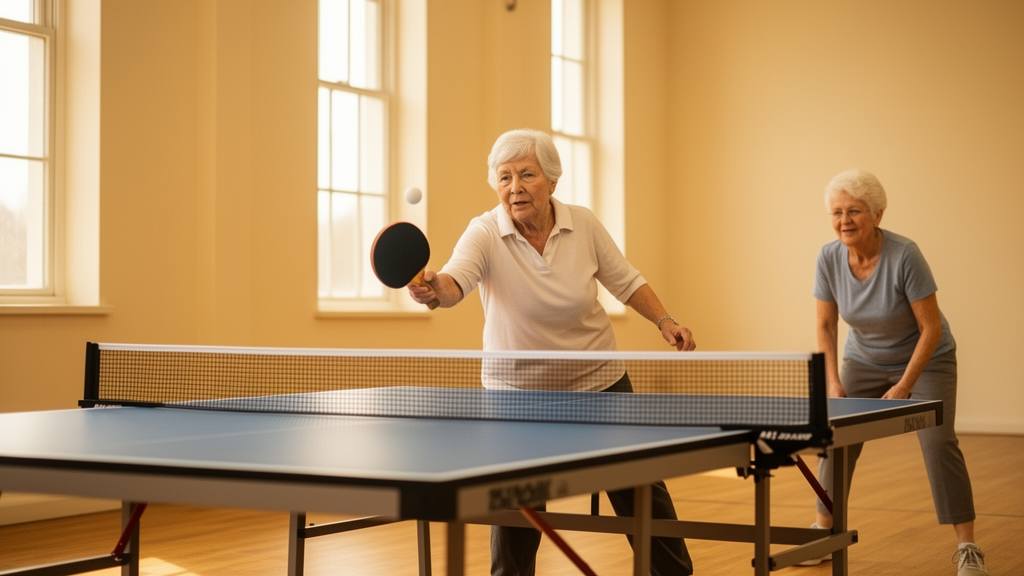
Table tennis has emerged as the top-ranked open-skill sport for cognitive health promotion and community implementation among older adults, according to a multi-criteria decision analysis published in Discover Aging. The study, led by Takao Yamasaki and colleagues including Shuzo Kumagai, evaluated eight open-skill exercises—tennis, table tennis, badminton, basketball, volleyball, soccer, baseball, and non-combat judo—using a structured framework designed to compare sports that are rarely assessed side by side. Soccer ranked second, driven by high physical intensity and strong social interaction, while badminton came third with a balanced cognitive–physical profile.
Open-skill exercise refers to sport-based physical activity performed in externally paced, unpredictable environments that require continuous perceptual–motor adaptation. Unlike closed-skill activities such as walking or stationary cycling, open-skill sports demand ongoing processing of environmental cues, dynamic decision-making, attentional switching, and visuomotor integration. The authors argue that these features may stimulate frontal–parietal, cerebellar, and sensorimotor networks more extensively, potentially supporting executive function, visuospatial processing, and processing speed in aging populations. Yet despite growing interest, systematic comparisons across different open-skill sports have remained scarce, with most studies focusing on a single sport or training protocol.
To fill that gap, the team first drew on an established classification identifying fourteen sports with a high degree of open-skill character, then refined the list using three predefined criteria: global or regional participation, feasibility of community-level implementation among older adults, and available evidence on safety, accessibility, and cognitive benefits. Korfball, wushu, American football, fencing, hockey, and handball were excluded on those grounds. For martial arts, the scope was restricted to non-combat judo, defined as kata and structured training without competitive sparring, which has shown greater adaptability and safety for older adults. Eight sports were retained for full evaluation.
The analytical core of the study is a composite cognitive demand metric built from two components. Cognitive breadth counts how many of six core cognitive domains are engaged during active play, spanning perceptual–attentional control, processing speed and reactive adaptation, executive and strategic control, visuospatial awareness and anticipation, decision-making and tactical reasoning, and multitasking and cognitive flexibility. Decision intensity measures the frequency of discrete decision-making events per minute during active play, including both on-ball and off-ball situations. Both components were normalized using min–max scaling and combined multiplicatively, a formulation chosen because it limits the extent to which a high value in one dimension can offset a low value in the other.
Each sport was scored on eight criteria organized into four domains: intrinsic features (cognitive demand, physical demand, safety, and social interaction), implementation feasibility (facility and cost demand, and instructional and operational demand), sustainability and attractiveness, and applicability to virtual reality and e-sports environments. Physical demand was represented by normalized metabolic equivalent values from the Compendium of Physical Activities, while safety drew on sport-specific injury incidence data from nationally standardized surveys in Japan, as no globally comparable multi-sport dataset was available. Reflecting the study’s focus on dementia prevention, cognitive demand received a weight of 1.5 and physical demand 1.2, with all other criteria weighted at 1.0. The weighting scheme and scoring were developed through iterative discussions among the co-authors and confirmed by unanimous agreement.
The results revealed substantial heterogeneity. Table tennis recorded the highest composite cognitive demand at 0.769, followed by badminton at 0.591, with soccer, tennis, and volleyball forming an intermediate group and basketball lower at 0.141 despite high cognitive breadth. Baseball and non-combat judo showed near-minimum values, driven primarily by extremely low decision intensity. On the physical side, soccer topped the metabolic scale, followed by badminton and basketball, while table tennis and baseball registered the lowest values. Safety scores were highest for non-combat judo and table tennis, and social interaction was greatest in soccer, followed by basketball, volleyball, and baseball. Notably, cognitive and physical demands showed only partial correspondence across sports, underscoring the authors’ argument that single-domain metrics are insufficient.
Under the predefined weighting scheme, table tennis achieved the highest overall composite score at 6.033, followed by soccer at 5.195 and badminton at 4.626. Basketball and volleyball formed an intermediate group at 4.489 and 4.407 respectively, while tennis scored 3.708, non-combat judo 2.551, and baseball 1.519. The authors caution that these figures are relative indices rather than absolute measures of suitability, since the weights were not normalized to sum to one. Differences among several mid-ranked sports were small, indicating broadly comparable profiles rather than a strict hierarchy. Table tennis stood out for its favorable balance across cognitive, safety, feasibility, sustainability, and digital domains while maintaining relatively low physical demand, whereas soccer’s high ranking rested mainly on physical intensity and social interaction.
Sensitivity analyses tested the robustness of the ranking across alternative modeling assumptions, including different normalization constants, multiplicative versus additive formulations of cognitive demand, and weighted versus unweighted aggregation. Across all scenarios, table tennis consistently ranked first and soccer second, while tennis, non-combat judo, and baseball held fixed positions from sixth to eighth. Only minor shifts occurred among the intermediate sports of badminton, basketball, and volleyball, and these did not alter the overall ranking structure. The authors interpret this stability as evidence that the results are not driven by specific modeling choices.
The study carries important limitations. Cognitive breadth and decision intensity estimates were derived from published match analyses and conceptual synthesis, which may limit generalizability across populations, skill levels, and modified formats. Several criteria reflected standard or adult-level play and did not explicitly account for age-adapted versions such as walking soccer or reduced-court tennis, which may substantially alter decision frequency, physical intensity, and injury risk. Safety estimates came from country-specific Japanese data, and injury risk for non-combat judo was conservatively approximated as roughly an order of magnitude lower than competitive judo. Social interaction and feasibility measures relied on structured ordinal scales, and the weighting scheme represents one of several plausible approaches. The literature searches supporting criterion operationalization were explicitly not intended as a formal systematic review or meta-analysis.
Despite these caveats, the authors argue the findings support a shift away from one-size-fits-all exercise prescriptions toward diversified, context-sensitive strategies. Offering a portfolio that combines cognitively demanding racket sports, physically intensive team activities, and lower-intensity accessible formats may maximize reach and adherence across heterogeneous aging populations, they suggest, particularly in addressing the interconnected domains of cognitive, physical, and social frailty. Digital applicability also varied: table tennis, basketball, and baseball showed the highest potential for virtual reality and e-sports adaptation, while non-combat judo showed minimal digital replicability, pointing to hybrid digital–physical paradigms as complementary rather than replacement options. The team calls for future research on age-adapted sport formats, longitudinal intervention studies comparing high- and low-cognitive-demand sports, and pragmatic implementation research evaluating cost-effectiveness and scalability in real-world community settings.
Subject of Research: Multi-criteria decision analysis ranking eight open-skill sports for cognitive health promotion in older adults
Article Title: A multi-criteria decision analysis of open-skill exercise-based sports for cognitive health promotion in older adults
Article References: Yamasaki, T., Hamaguchi, K., Ikeda, T., Hiraoka, S., & Kumagai, S. (2026). A multi-criteria decision analysis of open-skill exercise-based sports for cognitive health promotion in older adults. Discover Aging, 1(1), Article 3. https://doi.org/10.1007/s44518-026-00003-4
Image Credits: AI Generated
DOI: 10.1007/s44518-026-00003-4
Keywords: open-skill exercise, table tennis, cognitive health, older adults, dementia prevention, multi-criteria decision analysis, physical activity, aging, badminton, soccer, frailty, community implementation
News Source: Beatrice Stafford. (October 29, 2026). Table Tennis Tops Ranking of Open-Skill Sports for Aging Brains. Scienmag.