• HOME
  • NEWS
  • EXPLORE
    • CAREER
      • Companies
      • Jobs
    • EVENTS
    • iGEM
      • News
      • Team
    • PHOTOS
    • VIDEO
    • WIKI
  • BLOG
  • COMMUNITY
    • FACEBOOK
    • INSTAGRAM
    • TWITTER
Tuesday, July 7, 2026
BIOENGINEER.ORG
No Result
View All Result
  • Login
  • HOME
  • NEWS
  • EXPLORE
    • CAREER
      • Companies
      • Jobs
        • Lecturer
        • PhD Studentship
        • Postdoc
        • Research Assistant
    • EVENTS
    • iGEM
      • News
      • Team
    • PHOTOS
    • VIDEO
    • WIKI
  • BLOG
  • COMMUNITY
    • FACEBOOK
    • INSTAGRAM
    • TWITTER
  • HOME
  • NEWS
  • EXPLORE
    • CAREER
      • Companies
      • Jobs
        • Lecturer
        • PhD Studentship
        • Postdoc
        • Research Assistant
    • EVENTS
    • iGEM
      • News
      • Team
    • PHOTOS
    • VIDEO
    • WIKI
  • BLOG
  • COMMUNITY
    • FACEBOOK
    • INSTAGRAM
    • TWITTER
No Result
View All Result
Bioengineer.org
No Result
View All Result
Home NEWS Science News Biology

Sustainable light sources: LEDs from bacterial production

Bioengineer by Bioengineer
February 25, 2020
in Biology
Reading Time: 3 mins read
0
IMAGE
Share on FacebookShare on TwitterShare on LinkedinShare on RedditShare on Telegram

IMAGE

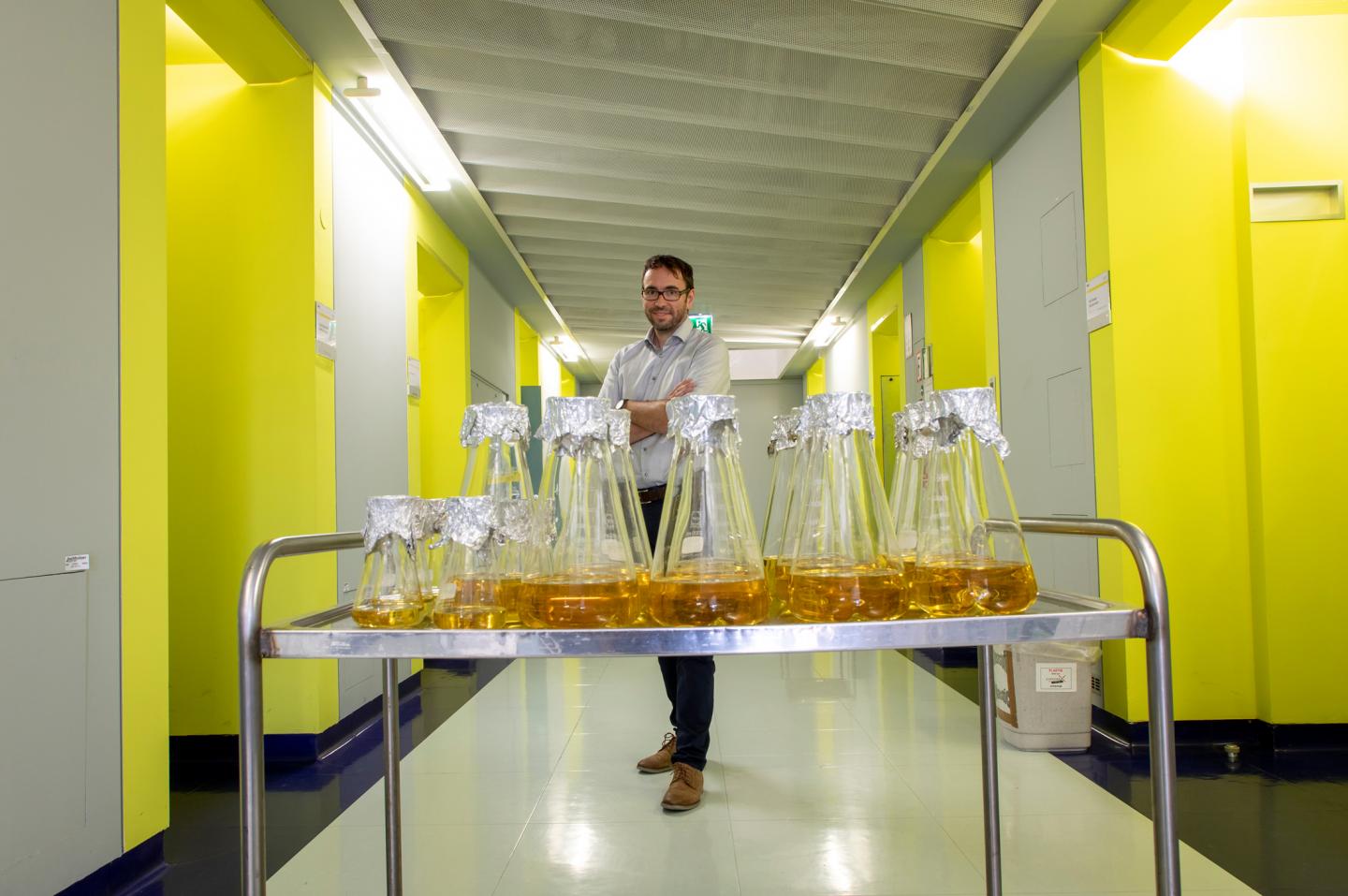
Credit: © Lunghammer – TU Graz

The basis for this vision is being laid at the Institute of Biochemistry at Graz University of Technology, where Gustav Oberdorfer and his team are designing proteins with the help of simulation software. “For this project, we’re analysing fluorescent protein structures from nature and testing how we need to modify them so that they bind different fluorescent organic molecules,” explains Oberdorfer. LEDs emit short-wave blue light which is then absorbed by a layer of inorganic lighting materials and converted into light of longer wavelength. The entire spectrum then results in the white light as we perceive it.

Oberdorfer developed the idea for the project together with cooperation partners from Spain and Italy who worked on the topic independently of each other and were able to achieve promising success.

Environmentally friendly LED coating

Rubén Costa from the Madrid Institute for Advanced Studies (IMDEA) developed a stable organic LED coating as an alternative to conventional LED coatings, which usually consist of problematic rare earth minerals. The mixture consists of organic polymers in which he and his team managed to embed fluorescent proteins. These fluorescent proteins are found in marine organisms and are used by them as a light source for hunting, communication and self-protection. The luminosity that can be achieved with such devices is however still too low to use them in lamps that illuminate entire rooms.

Organic dyes with good light emitting efficiency

Researchers of the Department of Chemistry at the University of Turin led by Claudia Barolo are in turn dealing with the synthesis of organic dyes that have a good light emitting efficiency and are used in organic light-emitting diodes (OLEDs). However, many of these dyes are costly and complex to synthesize. As part of the FET Open project, Barolo and her team are now looking for a suitable dye that can be produced with minimal effort and that can be modified so that it can be incorporated into proteins as an artificial amino acid.

FET Open project ENABLED combines the best of all the sub-sectors

The FET Open project ENABLED now brings together the successes of all groups. The goal is to use bacteria to develop completely new artificial fluorescent proteins. To this end, the Graz biochemists first simulate thousands of different hypothetical proteins that are to bind specifically to the synthetic dyes. A handful of these proteins – namely those closest to the structure of naturally fluorescent proteins – are then ordered as synthetic DNA constructs. The next step is to investigate whether these proteins really bind the dyes for which they were designed. As soon as this is confirmed, these new, artificial fluorescent proteins will be integrated into the polymer matrix and tested for their suitability with regard to bio-LEDs.

“The plan is that we will ‘harvest’ the proteins from the bacterial cell; in other words, we will be able to grow some part of the light sources,” said Oberdorfer, hoping for a proof of principle at the end of the project in four years’ time.

###

Cooperation partners:

CIC biomaGUNE – Centro de Investigación Cooperativa en Biomateriales (Spain)

IMDEA Materials Institute (Spain)

TU Graz, Institute of Biochemistry (Austria)

University of Oviedo (Spain)

University of Turin (Italy)

The ENABLED research project is part of TU Graz’s Field of Expertise “Human & Biotechnology”, one of five research foci of Graz University of Technology. It is funded by the FETopen research funding programme under the EU Horizon2020 programme to the amount of approx. 2.6 million euros. FET Open is reserved for unconventional, new research ideas at an early stage which aim at breakthroughs for new technologies.

Media Contact
Gustav Oberdorfer
[email protected]
43-316-873-6462

Original Source

https://www.tugraz.at/en/tu-graz/services/news-stories/media-service/singleview/article/nachhaltige-leuchtmittel-leds-aus-bakterieller-produktion0/

Tags: BiochemistryBiomedical/Environmental/Chemical EngineeringBiotechnologyChemistry/Physics/Materials SciencesMaterialsOpticsPolymer ChemistryResearch/Development
Share12Tweet8Share2ShareShareShare2

Related Posts

Here are a few rewritten headlines for a science magazine post, each with a slightly different tone: Intriguing & poetic: How do organs sculpt themselves? Sea stars hold the secret Direct & research-focused: Sea stars reveal the hidden rules of organ formation Metaphorical & inviting: Tiny architects beneath the waves: What sea stars teach us about building organs Short & punchy: Star-shaped clues to how our organs take shape Question-led: Could a sea star show us how organs form? Elegant & feature-style: The body’s blueprint, glimpsed in a sea star’s arm

July 6, 2026
Bacteria evolve faster with unconventional gene copies — Biology

Bacteria evolve faster with unconventional gene copies

July 6, 2026

Neighbours rewire soil feedback via root microbiome shifts

July 6, 2026

Evolution-Inspired Biosensors Revolutionize Lipid Tracking in Real Time

July 2, 2026
Please login to join discussion

POPULAR NEWS

  • Detection of EDCs in Breast Milk and Infant Urine Up to Six Months Highlights Early Exposure Risks

    77 shares
    Share 31 Tweet 19
  • New Drug Candidate Developed at McMaster Shows Potential for Treating Brain Cancer

    58 shares
    Share 23 Tweet 15
  • Saying Goodbye to PGY-6: Pediatric Fellowship Realities

    103 shares
    Share 41 Tweet 26
  • KTU Researchers Explore Ultrasound’s Role in Enhancing Blood Flow Beyond Diagnostics

    53 shares
    Share 21 Tweet 13

About

We bring you the latest biotechnology news from best research centers and universities around the world. Check our website.

Follow us

Recent News

Flame retardant BDE-209 targets molecularly linked to ulcerative colitis

Ultra-high frequency particle impacts mimic rockbursts to shatter hard rock

Kidney transplant outcomes in older adults studied by German researchers

Subscribe to Blog via Email

Enter your email address to subscribe to this blog and receive notifications of new posts by email.

Join 83 other subscribers
  • Contact Us

Bioengineer.org © Copyright 2023 All Rights Reserved.

Welcome Back!

Login to your account below

Forgotten Password?

Retrieve your password

Please enter your username or email address to reset your password.

Log In
No Result
View All Result
  • Homepages
    • Home Page 1
    • Home Page 2
  • News
  • National
  • Business
  • Health
  • Lifestyle
  • Science

Bioengineer.org © Copyright 2023 All Rights Reserved.