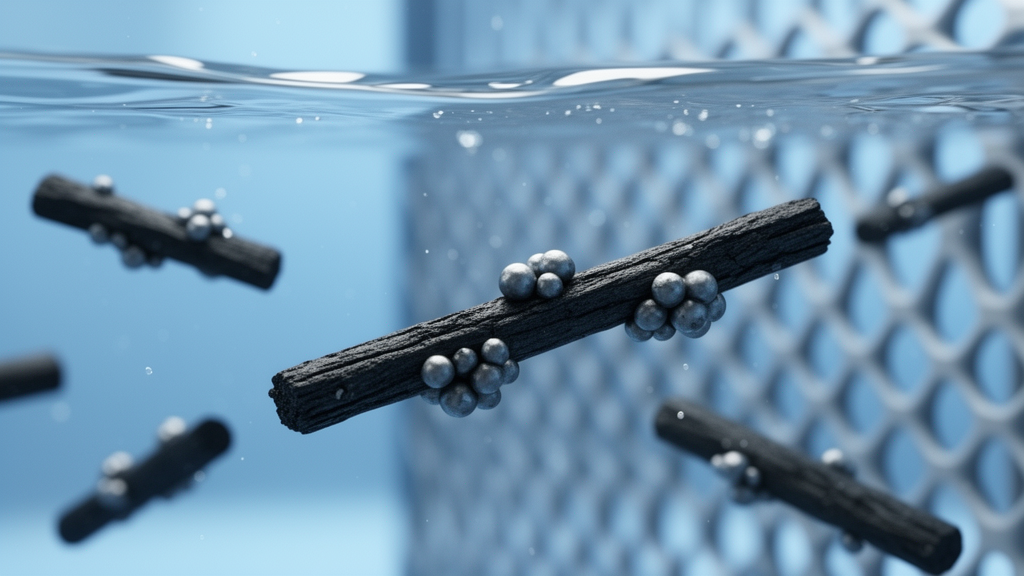
Activated carbon and biochar are workhorses of modern water treatment, prized for stripping dissolved contaminants from wastewater and drinking water alike. But a new laboratory study suggests these carbonaceous adsorbents carry a hidden liability: they shed microscopic and nanoscopic particles that slip through conventional filtration barriers, and those particles can ferry contaminants such as lead along with them, even after the dissolved pollutant appears to have been completely removed.
The research, published as an open-access original research article in the journal Biochar, set out to examine a step of the treatment train that is often taken for granted. Adsorption is typically deployed as tertiary treatment in wastewater plants or before disinfection in drinking water works, so the quality of the filtrate leaving the adsorption stage is critical to the final product. Yet, according to the authors, the disintegration of adsorbent grains and the presence of superfine carbon particles downstream of coagulation, sedimentation and sand filtration are frequently overlooked side effects of the process.
Ziheng Wang and Majid Sedighi built their experiments around two systems that mirror real plant configurations: fixed-bed columns packed with granular adsorbent, analogous to granular activated carbon filters, and stirred-tank suspensions of powdered material, analogous to powder activated carbon reactors. They tested commercially sourced activated carbon alongside three biochars — a hardwood biochar produced in a traditional burning stove, plus wheat straw and corn straw biochars pyrolysed at 500 degrees Celsius. Lead, introduced as lead nitrate, served as a tracer contaminant throughout.
The chemistry first had to be characterised. Batch and kinetic tests showed that all four adsorbents took up lead(II) spontaneously, with fitted Langmuir maximum capacities ranking corn straw biochar highest at 139.20 milligrams per gram, followed by activated carbon at 71.04, wheat straw biochar at 63.37 and hardwood biochar at 59.97 milligrams per gram. Notably, the ordering did not simply track specific surface area, which was highest for the activated carbon. The authors attribute the pattern to a combination of accessible pore structure, pore volume and oxygen-containing surface functional groups on the biochars, which infrared spectroscopy confirmed could retain lead through surface complexation, electrostatic interaction or cation exchange. Adsorption reached half of equilibrium capacity within five to ten minutes and roughly eighty percent within thirty minutes, justifying the thirty-minute residence time used in the column experiments.
In the fixed-bed tests, conventional filtered analysis told an encouraging story. Dissolved lead(II) was removed completely by every adsorbent — over ten pore volumes for activated carbon, eight for hardwood biochar, seven for wheat straw and nine for corn straw — as measured by inductively coupled plasma optical emission spectroscopy after passing samples through a 0.45 micrometre syringe filter. But that standard pre-filtration step, the researchers point out, is precisely what hides the problem: by removing particles before measurement, routine ICP techniques never account for metal ions riding on those particles, so the co-transport phenomenon simply vanishes from the data.
To chase the missing lead, the team passed column effluents and stirred-tank suspensions through a sequence of post-filters: a coarse Leighton Buzzard sand filter, a fine Redhill sand filter, a 0.45 micrometre nylon membrane and finally a 0.02 micrometre nylon membrane. Particle characterisation revealed apparent size-distribution peaks at around 5 micrometres, 0.5 to 1 micrometre, and 100 to 200 nanometres. Scanning electron microscopy with energy-dispersive X-ray spectroscopy then detected lead on the residual superfine particles, with surface lead content varying from site to site between zero and 4.4 percent — equivalent to 44 milligrams per gram at the maximum. The signals were stronger and more frequent on biochar particles than on activated carbon, consistent with the biochars’ richer surface chemistry, though the authors caution that these are local surface observations rather than a quantitative comparison of total adsorption capacity.
One puzzling feature demanded careful interpretation: an apparent 5 micrometre fraction persisted even in filtrate that had passed through the 0.45 micrometre membrane, whose pores should exclude intact particles of that size. The researchers argue these are not individual 5 micrometre particles slipping through the membrane. A more plausible explanation, they write, is that nanoscale and submicron particles that did pass through formed secondary aggregates during filtration, sample collection, concentration or measurement — an interpretation supported by clustered structures seen in electron micrographs. Because the study included no time-resolved aggregation kinetics or in situ imaging, the team frames this as a hypothesis requiring further verification, and treats the 100 to 200 nanometre fraction as the genuinely transport-prone population.
The decisive evidence came from a quantitative fractionation scheme. Unfiltered effluent was acid-digested to give total lead; parallel aliquots were filtered through 0.45 and 0.02 micrometre membranes; and the material retained on each membrane was separately digested and analysed. In fine-sand filtrates, total lead ranged from 5.8 to 26.4 micrograms per litre, while the operationally dissolved fraction below 0.02 micrometres held only 0.6 to 1.6 micrograms per litre. Particle-bound lead accounted for 84.5 to 90.2 percent of the total, ranking corn straw biochar highest at 90.2 percent and activated carbon lowest at 84.5 percent. Even after 0.45 micrometre membrane filtration, lead-bearing particles in the 0.02 to 0.45 micrometre band persisted at concentrations of 1.6 to 9.4 micrograms per litre across the four adsorbents, with mass recoveries of 91.3 to 96.2 percent confirming the procedure’s reliability.
The authors also translated their findings into a drinking-water context. An earlier screening estimate, built from measured particle concentrations of 0.5 to 10 milligrams per litre, a detection rate of roughly one in three particles and an average surface lead content near one percent, put particle-associated lead between 1.67 and 33 micrograms per litre. The lower bound sits below common drinking-water limits, but the upper bound exceeds the current European Union transitional parametric value of 10 micrograms per litre, the future value of 5 micrograms per litre, and the United States Environmental Protection Agency action level of 15 micrograms per litre. The team stresses that actual health risk depends on particle persistence, ingestion probability and bioaccessibility, none of which were quantified here, and that lead served only as a tracer — the same pathway could matter more for highly toxic contaminants such as mercury, radioactive elements, PCBs and dioxins.
Several caveats frame the work. The experiments used distilled water and lead solutions under controlled laboratory conditions, whereas real waters carry dissolved ions, variable pH and natural organic matter that could either promote aggregation and retention or stabilise particles and enhance their mobility. The absence of coagulation in the simulated powder reactor was a deliberate choice to maintain measurable particle concentrations, and prior work by the same group showed that particle release is an inherent hydraulic stability issue, continuing detectably for up to 1,000 pore volumes even in contaminant-free flushing. The authors propose mitigation strategies — adsorbent pre-washing, mechanical stabilisation, pelletisation or granulation, selection of low-erosion materials, optimised coagulation and combined sand–membrane filtration — and call for verification with time-resolved light scattering, in situ microscopy and direct acid digestion of collected particles. Their core message stands: assessing treatment performance may require evaluating dissolved and particle-associated contaminants together, because a filtrate that looks clean by conventional measures may still be carrying its pollutants on particles too small to see.
Subject of Research: Particle-facilitated lead transport by residual superfine activated carbon and biochar particles in post-filtration water treatment
Article Title: Co-transport of contaminants by disintegrated and residual superfine particles in biocarbon-based adsorbents
Article References: Wang, Z., & Sedighi, M. (2026). Co-transport of contaminants by disintegrated and residual superfine particles in biocarbon-based adsorbents. Biochar, 8(1), Article 137. https://doi.org/10.1007/s42773-026-00654-4
Image Credits: AI Generated
DOI: 10.1007/s42773-026-00654-4
Keywords: biochar, activated carbon, water treatment, lead, particle-facilitated transport, filtration, ICP-OES, colloids, drinking water, adsorption, membrane filtration, superfine particles
News Source: Alan Morgan. (October 28, 2026). Superfine particles from carbon water filters can smuggle lead past treatment. Scienmag.