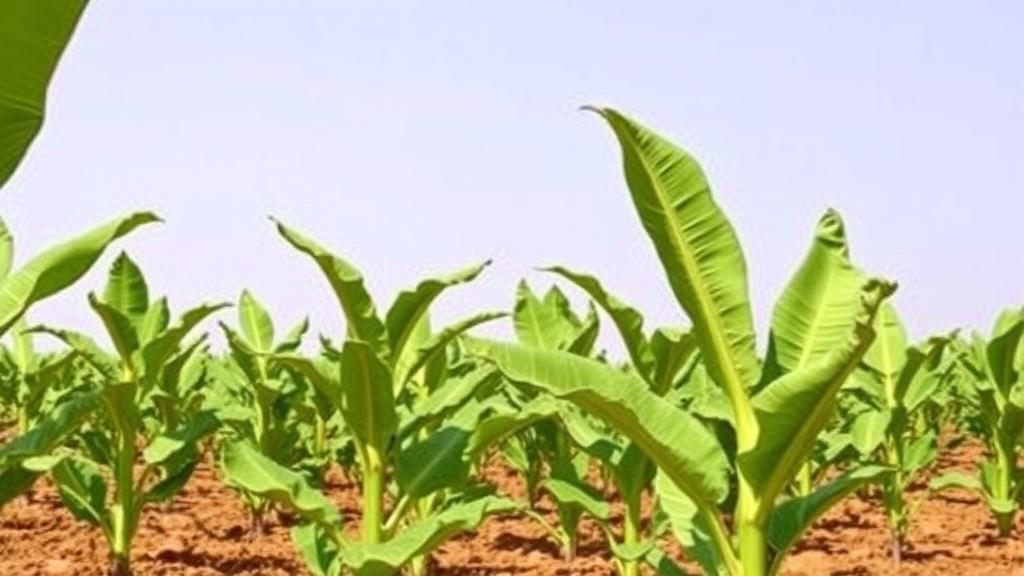
Banana growers in South Lebanon are facing a quiet invasion beneath their feet. A two-year survey of 87 banana fields across 22 villages in the Tyre and Sidon districts, conducted from January to April 2023, found that 26 fields, or 29.9 percent, tested positive for Fusarium oxysporum f. sp. cubense Tropical Race 4, the fungal pathogen behind Fusarium wilt, also known as Panama disease. The finding, confirmed both by internal pseudostem symptoms and by molecular PCR diagnostics that amplified a 464-base-pair fragment of the pathogen’s SIX9 gene, documents a substantial regional footprint for one of the most destructive soilborne pathogens in global agriculture.
The survey’s geographic pattern was uneven. The central coastal zone, particularly El Qlaileh, Mansouri, and the stretch from Borghliyeh to Kfarbedda, emerged as a hotspot with the highest disease incidence. Southern locations such as Iskandarouna showed moderate pathogen presence, while the northernmost stretch between Kfarbedda and Ansarieh remained largely uninfected, marked by clusters of healthy fields. The pathogen turned up in farms of every scale, from smallholder plots to large commercial plantations, and in plantations ranging from one to ten years old. Farmer awareness lagged behind the outbreak: while most surveyed growers knew of Fusarium wilt generally, only 39 percent, 34 of 87, specifically recognized Foc TR4 as its causal agent, and many had learned of the disease through the internet, agricultural consultants, or neighboring farmers.
The stakes are global as well as local. Banana is a staple food for more than 400 million people, and production exceeded 135 million tons in 2023, with trade valued at roughly 14.5 billion dollars annually. More than half of global output and nearly all international exports depend on a narrow genetic base within the Cavendish subgroup, a genetic uniformity that leaves the crop acutely vulnerable to emerging pathogens. Foc TR4, first identified in Taiwan in the 1960s, has now spread to more than 24 countries across five continents, with recent detections in Colombia in 2019, Peru in 2021, and Venezuela in 2024. The fungus invades through banana roots, colonizes vascular tissue, and produces hydrolytic enzymes and fusaric acid that disrupt water transport, leading to progressive yellowing, wilting, and plant death. Its thick-walled chlamydospores can persist in soil for decades even without a host, and it resists chemical treatment while spreading readily through contaminated soil, water, and planting material, making it a major quarantine concern.
Against this backdrop, researchers at the American University of Beirut ran a multi-scale evaluation of biological control agents, testing whether microbial antagonists could offer a practical complement to quarantine and sanitation measures. In a dual-culture laboratory assay on potato dextrose agar, seven Trichoderma harzianum strains, previously characterized in Italy and provided through FAO contacts, were paired against Foc TR4 cultures and incubated in darkness at 25 degrees Celsius for ten days. All seven strains significantly inhibited the pathogen’s mycelial growth, with inhibition rates ranging from 56.23 to 74.44 percent. Strain T24 proved the strongest antagonist at 74.44 percent inhibition, followed by T42 at 69.95 percent and T3 at 69.08 percent, while T26 lagged at 56.23 percent. Visual inspection showed consistent overgrowth and sporulation of Trichoderma over the pathogen in every dual culture, while control plates of Foc TR4 alone developed unrestrictedly.
The greenhouse stage moved from petri dishes to living plants. In a 320-square-meter greenhouse in Abbassieh, South Lebanon, 240 tissue-cultured banana plantlets were transplanted into pots filled with soil artificially infested with Foc TR4-colonized corn kernels, then treated with four commercial biocontrol products applied as soil drenches: Trichoderma harzianum (Bio-TH WP), Pythium oligandrum (Polyversum), a Bacillus subtilis plus Pseudomonas putida consortium (Fulzyme), and Bacillus amyloliquefaciens (NovoTreat). Under temperatures simulating subtropical field conditions, treatment type had a significant effect on both leaf and rhizome disease severity indices, while cultivar type and the treatment-by-cultivar interaction did not. Trichoderma harzianum achieved the lowest indices, reducing the rhizome disease severity index to 42 percent in Baladi and 47 percent in Canarian, and the leaf index to 20 and 25 percent respectively, compared with positive controls that in some cases exceeded 90 percent. Negative controls remained symptom-free, confirming the inoculation protocol worked as designed. Separate comparisons under artificial inoculation showed that the resistant cultivar GCTCV 218, a Giant Cavendish tissue-culture variant, and the medium Cavendish cultivar Grand Naine exhibited lower disease indices than the local Baladi and Canarian types.
The first field trial, run from October 2022 to March 2024 on a 3,750-square-meter loamy clay banana field in Borj Rahal where the farmer suspected infestation, tested the same biocontrol products under natural conditions. No external Fusarium wilt symptoms appeared during the trial, but pseudostem sampling told a different story. In untreated controls, 100 percent of Canarian and Baladi samples carried endophytic Fusarium, while Trichoderma harzianum treatment showed complete suppression of Fusarium detection in both cultivars. The bacterial consortium and Pythium oligandrum reduced incidence to 66 and 33 percent in Baladi and 66 percent in Canarian, with Bacillus amyloliquefaciens less effective still. Yield followed a parallel pattern: GCTCV 218 and Grand Naine produced the heaviest bunches at 30.7 and 29.6 kilograms without biocontrol, while among treated susceptible cultivars, Trichoderma raised Canarian bunch weight to 27.0 kilograms versus 25.4 kilograms in controls, and Baladi to 21.3 kilograms versus 19.1 kilograms.
The second, larger field experiment provided the most demanding test. Conducted from October 2023 to early 2025 in a commercial orchard in Al-Wasta, South Lebanon, naturally infested with Foc TR4, the trial covered roughly 0.7 hectares with 768 banana plants across four cultivars: susceptible Baladi and Canarian, highly tolerant GCTCV 218, and the wild non-Cavendish Calcutta 4 (C4), included for its reported tolerance. Here the two strongest laboratory strains, T24 and T42, were applied in combination alongside the commercial products. The results were striking. The combined T24 plus T42 treatment reduced the rhizome disease severity index to 5 percent in GCTCV 218 and 58 percent in Canarian bananas, compared with 57 and 82 percent in their respective untreated controls. Across the whole trial, the T24 plus T42 treatment recorded the lowest mean rhizome index at 1.87 and leaf index at 2.20, against 3.71 and 3.48 in controls, with bacterial and oomycete treatments falling in between.
Yield outcomes reinforced the disease data. All biocontrol treatments significantly improved bunch weight, bunch number, and total yield, and cultivar effects were significant for all parameters. Mean bunch weight rose from 25.15 kilograms in controls to 28.30 kilograms with T24 plus T42, and total yield climbed from 80.04 to 152.14 kilograms per 192-square-meter plot. Measured per cultivar against its own control, the T24 plus T42 treatment lifted total yield by 79 percent in GCTCV 218, roughly 107 percent in C4, 65 percent in Baladi, and 198 percent in the Canarian variety. Bunch numbers rose in parallel, from 18 to 28 in GCTCV 218, 14 to 26 in C4, 8 to 14 in Baladi, and 6 to 16 in Canarian, depending on treatment. By cultivar, GCTCV 218 again showed the lowest disease severity indices, Canarian the highest, confirming the susceptible cultivar’s vulnerability even under treatment.
The authors caution that complete eradication of Foc TR4 remains out of reach, and that the significant biocontrol-by-cultivar interaction for bunch weight means treatment responses are genotype-specific and warrant further study. Still, the combined message of survey and trials is coherent: pairing tolerant cultivars such as GCTCV 218 with locally adapted multistrain Trichoderma formulations delivered consistent disease suppression and yield gains across laboratory, greenhouse, and two field settings, something most published biocontrol studies, which typically rely on a single experimental scale, have not attempted. The research team frames the approach as the core of a bio-intensive integrated pest management strategy, supported by regional nurseries producing certified disease-free planting material, farmer training, and quarantine policy. For a region where traditional cultivars like Baladi and Canarian carry real cultural and economic value but little resistance to the pathogen, the trial results offer a practical path for sustaining banana production under active Foc TR4 pressure.
Subject of Research: Biological control of Fusarium wilt of banana (Foc TR4) in South Lebanon using Trichoderma harzianum and tolerant cultivars across laboratory, greenhouse and field trials.
Article Title: Biointensive management of Fusarium wilt of banana (Foc TR4): survey and multi-scale evaluation of antagonistic agentS
Article References: Mrad, M., Fardoun, A., Sobh, H., Shaib, H., Dagher, C., & Jawdah, Y. A. (2026). Biointensive management of Fusarium wilt of banana (Foc TR4): survey and multi-scale evaluation of antagonistic agentS. Egyptian Journal of Biological Pest Control, 36(1), Article 20. https://doi.org/10.1186/s41938-026-00895-2
Image Credits: AI Generated
DOI: 10.1186/s41938-026-00895-2
Keywords: Fusarium wilt, Foc TR4, banana, Trichoderma harzianum, biological control, South Lebanon, GCTCV 218, Cavendish, plant disease, integrated pest management, field trial, soilborne pathogen
News Source: Roger Howard. (October 29, 2026). Trichoderma Fungus Cuts Banana Wilt Damage and Boosts Yields in Lebanon Field Trials. Scienmag.