• HOME
  • NEWS
  • EXPLORE
    • CAREER
      • Companies
      • Jobs
    • EVENTS
    • iGEM
      • News
      • Team
    • PHOTOS
    • VIDEO
    • WIKI
  • BLOG
  • COMMUNITY
    • FACEBOOK
    • INSTAGRAM
    • TWITTER
Tuesday, October 20, 2026
BIOENGINEER.ORG
No Result
View All Result
  • Login
  • HOME
  • NEWS
  • EXPLORE
    • CAREER
      • Companies
      • Jobs
        • Lecturer
        • PhD Studentship
        • Postdoc
        • Research Assistant
    • EVENTS
    • iGEM
      • News
      • Team
    • PHOTOS
    • VIDEO
    • WIKI
  • BLOG
  • COMMUNITY
    • FACEBOOK
    • INSTAGRAM
    • TWITTER
No Result
View All Result
Bioengineer.org
No Result
View All Result
Home NEWS Science News Agriculture

Study finds differing tissue multi-element profiles among 26 wild plant taxa in eastern Türkiye

by
October 20, 2026
in Agriculture
Reading Time: 2 mins read
0
Study finds differing tissue multi-element profiles among 26 wild plant taxa in eastern Türkiye

Wild Plants in Eastern Türkiye Reveal Striking Differences in Metal Uptake, New Study Finds

Share on FacebookShare on TwitterShare on LinkedinShare on RedditShare on Telegram

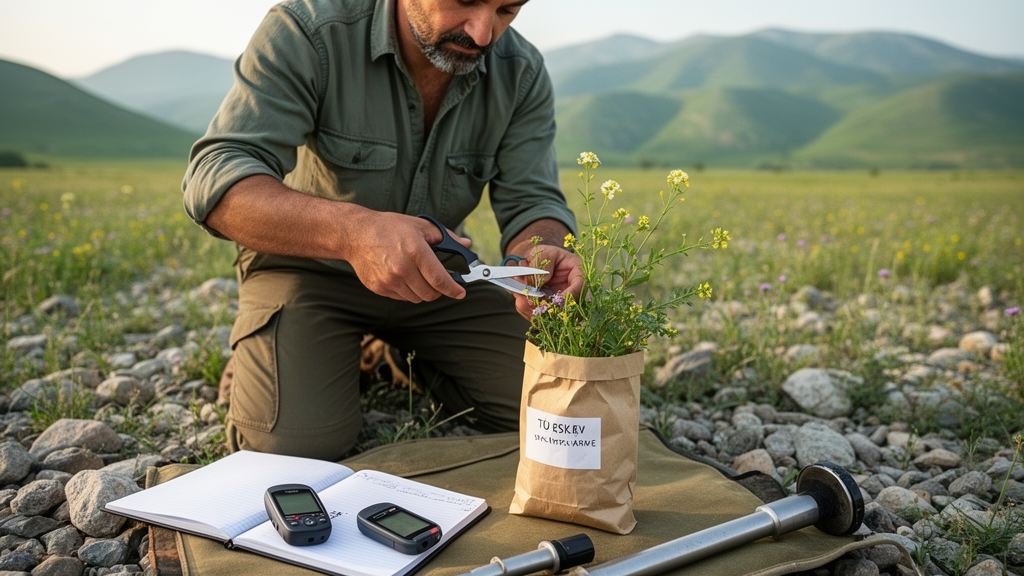
An observational field study summarized in the abstract measured nine elements in above-ground or leaf tissue from 123 composite samples representing 26 wild plant taxa in 14 botanical families in the Çapakçur microcatchment, eastern Türkiye. The investigated elements were cadmium, cobalt, chromium, copper, iron, manganese, nickel, lead and zinc. The researchers found statistically significant differences among both families and taxa for every investigated element, indicating that tissue multi-element concentration profiles varied across the plant groups sampled.

Permutation multivariate analysis of variance indicated significant differences in multi-element tissue concentration profiles among family and taxon groups. The abstract, however, cautions against a strong interpretation of these results because sampling was unbalanced, taxa were nested within families, and sampling locations may have differed in environmental exposure. Two complementary descriptive indices—the Metal Pollution Index and Species Metal Accumulation Score—summarized variation within the dataset. Globularia trichosantha had the highest Species Metal Accumulation Score, while Centaurea bingoelensis had the highest Metal Pollution Index. These rankings describe the sampled dataset and do not establish either taxon as a validated biomonitor.

Family Metal Enrichment Ratio analysis indicated element-specific enrichment tendencies within the study dataset, but the researchers said these patterns should not be treated as general family-level traits because some families were represented by only one taxon. Principal component analysis, heatmapping, clustering and Spearman correlation analyses further showed heterogeneous, largely element-specific tissue profiles. The analysis found limited evidence of strong co-association among elements apart from a positive relationship between nickel and copper. Together, the results support the conclusion that wild plant taxa in the microcatchment differ in their measured above-ground or leaf tissue multi-element concentrations, although the patterns cannot be attributed to intrinsic plant traits alone.

The study is limited by its observational design and by differences in tissue type, local exposure and microhabitat conditions across sampled plants. The composite sampling, uneven representation of taxa and families, and potential variation among locations constrain the conclusions that can be drawn from the family- and taxon-level comparisons. The researchers proposed that taxa with relatively high within-dataset scores could be prioritized for future biomonitoring validation, but they said such validation would require paired soil–plant sampling, standardized plant organs, analysis of bioavailable soil fractions, spatially co-located sampling and seasonal monitoring. Those proposed studies would be needed to confirm indicator value and clarify soil–plant transfer mechanisms; the reported findings do not demonstrate an established biomonitoring role or a causal process.

Subject of Research: Variation in tissue concentrations of nine elements among 26 wild plant taxa in eastern Türkiye

Article Title: Variation in above-ground tissue multi-element concentrations among wild plant taxa in the Çapakçur microcatchment, Eastern Türkiye

Article References: Demir, Y., Sinan, A., Doğan Demir, A., Meral, A., & Erdoğan, İ. Y. (2026). Variation in above-ground tissue multi-element concentrations among wild plant taxa in the Çapakçur microcatchment, Eastern Türkiye. BMC Plant Biology. https://doi.org/10.1186/s12870-026-10011-z

Image Credits: AI Generated

DOI: 10.1186/s12870-026-10011-z

Keywords: wild plant taxa, tissue concentrations, trace elements, heavy metals, biomonitoring, Çapakçur microcatchment, eastern Türkiye, plant ecology, Variation, above-ground, tissue, multi-element

News Source: Alan Morgan. (October 20, 2026). Study finds differing tissue multi-element profiles among 26 wild plant taxa in eastern Türkiye. Scienmag.


Tags: above-groundbiomonitoringÇapakçur microcatchmenteastern Türkiyeheavy metalsmulti-elementplant ecologytissuetissue concentrationstrace elementsvariationwild plant taxa
Share12Tweet7Share2ShareShareShare1

Related Posts

Mitogenome architecture and evolutionary insights in Origanum vulgare: comparative analysis of structural diversity and repeat-mediated recombination

Mitogenome architecture and evolutionary insights in Origanum vulgare: comparative analysis of structural diversity and repeat-mediated recombination

October 20, 2026
Comparative genome study identifies candidate genomic correlates of invasiveness in three cucurbit species

Comparative genome study identifies candidate genomic correlates of invasiveness in three cucurbit species

October 20, 2026

Polystyrene microplastics with molybdenum improved wheat seed germination in an experimental study

October 20, 2026

Comparative chloroplast genomics of Gnaphalieae (Asteraceae)

October 20, 2026

POPULAR NEWS

  • Quercetin improves bone measures in rats with collagen-induced arthritis alongside reduced Wnt3A and β-catenin expression

    Quercetin improves bone measures in rats with collagen-induced arthritis alongside reduced Wnt3A and β-catenin expression

    29 shares
    Share 12 Tweet 7
  • Longitudinal qualitative study reports limited media-advocacy engagement in agricultural safety program

    29 shares
    Share 12 Tweet 7
  • Study finds differing tissue multi-element profiles among 26 wild plant taxa in eastern Türkiye

    29 shares
    Share 12 Tweet 7
  • Viewpoint argues that respecting autonomy requires retaining clinical responsibility

    29 shares
    Share 12 Tweet 7

About

We bring you the latest biotechnology news from best research centers and universities around the world. Check our website.

Follow us

Recent News

Quercetin improves bone measures in rats with collagen-induced arthritis alongside reduced Wnt3A and β-catenin expression

Longitudinal qualitative study reports limited media-advocacy engagement in agricultural safety program

Study finds differing tissue multi-element profiles among 26 wild plant taxa in eastern Türkiye

Subscribe to Blog via Email

Enter your email address to subscribe to this blog and receive notifications of new posts by email.

Join 85 other subscribers
  • Contact Us

Bioengineer.org © Copyright 2023 All Rights Reserved.

Welcome Back!

Login to your account below

Forgotten Password?

Retrieve your password

Please enter your username or email address to reset your password.

Log In
No Result
View All Result
  • Homepages
    • Home Page 1
    • Home Page 2
  • News
  • National
  • Business
  • Health
  • Lifestyle
  • Science

Bioengineer.org © Copyright 2023 All Rights Reserved.