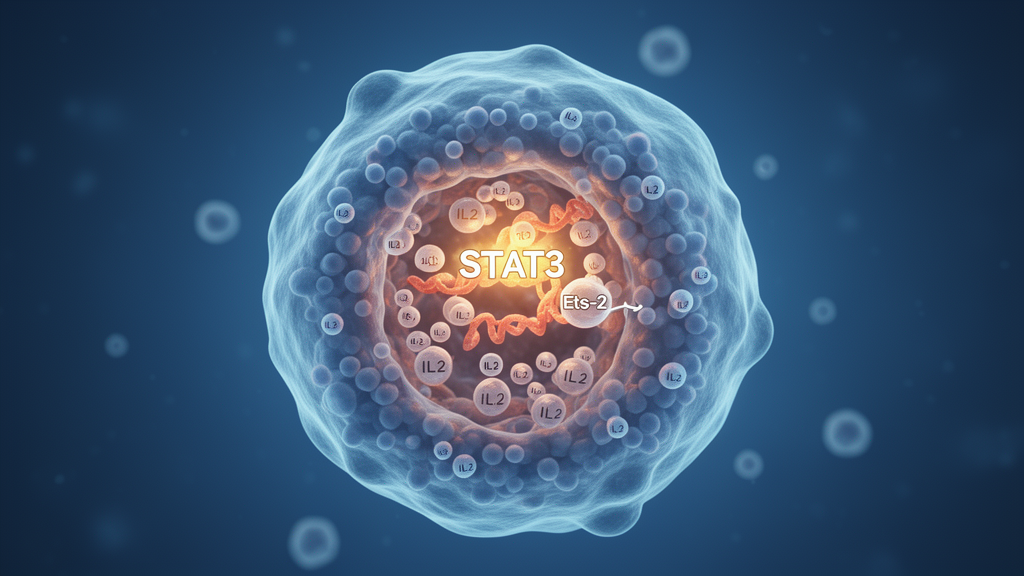
Activation of human T helper cells was associated with increased STAT3 activity, reduced expression of the transcription factor Ets-2, and greater production of the signaling protein interleukin-2, according to a molecular biology study published in Molecular Biology Reports. The experiments used Jurkat cells as a laboratory model and identified phosphorylated STAT3 at the Ets-2 promoter, supporting a direct mechanism through which STAT3 suppresses a transcriptional brake on IL-2 expression.
IL-2 is the first cytokine produced by naïve T helper cells after antigen recognition and is required for the initiation of T helper cell proliferation and differentiation. Previous work identified Ets-2 as a pre-induction silencer of IL-2: reducing its expression after T cell activation permits the cytokine gene to be transcribed. The new study asked how this change in Ets-2 expression is controlled, focusing on the STAT family of transcription factors because of their established role in regulating genes in T helper cells.
Bioinformatic analysis found potential STAT binding motifs in the promoter of Ets-2, providing a basis for testing whether STAT3 controls the gene directly. Investigators then examined STAT3, Ets-2, and IL-2 expression in activated Jurkat cells. Cell activation increased STAT3 messenger RNA and protein levels, while Ets-2 expression declined and IL-2 production rose. Ets-2 messenger RNA and protein were measured by real-time PCR and western blotting, respectively, allowing the researchers to track the response at both RNA and protein levels.
The study then tested the effect of changing STAT3 abundance. Overexpression of STAT3 significantly reduced Ets-2 messenger RNA and protein levels, whereas knocking down STAT3 increased Ets-2 expression. These gain- and loss-of-function results support a suppressive role for STAT3 in the regulation of Ets-2. The experiments also provide a functional connection between STAT3 activity, repression of Ets-2, and the relief of Ets-2-mediated silencing of IL-2.
Chromatin immunoprecipitation supplied more direct evidence for the proposed regulatory pathway. The researchers detected binding of phosphorylated STAT3 at the Ets-2 promoter. Specifically, the study found STAT3 phosphorylated at tyrosine 705 associated with promoter sequences, indicating that activated STAT3 can bind the Ets-2 regulatory region rather than acting only through an unidentified intermediate. Taken together, the promoter analysis, expression measurements, STAT3 manipulation, and binding assay support a model in which activation-induced STAT3 binds the Ets-2 promoter and suppresses its transcription. Lower Ets-2 expression then removes a pre-induction restraint on IL-2 production. The findings were obtained in a Jurkat T cell line model, so their relevance to primary T helper cells and to biological outcomes in people remains to be established through additional research.
Subject of Research: STAT3-mediated repression of the Ets-2 pre-induction silencer in activated T cells
Article Title: STAT3-mediated suppression of the pre-induction silencer Ets-2 in activated T helper cells
Article References: Theodoraki, V., Lazaris, C., Mouzaki, A., & Georgakopoulos, T. (2026). STAT3-mediated suppression of the pre-induction silencer Ets-2 in activated T helper cells. Molecular Biology Reports, 53(1), Article 1509. https://doi.org/10.1007/s11033-026-12699-6
Image Credits: AI Generated
DOI: 10.1007/s11033-026-12699-6
Keywords: STAT3, Ets-2, IL-2, T helper cells, transcriptional regulation, T cell activation, chromatin immunoprecipitation, Jurkat cells, gene expression, STAT3-mediated, suppression, pre-induction
News Source: Juliet Wilcox. (October 20, 2026). STAT3 directly silences Ets-2 to enable IL-2 in activated T cells. Scienmag.