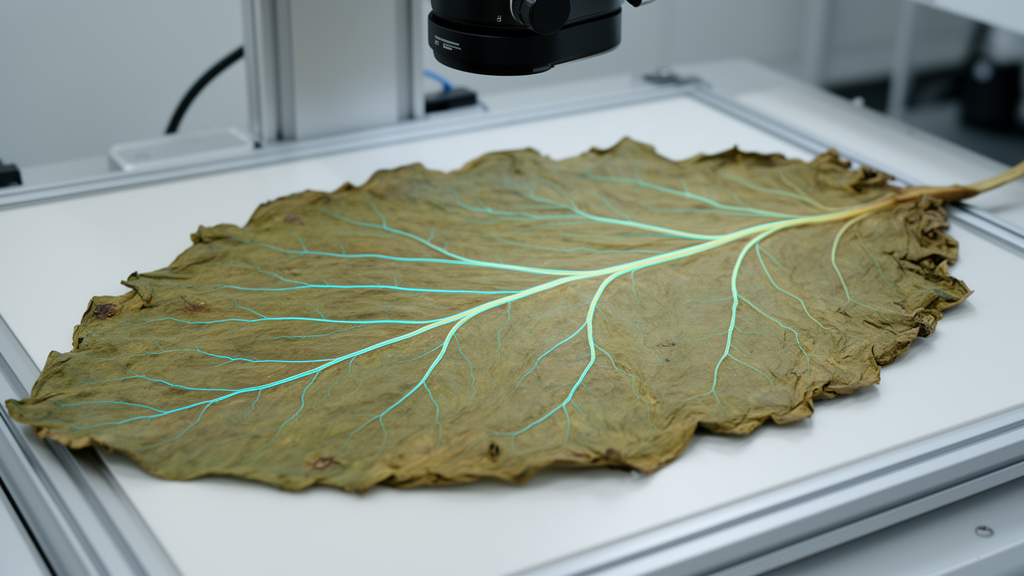
A deep-learning system developed for flue-cured tobacco has substantially improved the recovery of leaf-vein networks from images captured throughout the curing process. The CTVSeg-UNet model reached a mean pixel accuracy of 87.33% and a recall of 77.03% on a 99-image test set, compared with 73.26% and 47.12% for a standard U-Net. The gains were accompanied by more continuous masks for major and lateral veins, although the new model was less precise, producing more extra pixels along vein boundaries and in nearby leaf tissue. The researchers considered this trade-off favorable for phenotyping because missed branches can compromise measurements of venation geometry during curing.
The study targeted a difficult form of image-based plant phenotyping: identifying thin, branching structures when the foreground occupies only 2.43% of all annotated pixels. Tobacco leaves are useful test subjects because their broad lamina contains a prominent midrib and dense lateral network, while curing continually changes their color, moisture, texture, area, and vein visibility. Images collected from May through September 2025 covered 28 curing sequences, six cultivars, four producing regions in China, both upper and lower leaf surfaces, and multiple stages from green leaves through yellowing, browning, and drying. A custom imaging system captured 2,560 × 1,920-pixel photographs every 10 minutes inside curing barns.
For model development, the researchers reduced the sequence sampling because leaf appearance changed little during each 10-minute interval. They reserved 50 images from one independently selected adaxial group and 49 from one abaxial group for testing. The remaining 891 images were divided into 792 training images and 99 validation images. Horizontal flipping, random rotation, brightness adjustment, and Gaussian blur expanded the training set to 3,960 samples, with masks transformed alongside images for the geometric changes. Vein masks were manually drawn under a predefined protocol that excluded ambiguous textures and wrinkles unless their continuity with visible venation could be confirmed. Experienced reviewers checked the annotations, which were converted to binary images for training. Quantitative evaluation was conducted on network outputs resized to 256 × 256 pixels without preserving the original 1,060 × 1,920 aspect ratio.
CTVSeg-UNet builds on U-Net, an encoder-decoder network whose skip connections carry fine spatial information from the image-analysis stage to the reconstruction stage. Three modifications address the scarcity of vein pixels and the need to retain narrow branches. First, the cross-entropy loss assigned veins a weight of 40 and background a weight of 1, increasing the influence of the minority class during optimization. Second, a collaborative upsampling module ran bilinear interpolation and transposed convolution in parallel and fused their outputs. Bilinear interpolation offered stable spatial recovery, while learnable transposed convolution could reconstruct finer details. Third, the enhanced U-Net served as the generator in a PatchGAN adversarial framework, with a discriminator evaluating local consistency between leaf images paired with real or predicted masks.
Comparisons with four semantic-segmentation models showed why conventional accuracy figures alone could be misleading. PSPNet achieved 60.33% mean pixel accuracy and 58.64% mean intersection over union, while DeepLabV3 reached 60.46% and 58.83%. SegNet scored 64.37% and 60.34%. The baseline U-Net rose to 73.26% mean pixel accuracy and 67.00% mean intersection over union, but its visual masks contained broken branches and missed fine laterals. CTVSeg-UNet produced the most visually complete networks, recovering most of the midrib and many lateral veins across stages and cultivars. Its mean intersection over union was 65.60% and its F1 score 50.73%, both slightly below the baseline U-Net’s 67.00% and 52.48%.
The model’s lower precision, 37.82%, reflected its greater willingness to identify faint vein-like structures. DeepLabV3 had the highest precision at 69.36%, yet it detected only portions of the midrib and missed most lateral veins. CTVSeg-UNet instead classified more adjacent lamina and boundary pixels as veins. The authors also note that some extremely faint branches may have been omitted from the manual masks, meaning a portion of the apparent false-positive area could correspond to genuine venation. A miss-rate analysis found that 13.39% of annotated vein pixels went unidentified by CTVSeg-UNet, compared with 50.15% for the baseline U-Net. The refined model also produced lateral-vein spacing estimates closer to the ground truth, including for fine branches that the baseline could not measure.
Ablation experiments demonstrated that the improvements worked mainly as a combined system. Replacing transposed convolution with bilinear interpolation alone barely changed baseline performance, whereas the collaborative module raised mean intersection over union to 68.03%, precision to 63.08%, and F1 score to 54.58%. Adding the 40:1 class weights increased recall from 47.12% to 64.60% and mean pixel accuracy from 73.26% to 81.63%, but reduced precision to 47.33%. Adversarial learning applied directly to the unmodified U-Net lowered recall to 42.14%, showing that a discriminator could not compensate for a generator with poor vein-recognition ability. Combining collaborative upsampling and weighted loss raised recall to 72.46%; adding adversarial refinement then increased it to 77.03%. Three repeated runs of the final and penultimate configurations gave similar results, indicating stable training in those comparisons.
The researchers translated the model into an application that links camera acquisition, image separation, standardization, saturation-channel extraction, inference, mask display, and local storage. In batch mode, it processes previously collected curing images. In real-time mode, an edge device connected through TCP/IP controls the camera, preprocesses each frame, runs the embedded model, displays the original image and predicted mask, and stores the results during curing. Such masks can feed subsequent measurements of vein continuity, lateral spacing, and the angle between the midrib and lateral veins. The deployment demonstrates workflow feasibility, but the study did not report a formal field trial of curing decisions or end-to-end improvements in tobacco quality.
Visual tests across all six cultivars and both leaf surfaces showed that the system generally preserved the dominant venation framework despite differences in morphology, texture, and viewing angle. Performance nevertheless declined during the late color-fixing and stem-drying stages, when dehydration produced wrinkles and folds and reduced contrast between fine veins and the surrounding lamina. Some masks became locally discontinuous, missed lateral branches, or treated folded textures as veins. These limitations identify the main targets for future work: temporal information from curing sequences, multi-view imaging, structure-aware evaluation, and topology-preserving constraints. The study involved plant images only, with no human participants or live-animal experiments. Overall, the results show that CTVSeg-UNet can extract more complete tobacco vein networks than the tested baseline, while its lower precision and reduced performance in late-stage leaves remain important limitations of the reported evaluation.
Subject of Research: Deep-learning segmentation of tobacco leaf vein networks during flue curing
Article Title: CTVSeg-UNet: robust refinement for leaf vein phenotyping in curing tobacco
Article References: Ma, Y., Zhang, H., Wang, W., Zhang, X., Zhang, M., Zhang, H., Song, Z., & Wu, J. (2026). CTVSeg-UNet: robust refinement for leaf vein phenotyping in curing tobacco. Smart Agricultural Technology, 15, Article 102650. https://doi.org/10.1016/j.atech.2026.102650
Image Credits: AI Generated
DOI: 10.1016/j.atech.2026.102650
Keywords: CTVSeg-UNet, tobacco curing, leaf venation, semantic segmentation, plant phenotyping, U-Net, computer vision, adversarial learning, thin structures, robust, refinement, leaf
News Source: Alan Morgan. (October 20, 2026). CTVSeg-UNet: robust refinement for leaf vein phenotyping in curing tobacco. Scienmag.