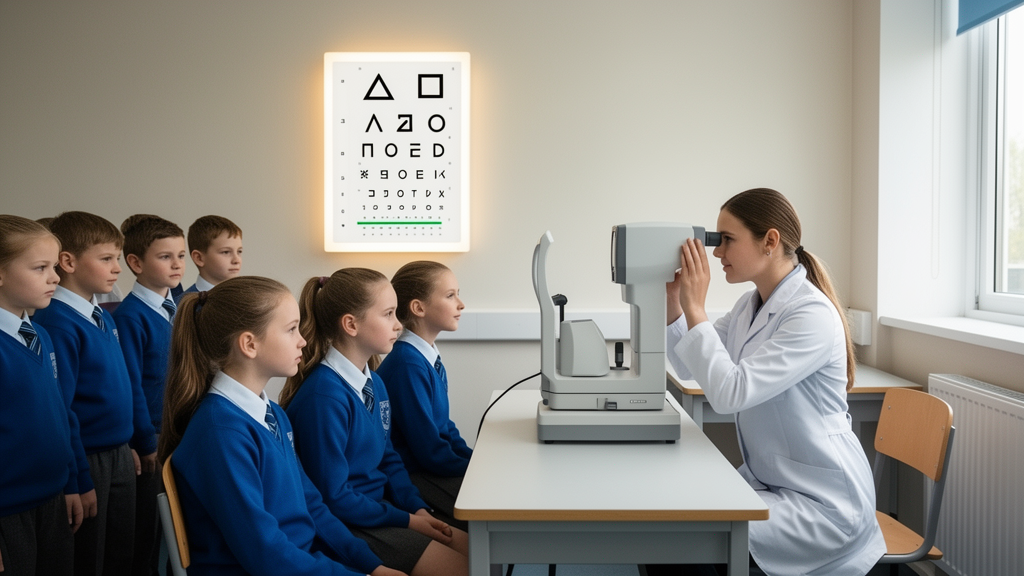
Girls had higher screening-defined myopia prevalence than boys from primary school onward in a cross-sectional analysis of 4.47 million school vision-screening records from Southern Fujian, China, while the two sexes had similar prevalence before school age. The study included 1,623,070 students aged 3–18 who were assessed in Xiamen, Quanzhou and Zhangzhou between 2021 and 2024. Girls had lower mean spherical equivalent than boys beginning in primary school, with the pooled difference reaching −0.20 diopters at ages 13–15. By senior high school, screening-defined myopia affected 88.7% of girls and 80.4% of boys, an absolute difference of 8.3 percentage points.
The researchers analysed routine, non-cycloplegic autorefraction measurements and uncorrected visual-acuity tests conducted by uniformly trained technicians in 1,361 schools. Spherical equivalent, or SE, was calculated by adding half the cylindrical value to the spherical value. Myopia was defined as SE of −0.50 diopters or lower. Screening-based visual impairment was defined as uncorrected visual acuity below 5.0 on the standard Chinese five-point logarithmic chart, equivalent to decimal visual acuity below 1.0. This threshold differs from the stricter clinical classifications of functional visual loss used by the World Health Organization, so the study’s visual-impairment estimates should not be treated as direct clinical diagnoses. The analysis was approved by the ethics committee of Xiamen Eye Center Affiliated to Xiamen University, with a waiver of informed consent for the retrospective analysis of anonymized routine-screening data.
Refractive status was similar between boys and girls before school age. Among children aged six or younger, the female-minus-male SE difference was +0.04 diopters, with a 95% confidence interval of +0.02 to +0.06. Girls therefore had slightly less myopic spherical-equivalent values on average, although the groups had little practical separation in myopia prevalence. The prevalence was 14.5% among girls and 14.2% among boys. The age-stratified pattern changed once children entered primary school: the female-minus-male SE difference was −0.12 diopters, with a 95% confidence interval of −0.14 to −0.10, and myopia prevalence was 62.3% among girls compared with 58.1% among boys. Thus, the higher female prevalence was reported from primary school onward rather than across the full childhood range.
The greatest separation in continuous refractive measurements occurred among junior high school students aged 13–15. Girls’ mean SE was 0.20 diopters lower than boys’ in the pooled data, with a 95% confidence interval of −0.21 to −0.19. The difference narrowed to 0.17 diopters among students aged 16 or older, with a 95% confidence interval of −0.19 to −0.15. City-level estimates followed the same broad sequence: a small female advantage in preschool, a female disadvantage beginning in primary school, the widest gaps during junior high school and partial convergence in two of the three cities during senior high school. The estimates for the oldest students were −0.20 diopters in Xiamen, −0.09 in Quanzhou and −0.20 in Zhangzhou. Although the continuous SE gap narrowed after junior high school, the difference in myopia prevalence remained substantial at the oldest age group, with 88.7% among girls and 80.4% among boys.
Uncorrected visual acuity followed a similar age-graded pattern. Mean scores were nearly identical in preschool, with 4.877 for boys and 4.876 for girls on the five-point chart. Girls had lower mean scores in each school-age stratum: the difference was −0.029 in primary school, −0.057 in junior high school and −0.053 in senior high school. The visual-acuity analysis included 4,237,528 records with available right-eye measurements; 4.9% were missing, predominantly because preschool children often cooperated poorly with the examination. No multiple imputation was performed, and analyses of uncorrected visual acuity used complete-case subsets for that outcome. All records in the final dataset had valid autorefraction measurements and were included in analyses of spherical equivalent.
Across the full dataset, generalized estimating equation models associated female sex with an overall SE difference of −0.141 diopters, with a 95% confidence interval of −0.154 to −0.128, after adjustment for age and city. Female sex was also associated with higher odds of screening-defined visual impairment, with an odds ratio of 1.26 and a 95% confidence interval of 1.22–1.30, and with higher odds of myopia, with an odds ratio of 1.18 and a 95% confidence interval of 1.11–1.25. These are adjusted associations, not estimates of a direct causal effect of sex. The available covariates were limited to age and city, with city used to account for regional heterogeneity; the models could not adjust for individual education, behaviour or family-history variables.
The models used generalized estimating equations with an exchangeable correlation structure to account for repeated screening records from the same student, for which the within-student intraclass correlation coefficient was 0.473. A sex-by-age interaction was statistically significant at p less than 0.001, indicating that the magnitude of the observed sex difference varied among age groups. Sensitivity analyses tested whether the result depended on the use of multiple encounters by refitting the models with only each student’s most recent valid measurement. The direction of the association remained consistent, mean SE differences varied by less than 0.05 diopters and prevalence differences by less than 2 percentage points. The stability across the two analytic units argues against the pattern being solely an artifact of repeated screening or unequal encounter counts.
Several biological explanations are compatible with the observed pattern, but the study did not measure them directly. Girls generally enter puberty earlier than boys, so comparisons based on chronological age may place girls closer to the period of rapid ocular axial elongation while boys have not reached the same developmental stage. The authors therefore considered a temporary phase shift compatible with the pattern, including the possibility that boys partially caught up in continuous SE during senior high school. Estrogen-receptor signaling and sex differences in pubertal timing were also discussed as possible contributors to refractive development. However, the screening database contained no markers such as menarche, Tanner staging or peak-height velocity, so it could not separate pubertal timing from inherent differences in refractive susceptibility. Moreover, the cross-sectional design compared different age groups rather than following the same children as they developed.
Environmental and behavioural pathways may also have contributed, but they likewise could not be tested directly in this dataset. The authors cited population evidence that boys generally have higher physical-activity levels and that girls may spend more time in sedentary activities, potentially affecting outdoor exposure and near-work burden. Individual outdoor time, near-work intensity, educational workload, parental myopia history and genetic background were unavailable, however, and sex could partly serve as a marker for correlated exposures rather than represent an independent causal factor. A published cycloplegic-refraction cohort cited by the study found that sex lost independent predictive power for myopia progression after educational-model variables were included, underscoring the importance of collecting such data in prospective research. The current findings therefore identify age-graded associations in a large screening population rather than demonstrating a biological or behavioural mechanism.
Several limitations constrain interpretation of the results. Non-cycloplegic autorefraction can systematically overestimate myopia prevalence and underestimate hyperopia, with the largest distortion among younger children and hyperopic eyes. Sex-specific differences in accommodative tone also cannot be excluded, although the direction of the disparity was consistent across ages and cities, making a purely technical explanation less likely; cycloplegic measurements would be needed to confirm the magnitude definitively. The 2021–2024 screening window also overlapped with the COVID-19-associated surge in near-work associated with remote schooling, which may have affected birth cohorts unevenly. The observed age pattern is consistent with developmental differences, but it cannot be separated definitively from birth-cohort effects. Even with these constraints, the scale and consistency of the dataset make the measured pattern notable: refractive disadvantage was not apparent in preschool, appeared in primary school, was largest during junior high school and narrowed somewhat in continuous SE among older students without disappearing in myopia prevalence. The findings support treating sex as a dimension in population-level myopia surveillance while leaving the causes unresolved.
Subject of Research: Age-graded sex differences in childhood myopia across Southern Fujian school screenings
Article Title: Sex-related refractive disparities in school-aged children: a population-based cross-sectional study of 4.47 million screening records
Article References: Li, D.-K., Chen, C.-H., Zhan, X.-F., Lin, B., & Li, X.-F. (2026). Sex-related refractive disparities in school-aged children: a population-based cross-sectional study of 4.47 million screening records. Frontiers in Public Health, 14, Article 1983884. https://doi.org/10.3389/fpubh.2026.1983884
Image Credits: AI Generated
DOI: 10.3389/fpubh.2026.1983884
Keywords: myopia, childhood vision, sex differences, school screening, spherical equivalent, refractive development, Southern Fujian, cross-sectional study, puberty, visual impairment, Sex-related, refractive
News Source: Ophelia Keating. (October 20, 2026). Girls show higher myopia rates from primary school in Fujian screenings. Scienmag.