A conservative multi-omics reappraisal has prioritized the candidate gene SDC1 through patient-level spatial transcriptomic analysis in triple-negative breast cancer, while revealing that existing genetic and clinical datasets do not support definitive causal links between candidate genes and perioperative anesthesia exposure. Conducted by researchers Weixian Xie, Wenyue Xiang, and Zhiming Huang and published in BMC Cancer, the exploratory investigation evaluated whether public genomic resources substantiate claims regarding anesthesia-associated gene mechanisms in tumor progression. Triple-negative breast cancer remains a notoriously aggressive malignancy marked by pronounced stromal and immune heterogeneity, prompting the research team to establish a rigorous baseline that distinguishes between verified spatial transcriptomic patterns and unconfirmed causal inferences.
Perioperative anesthetic exposure has frequently been linked to alterations in tumor biology across diverse experimental models and observational clinical investigations. However, the study authors highlighted that analyses relying solely on public databases risk substantially overstating clinical implications and causal relationships, particularly when genetic instruments, disease endpoints, and external validation cohorts remain incomplete. To address these evidentiary limitations, the investigators designed a conservative analytical framework focusing exclusively on findings that could be directly supported by accessible public multi-omics data, deliberately avoiding unwarranted assertions regarding specific surgical anesthetics or clinical interventions.
The research team initiated their assessment by curating 39 anesthesia-associated candidate genes from established public resources, including the Comparative Toxicogenomics Database, DisGeNET, and GeneCards, relying on targeted search queries related to anesthetic agents and perioperative pharmacology. The authors explicitly emphasized that this curation represents an annotation-level catalog rather than evidence of verified patient exposure to anesthetic drugs. Furthermore, when auditing existing genetic instruments from Mendelian randomization, summary-data-based Mendelian randomization, and colocalization analyses, the accessible genetic outcome was limited to overall breast cancer from GWAS Catalog accession GCST010098 rather than a triple-negative specific endpoint, requiring all genetic interpretations to be framed strictly around general breast cancer susceptibility.
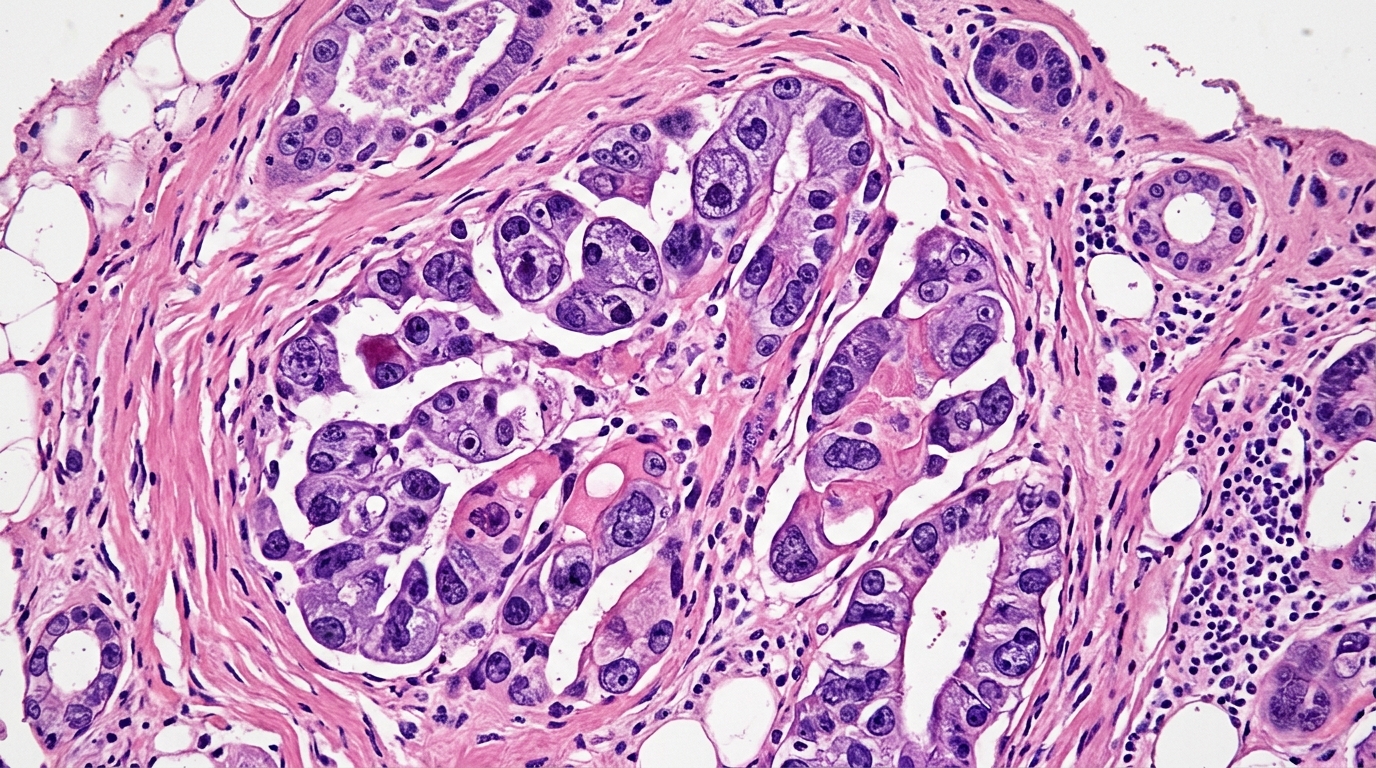
To investigate spatial organization directly within human tumor samples, the authors analyzed de novo spatial transcriptomic profiles from public dataset GSE210616 at the individual patient level. The analytical sample comprised three distinct tissue sections derived from three separate triple-negative breast cancer patients, contributing a total of 5,103 technical tissue spots. Spatial autocorrelation was quantified within each patient section using Moran’s I and subsequently combined across patients through Stouffer meta-analysis. Although ten candidate genes were pre-specified for spatial interrogation, CHRNA4 was absent from the processed expression matrix, restricting the spatial investigation to nine candidate genes while accounting for the technical nesting of spots within patients.
The resulting genetic audits failed to establish definitive causal evidence for the primary candidate genes evaluated in relation to breast cancer. Within the analyzed Mendelian randomization pipelines, a proxy-matched real-data summary-data-based Mendelian randomization signal was observed for SCN9A, but the investigators cautioned that this result cannot be regarded as a fully instrument-verified causal finding. In contrast, complete expression quantitative trait locus-supported Mendelian randomization results were entirely unavailable for SDC1, ZNF521, LPO, TRPA1, and GSDME, confirming that public genetic resources currently lack the instrumental completeness needed to validate causal claims.
Spatial transcriptomics provided the most robust and directly usable evidence in the study, with SDC1 exhibiting consistent positive spatial clustering across all three individual patient sections. SDC1 achieved a mean Moran’s I of 0.3042 and a combined patient-level Stouffer meta-analysis P value of 7.92e-06. The team also examined transcriptional hotspots associated with tertiary lymphoid structures, which accounted for 192 of the 5,103 analyzed tissue spots, or 3.8 percent of the total dataset. Hotspot distribution was highly patient-dependent, comprising 125 spots in the first sample, 67 spots in the second sample, and zero spots in the third sample.
Although pooled spot-level comparisons indicated higher SDC1 expression in tertiary lymphoid structure hotspots compared to non-hotspot tissue spots, showing values of 0.454 versus negative 0.018 with a difference of 0.471 and a P value of 5.75e-11, this elevation failed to replicate within individual sections. In section GSM6433613, mean scaled SDC1 expression was actually lower within hotspots than outside them, measuring 0.733 versus 0.891, while section GSM6433585 showed only a modest elevation of negative 0.066 versus negative 0.124. In contrast, the expression contrast for HIF1A was directionally consistent across sections, placing HIF1A second in overall spatial prioritization.
Further spatial correlation analyses revealed that SDC1 expression was positively correlated with CD44, demonstrating a Spearman correlation coefficient of 0.3307 and a P value of 1.69e-130. Conversely, SDC1 showed a weak negative correlation with the M2 macrophage score, characterized by a Spearman coefficient of negative 0.0336 and a P value of 0.0165, demonstrating that this candidate axis is not supported as an active positive macrophage mechanism. The authors concluded that their findings represent an exploratory prioritization effort rather than proof of anesthesia-driven triple-negative breast cancer metastasis, noting that the analyzed dataset contained no records of actual anesthetic administration. Validating these preliminary hypotheses will require triple-negative specific genetic endpoints, independent validation cohorts, and dedicated experimental biological studies.
Subject of Research: Spatial transcriptomic and multi-omics prioritization of anesthesia candidate genes in triple-negative breast cancer
Article Title: Spatial transcriptomic prioritization of anesthesia-associated candidate genes in triple-negative breast cancer: an exploratory multi-omics reappraisal
Article References: Xie, W., Xiang, W., & Huang, Z. (2026). Spatial transcriptomic prioritization of anesthesia-associated candidate genes in triple-negative breast cancer: an exploratory multi-omics reappraisal. BMC Cancer. https://doi.org/10.1186/s12885-026-17307-1
Image Credits: AI Generated
DOI: 10.1186/s12885-026-17307-1
Keywords: triple-negative breast cancer, spatial transcriptomics, SDC1, anesthesia-associated genes, multi-omics reappraisal, Moran's I, Stouffer meta-analysis, tertiary lymphoid structures, CD44, M2 macrophage score, HIF1A, SCN9A, Mendelian randomization, summary-data-based Mendelian randomization, breast cancer genetics, GSE210616, spatial autocorrelation, perioperative oncology
News Source: Nathaniel Bowman. (November 11, 2026). Spatial Transcriptomics Prioritizes SDC1 in Breast Cancer Without Establishing Anesthesia Links. Scienmag.