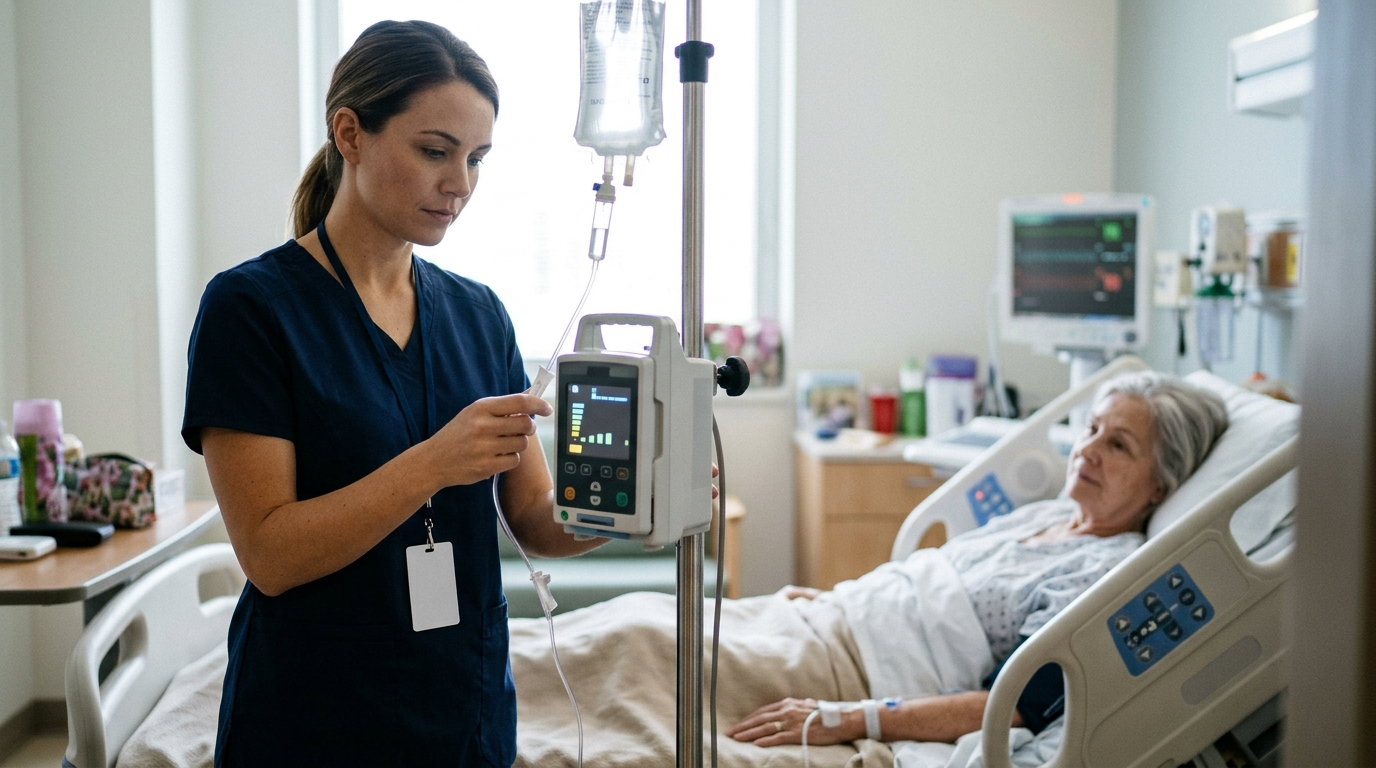
Higher professional self-efficacy among hospital nurses is significantly associated with lower levels of missed nursing care, according to an analytical cross-sectional investigation published in BMC Nursing. The research evaluated how individual nurse-related attributes relate to instances where necessary patient care is omitted or delayed during clinical shifts. While self-efficacy demonstrated a strong inverse association with missed care, an individual nurse’s perception of conscience showed no direct statistical association with care omissions in multivariate models.
Missed nursing care represents a critical operational concern in healthcare settings, formally defined as the omission or delay of required patient care activities. Such lapses directly threaten patient safety and diminish overall clinical care quality. While prior literature has frequently emphasized structural and organizational determinants of care omissions, the investigators focused on individual professional characteristics, specifically examining the intersecting associations connecting missed care, professional self-efficacy beliefs, and personal perceptions of conscience.
The study was conducted across two public teaching hospitals located in Semnan, Iran, covering data collection from January to August 2025. The research team utilized a census sampling approach across the target institutions. Following recruitment, a total of 279 nurses completed the required assessment protocols and were included in the final analytical sample, representing an overall response rate of 76.4 percent among eligible nursing staff.
To evaluate the core dimensions under investigation, the researchers administered three structured assessment instruments. Missed care activities were measured using the MISSCARE Survey, while professional confidence was documented through the Nursing Profession Self-Efficacy Scale. Nurses also completed the Perception of Conscience Questionnaire to capture personal moral orientations toward care. Analytical procedures included bivariate Pearson correlation calculations followed by multiple linear regression modeling to control for potential confounding variables.
Baseline assessments established the mean reported values across the study population. Participating nurses recorded an overall mean missed nursing care score of 50.71 with a standard deviation of 16.84. The mean score for professional self-efficacy reached 73.52 with a standard deviation of 14.47, whereas the mean score recorded for perception of conscience was 69.33 with a standard deviation of 8.17.
In the primary multiple linear regression analysis modeling missed nursing care, professional self-efficacy emerged as a significant independent factor, demonstrating an unstandardized regression coefficient of minus 0.51, a 95 percent confidence interval from minus 0.64 to minus 0.37, and a significance value of p less than 0.001. Clinical ward placement was also significantly associated with missed care, yielding an unstandardized coefficient of minus 2.52, a 95 percent confidence interval from minus 4.89 to minus 0.15, and a p-value of 0.037. By contrast, perception of conscience was not significantly associated with missed care, returning a p-value of 0.096.
Secondary multiple linear regression models identified reciprocal relationships among the remaining professional variables. When professional self-efficacy was modeled as a dependent measure, it demonstrated significant associations with missed nursing care, showing a coefficient of minus 0.33, a 95 percent confidence interval from minus 0.42 to minus 0.24, and p less than 0.001, as well as with perception of conscience, with a coefficient of 0.56, a 95 percent confidence interval from 0.38 to 0.74, and p less than 0.001. In turn, perception of conscience was significantly associated with professional self-efficacy, showing a coefficient of 0.21, a 95 percent confidence interval from 0.14 to 0.28, and p less than 0.001, and with clinical experience, yielding a coefficient of 0.22, a 95 percent confidence interval from 0.04 to 0.40, and a p-value of 0.017.
The study authors concluded that fostering higher professional self-efficacy corresponds to lower rates of missed care and stronger perceptions of conscience. These observations suggest that healthcare administrators might profitably support nursing confidence through structured mentoring programs and supportive clinical supervision. Nevertheless, because cross-sectional observations cannot establish causality, the authors emphasized that prospective longitudinal designs and formal interventional studies remain necessary to evaluate whether actively improving professional self-efficacy directly reduces missed patient care.
Subject of Research: Association between missed nursing care, professional self-efficacy, and perception of conscience among hospital nurses
Article Title: Association between missed nursing care, professional self-efficacy, and perception of conscience among nurses: a cross-sectional study
Article References: Imani, M., Hasanabad, V. R., Hydarbaki, M., Aliyari, R., & Raiesdana, N. (2026). Association between missed nursing care, professional self-efficacy, and perception of conscience among nurses: a cross-sectional study. BMC Nursing. https://doi.org/10.1186/s12912-026-05682-w
Image Credits: AI Generated
DOI: 10.1186/s12912-026-05682-w
Keywords: Missed nursing care, Professional self-efficacy, Perception of conscience, Patient safety, Quality of care, Nursing Profession Self-Efficacy Scale, Perception of Conscience Questionnaire, MISSCARE Survey, Cross-sectional study, Multiple linear regression, Teaching hospitals, Semnan, Clinical wards, Work experience, Clinical supervision, Mentoring, Nursing management
News Source: Ophelia Keating. (November 18, 2026). Higher Professional Self-Efficacy Linked to Reduced Missed Nursing Care. Scienmag.