Researchers have developed an injectable hydrogel sealant that can be delivered through an endoscope in a single step to repair gastrointestinal fistulas, abnormal connections that can leak digestive fluids into the abdomen and are among the main causes of illness and death after surgery and injury. The material, described in Nature Biomedical Engineering, forms through slug-inspired biomimetic self-assembly and was tested in living Sprague–Dawley rat and Bama miniature pig models, where it repaired fistulas and demonstrated its convenience in non-invasive endoscopic surgery.
The sealant, called PGaIII, is a thermoresponsive hydrogel built from positively charged poly(N-isopropylacrylamide), or PNIPAM, combined with gallium ions. Its defining trick is a slug-inspired biomimetic self-assembly process: when the precursor solution is injected, it forms a hydrogel with Janus-type adhesion, meaning the two faces of the material behave differently. One side sticks to tissue while the other remains non-adhesive, a Janus-type adhesion formed in a single step.
According to the study, the formulation integrates injectability with this single-step-formed adhesion, so clinicians would not need to prepare the material in separate stages or handle a pre-formed patch during a procedure. The hydrogel also shows active shrinkage and resists water and acid, features the authors list among its properties alongside biocompatibility and antibacterial activity.
Beyond its mechanical performance, the researchers report that PGaIII exhibits excellent biocompatibility and antibacterial properties. The authors report that PGaIII has antibacterial properties. The authors state that these properties enable PGaIII to serve as a ready-to-use biological sealant for endoscopic repair of gastrointestinal fistulas and prevention of postoperative adhesions.
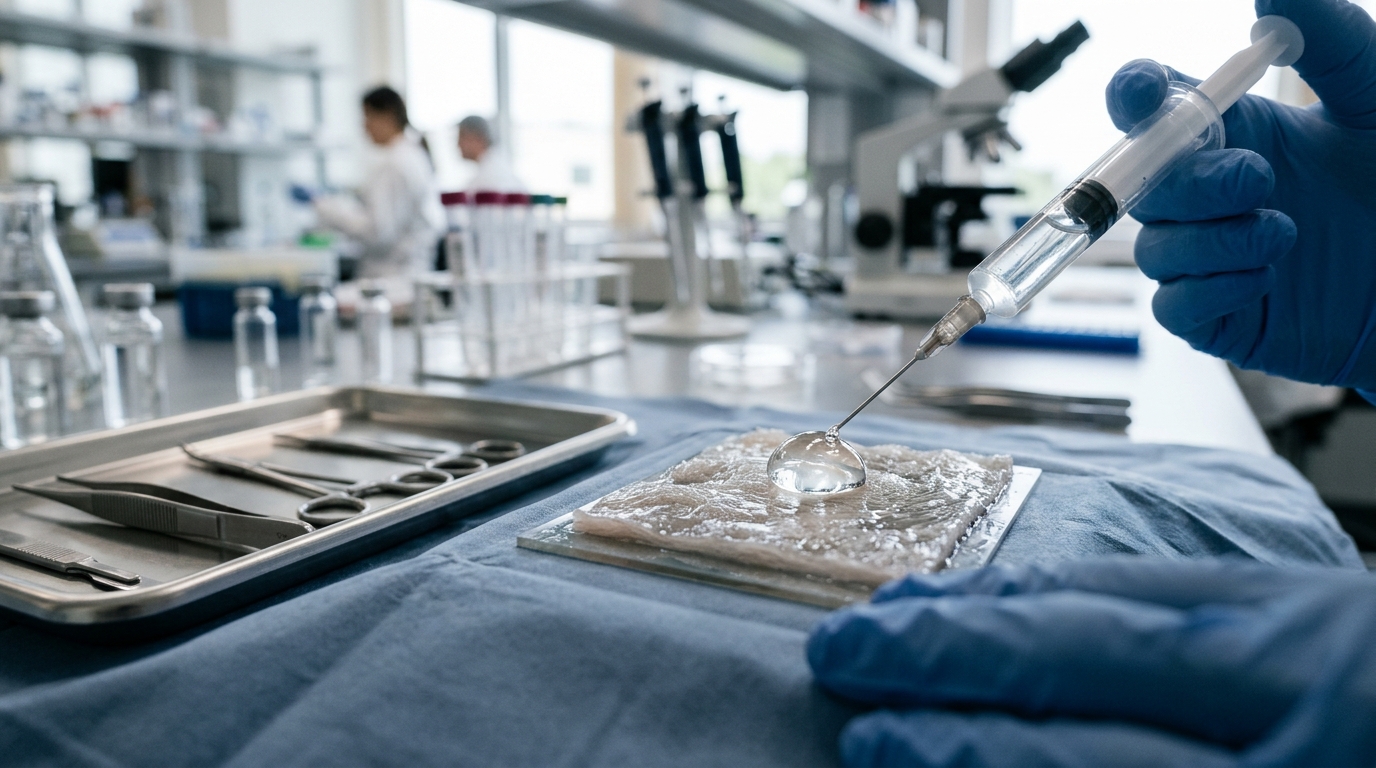
To test whether the material actually works in living animals, the team evaluated it in rat models of gastrointestinal fistula and then scaled up to Bama miniature pigs, whose gastrointestinal anatomy and size are closer to those of humans. In both species, the hydrogel was delivered endoscopically and repaired the fistulas, demonstrating both its effectiveness as a sealant and the convenience of a one-step, non-invasive endoscopic procedure. The porcine experiments demonstrate the approach in Bama miniature pigs, whose larger size is closer to that of humans.
The study’s figures outline the progression from concept to animal testing: the design and mechanism of the injectable Janus-adhesive hydrogels, their synthesis and characterization, the Janus-type adhesion properties of PGaIII, its water and acid resistance along with active shrinkage and antibacterial effects, and finally the treatment of gastrointestinal fistulas in rat and porcine models.
Gastrointestinal fistulas represent one of the main causes of morbidity and mortality, and while endoscopic techniques provide a minimally invasive approach to repair with advantages over conventional surgical approaches, integrating endoscopic delivery with hydrogel sealants in user-friendly, easy processes remains a great challenge. Endoscopic techniques offer a minimally invasive alternative with advantages over open surgery, but the field has struggled to combine endoscopic delivery with hydrogel sealants in a user-friendly, easy process. The authors identify this integration as a great challenge, and their single-step injectable design is presented as a direct answer to it.
The researchers suggest that the approach holds potential beyond the gastrointestinal tract, proposing that PGaIII could be adapted to repair fistulas in other organs in vivo. The authors suggest that PGaIII holds potential for the repair of fistulas in other organs in vivo, promoting safer and more effective clinical treatment options for related diseases. However, the evidence reported so far comes from animal models, and the study does not include human trials, so the path from rats and pigs to patients would require further testing of safety, dosing and long-term healing outcomes before any clinical use.
According to the study, PGaIII integrates injectability with single-step-formed Janus-type adhesion to tissues, while simultaneously featuring biocompatibility, water/acid resistance, active shrinkage and antibacterial properties. The thermoresponsive, positively charged PNIPAM/Ga3+ hydrogel sealant is formed by slug-inspired biomimetic self-assembly and is described by the authors as an effective ready-to-use biological sealant for endoscopic repair of gastrointestinal fistulas.
For now, the reported findings establish proof of concept in two animal species and demonstrate that a single-step endoscopic delivery of a Janus-adhesive hydrogel is feasible and effective in living models.
Subject of Research: A thermoresponsive injectable hydrogel sealant for single-step endoscopic repair of gastrointestinal fistulas tested in rat and miniature pig models.
Article Title: A single-step injectable Janus-adhesive hydrogel for endoscopic gastrointestinal fistula repair
Article References: Liang, S., Li, J., Li, Q., Jiang, T., Tian, Y., Han, Q., Jing, Y., Wang, S., Li, J., Wang, A., & Bai, S. (2026). A single-step injectable Janus-adhesive hydrogel for endoscopic gastrointestinal fistula repair. Nature Biomedical Engineering. https://doi.org/10.1038/s41551-026-01820-6
Image Credits: AI Generated
DOI: 10.1038/s41551-026-01820-6
Keywords: gastrointestinal fistula, hydrogel sealant, endoscopic repair, PNIPAM, Janus adhesion, biomimetic self-assembly, gallium ions, antibacterial, postoperative adhesions, animal models, biomedical engineering, single-step
News Source: Denise Maddox. (November 5, 2026). Slug-inspired injectable hydrogel seals gastrointestinal fistulas in rats and pigs. Scienmag.