


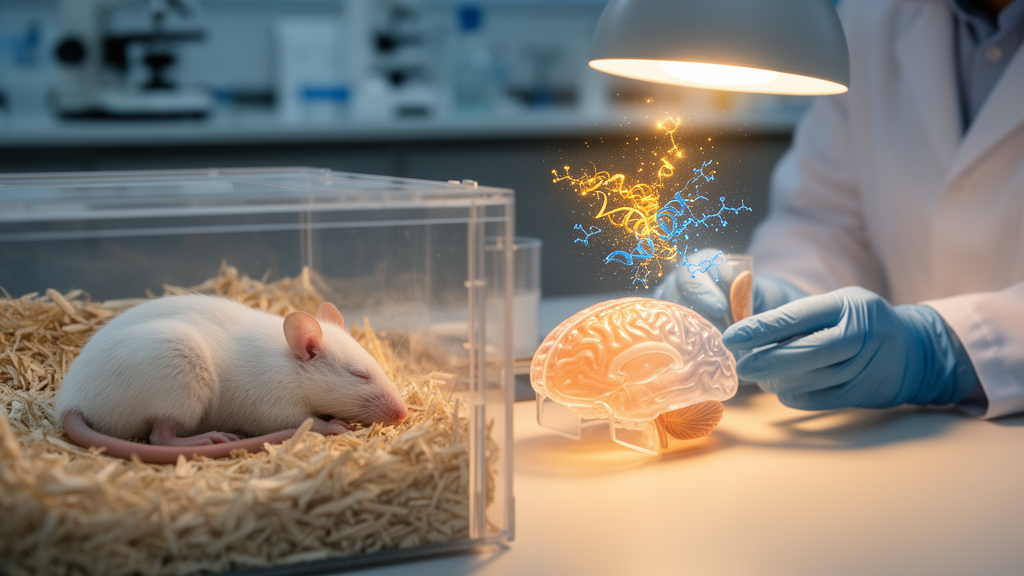
New research in mice shows that traumatic brain injury can trigger early Alzheimer's-related protein variant pathology in wild-type animals, and that post-injury sleep disruption altered recovery in a sex- and injury-dependent manner, with females showing increased accumulation of key amyloid-beta and tau variants. The study, published in Acta Neuropathologica Communications, shows that traumatic brain injury induced accumulation of Alzheimer's-related protein variants in the brains of wild-type mice, and that post-injury sleep disruption altered recovery in a sex- and injury-dependent manner.
Traumatic brain injury has long been recognized as a major risk factor for Alzheimer’s disease and related dementias, but the mechanisms connecting the two have remained difficult to pin down. The research team, led by Philip Schulz and Michael R. Sierks, focused on a specific aspect of this link: the accumulation of disease-relevant variants of three proteins that are hallmarks of neurodegeneration, namely amyloid-beta, tau, and TAR DNA-binding protein 43, commonly abbreviated as TDP-43. The researchers targeted disease-relevant conformational variants of these proteins, using variant-selective antibodies to map their accumulation across different brain regions.
The researchers hypothesized that two distinct forms of stress might work together to promote this pathology. The first is the acute stress of the injury itself, which the researchers describe as involving sustained neuronal stress and impaired proteostasis. The second is the longer-term stress of disrupted sleep, which the researchers note frequently accompanies traumatic brain injury and may exacerbate neurodegenerative vulnerability by increasing physiological stress and disrupting metabolic waste clearance. To test this, the team used a midline fluid percussion model to deliver either a mild or a moderate traumatic brain injury to male and female C57BL/6J mice, while a third group received sham surgery without actual injury.
After a seven-day recovery period, half of the animals in each injury group underwent seven consecutive days of continuous sleep disruption, while the rest were allowed to sleep normally. Behavioral assessments tracked functional recovery through fourteen days post-injury, and on day fifteen the researchers collected brain tissue for detailed regional analysis. They used conformational variant-selective antibodies, a technique that can distinguish between normal protein forms and the specific misfolded variants associated with disease, to map where and how much of each toxic variant had accumulated across different brain regions.
The results showed that traumatic brain injury, whether mild or moderate, induced the accumulation of Alzheimer’s-related protein variants in wild-type mouse brain that resembled those observed in early-stage human Alzheimer’s disease tissue. This finding is significant because the mice were wild-type, meaning the injury alone was sufficient to generate protein variants similar to those observed in early-stage human Alzheimer's disease tissue. The mice in the study were wild-type C57BL/6J animals, so the observed protein variant accumulation arose without any Alzheimer's-related genetic modifications.
At the group level, most behavioral deficits and protein pathology had resolved by fourteen days post-injury. However, sleep disruption altered this recovery trajectory in ways that depended on both the sex of the animal and the severity of the injury. Notably, females showed increased accumulation of key Alzheimer's-related amyloid-beta and tau variants with post-injury sleep disruption, indicating a sex-dependent response in this mouse model.
Beyond the group-level averages, the researchers identified a subset of individual mice that displayed persistent behavioral impairments alongside elevated levels of toxic protein variants. This observation links persistent behavioral impairment with elevated levels of toxic protein variants in a subset of mice, while most group-level deficits and pathology had resolved. Correlation analyses revealed variant- and region-specific relationships between protein levels and functional outcomes, with specific amyloid-beta and tau variants frequently associated with behavioral impairment.
The correlation analyses also pointed to a more nuanced picture than simple toxicity. Selected amyloid-beta and tau variants appeared to reflect an early, potentially adaptive response to stress rather than purely a pathological one. The researchers report that selected amyloid-beta and tau variants appeared to reflect an early, potentially adaptive response to stress.
The findings carry several important caveats. The study was conducted in mice using a midline fluid percussion injury model with a seven-day sleep disruption protocol, which may not capture the full complexity of chronic sleep disturbance in human patients. The behavioral assessments covered only fourteen days post-injury, and the detected protein variants resembled those in early-stage human Alzheimer's disease tissue but do not confirm that these mice would go on to develop Alzheimer's disease. Nevertheless, the work provides a controlled experimental framework for studying how traumatic brain injury and post-injury sleep disruption relate to early Alzheimer's-like protein variant pathology in wild-type mice, and it highlights female mice as showing increased accumulation of key disease-related amyloid-beta and tau variants under these conditions.
Subject of Research: How traumatic brain injury and post-injury sleep disruption generate early Alzheimer's-related protein variant pathology in wild-type mice
Article Title: Sleep disruption following traumatic brain injury generates early Alzheimer’s-related protein variant pathology in wild-type mice
Article References: Schulz, P., He, P., Tsvechenko, O., Mendez, M. V., Beauregard, L. L., Szewczak, M., Mannino, G. S., Green, T. R. F., Rowe, R. K., & Sierks, M. R. (2026). Sleep disruption following traumatic brain injury generates early Alzheimer’s-related protein variant pathology in wild-type mice. Acta Neuropathologica Communications. https://doi.org/10.1186/s40478-026-02452-2
Image Credits: AI Generated
DOI: 10.1186/s40478-026-02452-2
Keywords: traumatic brain injury, sleep disruption, Alzheimer's disease, amyloid-beta, tau, TDP-43, wild-type mice, protein pathology, neurodegeneration, fluid percussion injury, sex differences, proteostasis
News Source: Cassandra Pierce. (October 30, 2026). Sleep loss after brain injury boosts early Alzheimer-like protein changes in mice. Scienmag.



