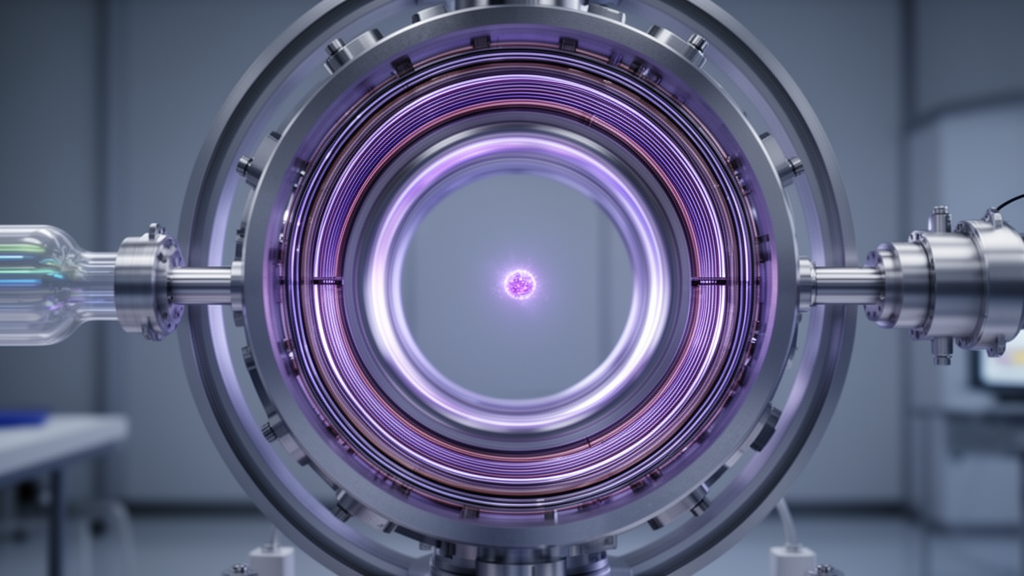
A Northwestern University team has trapped and cooled a single positron for months, bringing the antimatter counterpart of the electron into a highly controllable quantum state. The researchers captured positrons produced by radioactive decay, slowed them and guided one into a specialized apparatus that suspends it in a near-perfect vacuum, away from ordinary matter. Using precisely tuned microwaves, they demonstrated that they could manipulate and detect the positron’s individual quantum energy states. The achievement establishes what the team calls a one-positron quantum cyclotron, a controlled experimental system intended to support a stringent test of the symmetry between electrons and positrons.
The new result addresses a central practical challenge in antimatter physics: a positron cannot be stored in a conventional container for long. When a positron encounters an electron or the material forming a container, the pair can annihilate. The Northwestern apparatus instead confines the antimatter particle within an empty region at its center, where it does not touch the walls. Specialized electric and magnetic fields create the trapping configuration, while the interior is cooled to about 300 millikelvins, or 0.3 degrees above absolute zero. This ultracold environment allows the positron to settle into its quantum ground state, and the trapped particle has remained suspended for months.
Producing and capturing the positron was the first stage of the experiment. The team used nuclei of sodium-22, a rare radioactive isotope of sodium, to generate positrons. Positrons emitted in the decay process carry substantial energy, so they cannot simply be placed into the trap. The researchers first slowed the particles dramatically and then guided a positron into the apparatus, where it was suspended in the vacuum region. Once captured, the particle could be manipulated without contact with a physical wall. Its long confinement demonstrates that the combination of trapping fields, cryogenic cooling and vacuum isolation can preserve a single positron for extended experiments.
The researchers went beyond merely holding the particle in place. By delivering microwaves at carefully selected frequencies, the team added tiny, precise amounts of energy to the positron and detected the resulting quantum transitions. These measurements allowed the scientists to manipulate and observe the particle’s individual energy states. In the one-positron quantum cyclotron, the trapped particle behaves in a way that resembles an artificial atom with quantum energy levels that can be controlled and read. The demonstrated manipulation supplies an experimental foundation for a more demanding goal: measuring the positron’s magnetic properties and comparing them with measurements of the electron.
The proposed comparison follows the Standard Model’s expectation that electrons and positrons are nearly perfect mirror images. The model describes the electromagnetic, strong nuclear and weak nuclear forces and has reproduced many experimental predictions with exceptional accuracy, but it does not explain why the observable universe contains overwhelmingly more matter than antimatter. A sufficiently precise disagreement between the magnetic measurements of the two particles could expose behavior not captured by the present theory. Such a discrepancy would be a candidate sign that the Standard Model is incomplete and could provide a new avenue for investigating the matter–antimatter imbalance, although the positron measurement and final comparison are planned future work.
Electron measurements provide the benchmark for that future test. In previous work, Gerald Gabrielse, who led the new study, and his team used a one-electron quantum cyclotron to measure the electron’s magnetic moment to about one part in 10 trillion. That is among the most precise measurements ever made of an elementary particle. The researchers now plan to make an equivalent quantum measurement with the trapped positron and compare the two results. Current theories suggest that the measurements will show no difference. If the results differ, the researchers said, the discrepancy could point to the kind of fundamental failure they have spent decades searching for.
Gabrielse has pursued this question through both sides of the experiment. His group previously developed techniques for isolating a single electron and measuring its magnetic properties with extraordinary precision. It also pioneered methods for slowing, capturing and cooling antiprotons, helping establish low-energy antimatter research as an experimental field. The new work combines those two lines of research by applying the quantum control achieved with electrons to a single particle of antimatter. The result is not a demonstration that positrons and electrons differ. It shows that researchers can trap, cool and tune a single positron over months, creating the experimental conditions needed for a highly sensitive magnetic comparison.
The system also illustrates how sharply constrained antimatter experiments must be. The positron must remain isolated from material, and the apparatus depends on a maintained vacuum and a cryogenic environment. Preparing a trapped particle additionally requires radioactive material and a sequence in which a high-energy decay product is slowed before capture. Its confinement therefore represents more than keeping a particle behind a physical barrier: the team demonstrated that one positron can reach its quantum ground state, remain in the apparatus for months and undergo controlled microwave-induced transitions. Those operations are the essential experimental building blocks for the proposed magnetic-moment comparison, which remains a planned next step in the research program.
The research brings a long-standing search for physics beyond the Standard Model into a notably simple and controlled system. As Gabrielse explained, the aim is to examine one of the most fundamental particle systems with enough precision to identify an unambiguous failure of the theory. The Standard Model cannot predict why the universe exists in its present matter-dominated form, and the imbalance between matter and antimatter is one of its central unresolved shortcomings. By creating a one-positron quantum cyclotron, the team has demonstrated a technically demanding route to investigating whether one of the model’s most basic symmetries holds with the expected precision.
The study, “One-positron quantum cyclotron,” is scheduled for publication in Physical Review Letters on October 21, 2026, and was supported by the National Science Foundation through grant 2110565. Thomas Myers, a doctoral student in Gabrielse’s laboratory, is the paper’s first author. The experiment’s central achievement is the months-long confinement and quantum control of a single antimatter particle. Its next stage is to measure the positron’s magnetic moment with comparable precision and place it alongside the earlier electron result. Under current theories, the two measurements should agree; a reproducible disagreement could direct future searches toward new physics and offer clues to the enduring mystery of why ordinary matter, rather than antimatter, dominates the observable universe.
Subject of Research: Experimental trapping and quantum control of one positron for precision tests of electron–positron magnetic symmetry.
Article Title: Scientists trap and tame a single particle of antimatter for months
Article References: Scientists trap and tame a single particle of antimatter for months. Original publication (Bibliographic details unavailable.)
Image Credits: AI Generated
DOI: Not provided
Keywords: positron, antimatter, quantum cyclotron, quantum control, electron–positron symmetry, magnetic moment, Standard Model, cryogenic trap, particle physics, positron trapping, Scientists, trap
News Source: Katie Riggs. (October 26, 2026). Single positron trapped for months in quantum cyclotron. Scienmag.