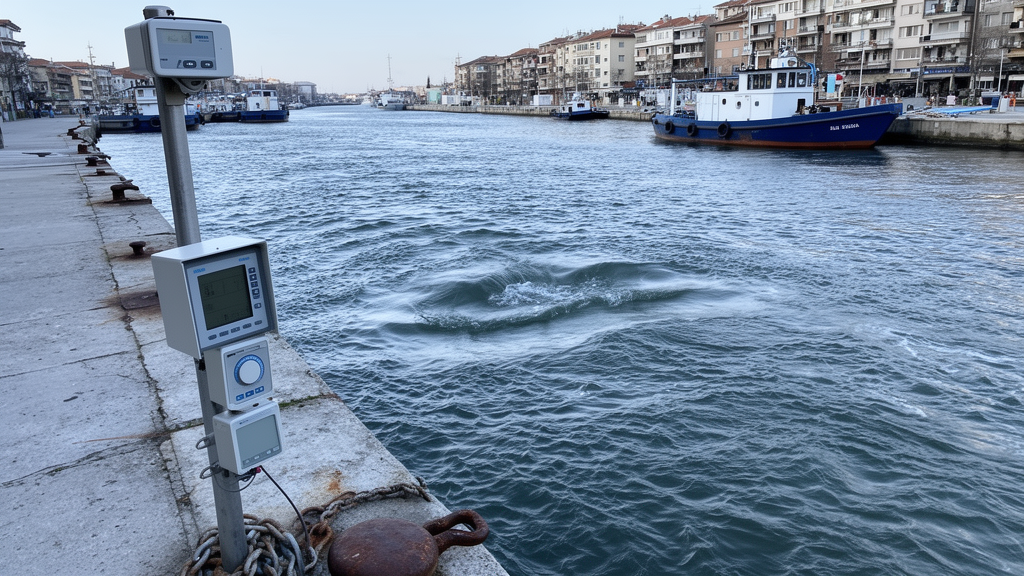
Estonian researchers have measured strong, potentially hazardous oscillations in the 2.4-kilometer-long, 300-meter-wide canal connecting Lake Varna with the Black Sea, including pronounced periods of 37 and 19 minutes. The observations and mathematical modeling indicate that resonance within the canal–lake system can amplify water movement under certain atmospheric conditions. During one exceptional episode, changes in current velocity and water level each reached 0.8 meters per second and 0.8 meters, respectively, over a 10-minute period. The researchers say fluctuations of that magnitude can make navigation highly dangerous, disrupt port operations and complicate coastal management.
The field study involved Maarja Kruusmaa, an academician and professor at Tallinn University of Technology, and researcher Laura Piho, who worked with the Port of Varna. Jüri Elken, professor emeritus of oceanography, joined the team in interpreting the unusual water movements. Investigators used Hydromast measuring stations developed at Tallinn University of Technology’s Center for Biorobotics. Three stations recorded the speed and direction of water movement and water levels at one-minute intervals. This high-temporal-resolution record allowed the researchers to capture rapid changes that could otherwise have gone undetected and to examine the canal’s sub-hourly dynamics.
Two exceptionally strong events were recorded during the monitoring period. In the first, water oscillations began abruptly and lasted for a couple of cycles. The researchers attributed it to a meteorological tsunami, which can occur when a weather front moves over shallow coastal waters at a speed associated with resonance. The second significant event occurred more than five hours after a storm, when offshore winds reached 20 meters per second. Over 10 minutes, the largest changes in current velocity reached 0.8 meters per second, while water levels changed by as much as 0.8 meters. In addition to these extremes, the canal also experienced normal moderate water movement.
Elken, Piho and Kruusmaa emphasized that the scientific paper primarily demonstrates how high-temporal-resolution measurements combined with mathematical modeling can identify and predict hazardous oscillations, rather than presenting a completed coastal forecasting system. The authors also propose specific steps for developing coastal monitoring and forecasting capabilities. The findings indicate potential applications in vessel navigation, forecasting strong currents and providing rapid warnings about changing conditions. More broadly, the researchers say strong currents and resonant sea-level fluctuations lasting less than an hour warrant study in other marine bays and in channels connecting those bays with upstream lakes and rivers, where comparable flow dynamics may occur.
The results provide information that could support port management, navigational safety and environmental impact assessment. The study’s scope was centered on the Varna harbor canal and the characteristics of its observed current and sea-level events; it does not establish that every canal will display the same behavior. The peer-reviewed article, “High current speed events in a harbor channel driven by resonant sub-hourly sea level dynamics: an example from Varna, Black Sea,” was authored by Jüri Elken, Laura Piho and Maarja Kruusmaa and published in Ocean Science on 17 August 2026.
Subject of Research: Hazardous short-period current and water-level oscillations in the Varna harbor canal
Article Title: Estonian scientists discover dangerous water oscillations between Lake Varna and Black Sea
Article References: Estonian scientists discover dangerous water oscillations between Lake Varna and Black Sea. Original publication (Bibliographic details unavailable.)
Image Credits: AI Generated
DOI: Not provided
Keywords: Varna Canal, Lake Varna, Black Sea, resonance, coastal currents, water levels, meteorological tsunami, port safety, Hydromast, coastal monitoring, Estonian, scientists
News Source: Bethany Barker. (October 26, 2026). Varna canal measurements reveal hazardous short-period water oscillations. Scienmag.