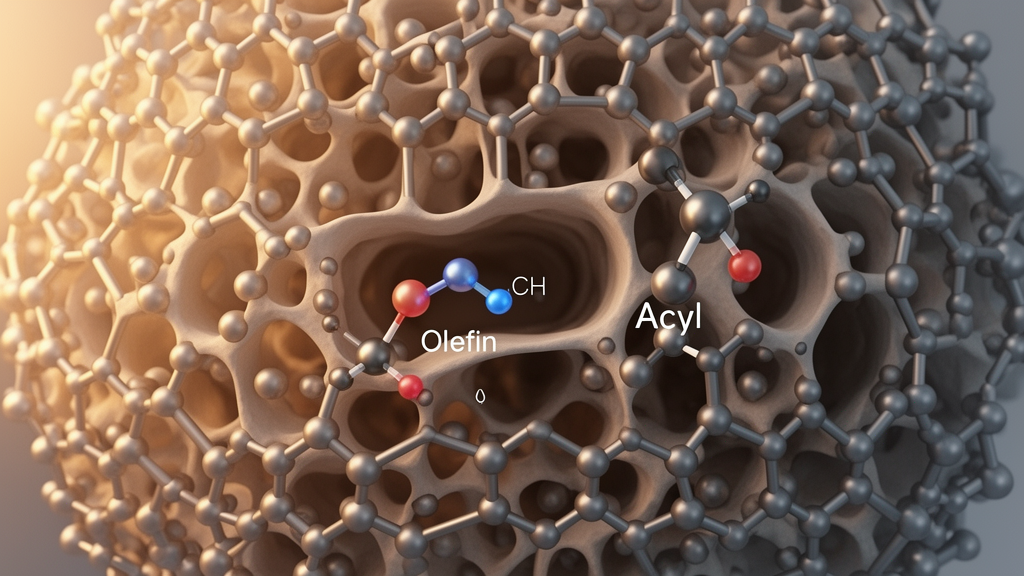
Researchers at the Dalian Institute of Chemical Physics of the Chinese Academy of Sciences have demonstrated two olefin carbonylation reactions catalyzed by zeolites without precious metals or organic ligands: the conversion of propene to isobutyric acid and the conversion of ethene to propionic acid. Both processes also proceeded in the presence of water, according to the team’s peer-reviewed study in Nature. The findings indicate that the size and position of pores within a zeolite can determine which olefins undergo carbonylation and which reaction pathway is favored.
“Zeolite-catalysed olefin carbonylation based on tuning spatial confinement” describes a catalyst design strategy that uses the material’s confined architecture as an active component of the reaction. The researchers found that active sites near the openings of ten-membered rings catalyzed propene carbonylation, whereas sites associated with eight-membered-ring cages catalyzed ethene carbonylation. This matching between pore geometry and the reactant appears to promote the desired reaction while suppressing a competing pathway: olefin polymerization.
Industrial carbonylation systems commonly use precious metals such as rhodium or iridium together with organic ligands to control catalytic activity and selectivity. The new zeolite processes instead rely on the dimensions and spatial arrangement of pores and channels within a crystalline solid. In propene carbonylation, for example, the confined environment facilitated formation of isobutyric acid; in ethene carbonylation, it supported production of propionic acid. Because the catalyst is a solid rather than a liquid-phase catalyst, it may also be easier to separate from reaction products, potentially simplifying catalyst recovery and product purification.
The study builds on work from the same team in 2017, when zeolites were used for carbonylation of dimethyl ether in a process that enabled large-scale industrial production of anhydrous ethanol. That earlier result showed that zeolites could function as catalysts rather than only as molecular sieves. The researchers subsequently explored whether their pore environments could support additional carbonylation chemistry and whether a general relationship could be established between architecture and selectivity. The two newly demonstrated reactions suggest that this approach may provide a framework for discovering and designing further zeolite-catalyzed transformations, although the study does not establish performance across the full range of possible olefins or operating conditions.
Subject of Research: Zeolite pore architecture for selective olefin carbonylation
Article Title: Zeolite pore architecture unlocks new olefin carbonylation reactions
Article References: Zeolite pore architecture unlocks new olefin carbonylation reactions. Original publication (Bibliographic details unavailable.)
Image Credits: AI Generated
DOI: Not provided
Keywords: zeolites, olefin carbonylation, isobutyric acid, propionic acid, spatial confinement, selective catalysis, porous materials, catalyst design, chemical synthesis, Zeolite, pore, architecture
News Source: Bethany Barker. (October 26, 2026). Zeolite pores enable ligand-free olefin carbonylation. Scienmag.