Researchers at multiple institutions have published a study in Acta Neuropathologica Communications that provides an exploratory single-cell transcriptomic description of the tumor microenvironment in two distinct types of vestibular schwannomas. The study focused on comparing tumors associated with NF2-related schwannomatosis, often abbreviated as NF2-SWN, with sporadic vestibular schwannomas. The primary objective was to characterize specific cell states within these tumors and to generate testable hypotheses regarding intercellular communication. By analyzing these specimens, the team aimed to address the incomplete understanding of how the tumor microenvironment differs between these two clinical entities, particularly given that NF2-related tumors can exhibit clinically aggressive behavior and pronounced vascularization.
The research team performed single-cell RNA sequencing on a total of six tumor specimens, comprising three from patients with NF2-SWN and three from patients with sporadic vestibular schwannomas. This approach allowed for the identification of 25 distinct cell clusters spanning Schwann, immune, and stromal populations. Because the biological replicate in this study was the patient, and only three tumors were available per group, the authors explicitly stated that between-group comparisons should be considered exploratory.
Among the immune populations analyzed, the study found that NK/NKT-associated cytotoxic programs were prominent in the tumor microenvironment. In contrast, few CD4-associated T cells were recovered from the samples. The authors cautioned that technical effects associated with tissue dissociation and sampling preclude interpreting the low recovery of CD4 T cells as a true biological absence.
Using a computational tool called CellChat, the researchers inferred group-associated differences in communication categories between the two tumor types. These categories included CXCL, TNF, MK, NEGR, and SEMA3 signaling pathways. However, the study emphasized that these are expression-based predictions derived from transcriptomic data. They do not establish that these pathways are actually activated or that they function as causal signaling mechanisms in the tumors.
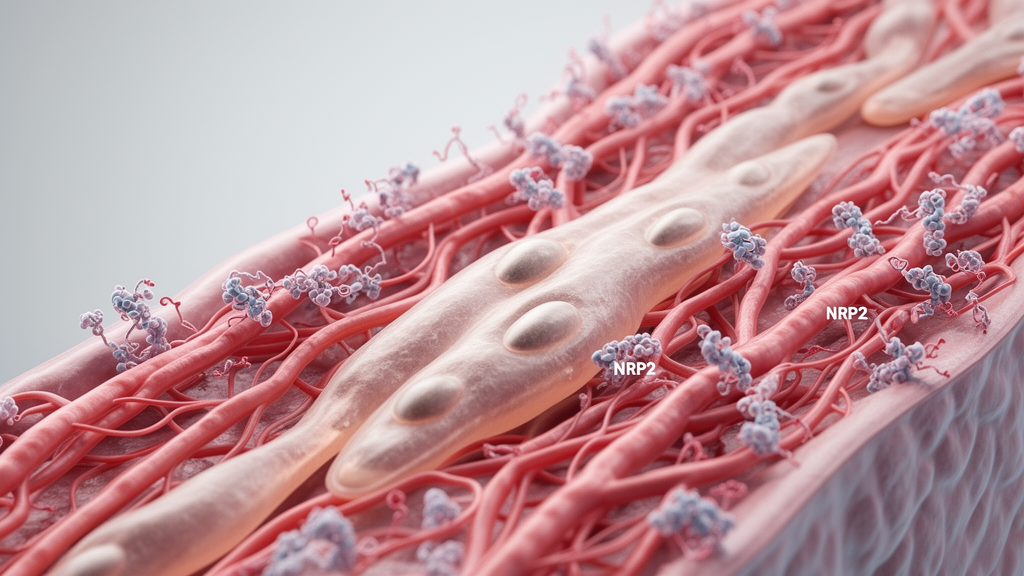
A key finding from the transcriptomic analysis was the concentration of NRP2 transcripts within the endothelial cell cluster. To investigate the functional implications of this observation, the researchers examined the effects of NRP2 knockdown in human umbilical vein endothelial cells, known as HUVECs. The study assessed the downstream effects on VEGFR2, ERK, and AKT signaling pathways.
The experimental results demonstrated that NRP2 knockdown reduced HUVEC migration and tube formation. These changes were accompanied by reductions in the phosphorylation of VEGFR2, ERK, and AKT. These findings suggest that NRP2 may play a role in supporting endothelial cell functions associated with angiogenesis. However, the study clearly positioned these results as in vitro observations.
The study concluded that it provides an exploratory single-cell description of both NF2-SWN and sporadic vestibular schwannomas. It identifies endothelial NRP2 as a candidate molecule associated with angiogenesis-related phenotypes in laboratory settings. The authors emphasized that independent cohorts, patient-level analyses, and rescue or in vivo studies are required before any disease-specific or causal conclusions can be established.
Subject of Research: Single-cell transcriptomic analysis of tumor microenvironments in NF2-related and sporadic vestibular schwannomas
Article Title: Single-cell transcriptomic analysis of the tumor microenvironment and inferred cell–cell communication in NF2-related schwannomatosis and sporadic vestibular schwannomas
Article References: Liu, Y., Ma, H., Li, Z., Yao, R., Chen, J., Tang, Q., Li, C., Shi, X., Zhang, D., Luo, S., Chen, G., Tao, B., Liu, Q., & Zhang, J. (2026). Single-cell transcriptomic analysis of the tumor microenvironment and inferred cell–cell communication in NF2-related schwannomatosis and sporadic vestibular schwannomas. Acta Neuropathologica Communications. https://doi.org/10.1186/s40478-026-02431-7
Image Credits: AI Generated
DOI: 10.1186/s40478-026-02431-7
Keywords: single-cell RNA sequencing, vestibular schwannoma, NF2-related schwannomatosis, tumor microenvironment, NRP2, endothelial cells, cell-cell communication, angiogenesis, Acta Neuropathologica Communications, Single-cell, transcriptomic, analysis
News Source: Ophelia Keating. (November 8, 2026). Single-Cell Data Reveal Endothelial NRP2 in Schwannomas. Scienmag.