• HOME
  • NEWS
  • EXPLORE
    • CAREER
      • Companies
      • Jobs
    • EVENTS
    • iGEM
      • News
      • Team
    • PHOTOS
    • VIDEO
    • WIKI
  • BLOG
  • COMMUNITY
    • FACEBOOK
    • INSTAGRAM
    • TWITTER
Monday, July 6, 2026
BIOENGINEER.ORG
No Result
View All Result
  • Login
  • HOME
  • NEWS
  • EXPLORE
    • CAREER
      • Companies
      • Jobs
        • Lecturer
        • PhD Studentship
        • Postdoc
        • Research Assistant
    • EVENTS
    • iGEM
      • News
      • Team
    • PHOTOS
    • VIDEO
    • WIKI
  • BLOG
  • COMMUNITY
    • FACEBOOK
    • INSTAGRAM
    • TWITTER
  • HOME
  • NEWS
  • EXPLORE
    • CAREER
      • Companies
      • Jobs
        • Lecturer
        • PhD Studentship
        • Postdoc
        • Research Assistant
    • EVENTS
    • iGEM
      • News
      • Team
    • PHOTOS
    • VIDEO
    • WIKI
  • BLOG
  • COMMUNITY
    • FACEBOOK
    • INSTAGRAM
    • TWITTER
No Result
View All Result
Bioengineer.org
No Result
View All Result
Home NEWS Science News Health

Sensing internal organ temperature with shining lights

Bioengineer by Bioengineer
March 24, 2020
in Health
Reading Time: 2 mins read
0
IMAGE
Share on FacebookShare on TwitterShare on LinkedinShare on RedditShare on Telegram

IMAGE

Credit: Tohoku University


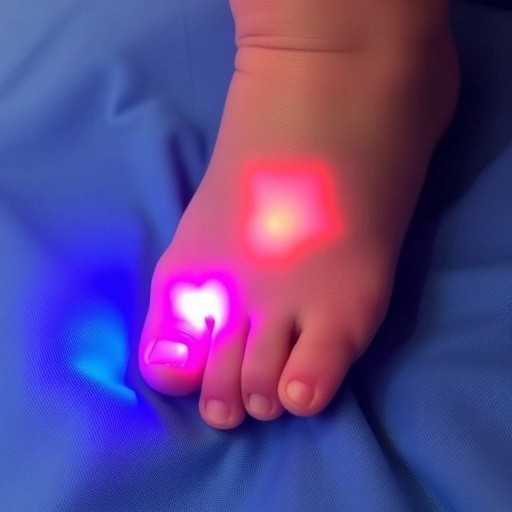
A cheap, biocompatible white powder that luminesces when heated could be used for non-invasively monitoring the temperature of specific organs within the body. Tohoku University scientists conducted preliminary tests to demonstrate the applicability of this concept and published their findings in the journal Scientific Reports.

Thermometers measure temperature at the body’s surface, but clinicians need to be able to monitor and manage core body temperatures in some critically ill patients, such as following head injuries or heart attacks. Until now, this is most often done by inserting a tiny tube into the heart and blood vessels. But scientists are looking for less invasive means to monitor temperature from within the body.

Applied physicist Takumi Fujiwara of Tohoku University and colleagues in Japan investigated the potential of a white powder called zirconia for this purpose.

Zirconia is a synthetic powder that is easily accessible, chemically stable, and non-toxic. When heated, its crystals become excited, releasing electrons. These electrons then recombine with ‘holes’ in the crystal molecular structure, a process that causes the crystals to emit light, or luminesce. Because of this material’s advantageous properties for use in the human body, the scientists wanted to test and see if its luminescence could be used for monitoring temperature.

The team heated zirconia under an ultraviolet lamp, and found that as zirconia’s temperature rose, its luminescence intensified. The same thing happened when a near-infrared laser light was shone on the material. This demonstrated that both heat and light could be used to induce luminescence in zirconia.

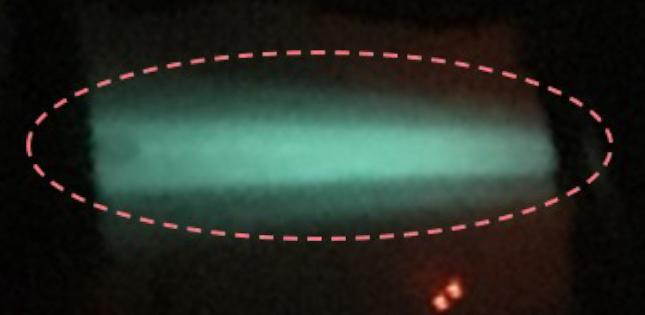
The scientists next showed that zirconia luminescence was visible with the naked eye when placed behind a piece of bone and illuminated using a near-infrared laser.

Together, the demonstrations suggest zirconia could potentially monitor internal body temperature by injecting it and then shining a near-infrared laser light on a targeted location, such as the brain. The intensity and longevity of the material’s luminescence will depend on the surrounding temperature.

“While this fundamental study leaves some important issues unresolved, this work is a novel and promising application of [synthetic luminescent substances] in the medical field,” the researchers conclude. Going forward, the researchers hope to discover a method that makes the wavelength of luminescence from zirconia in the region of red to near-infrared since it makes for better transmissibility for human tissues; thus, allowing for clearer information to be obtained.

###

Media Contact
Takumi Fujiwara
[email protected]
81-227-957-964

Original Source

https://www.tohoku.ac.jp/en/press/sensing_internal_organ_temperature_with_shining_lights.html

Related Journal Article

http://dx.doi.org/10.1038/s41598-020-58979-4

Tags: Medicine/Health
Share12Tweet8Share2ShareShareShare2

Related Posts

Laser Lancing Non-Inferior to Heel Prick for Preemies

July 6, 2026

De Jong Gierveld Scale validated for Portuguese seniors

July 6, 2026

DPP3 Sets the Immune Bar for Infection Survival

July 6, 2026

Lysine Pyruvylation Links Glycolysis to Epigenetics

July 4, 2026
Please login to join discussion

POPULAR NEWS

  • Detection of EDCs in Breast Milk and Infant Urine Up to Six Months Highlights Early Exposure Risks

    77 shares
    Share 31 Tweet 19
  • New Drug Candidate Developed at McMaster Shows Potential for Treating Brain Cancer

    58 shares
    Share 23 Tweet 15
  • Saying Goodbye to PGY-6: Pediatric Fellowship Realities

    103 shares
    Share 41 Tweet 26
  • KTU Researchers Explore Ultrasound’s Role in Enhancing Blood Flow Beyond Diagnostics

    53 shares
    Share 21 Tweet 13

About

BIOENGINEER.ORG

We bring you the latest biotechnology news from best research centers and universities around the world. Check our website.

Follow us

Recent News

Neighbours rewire soil feedback via root microbiome shifts

Laser Lancing Non-Inferior to Heel Prick for Preemies

De Jong Gierveld Scale validated for Portuguese seniors

Subscribe to Blog via Email

Enter your email address to subscribe to this blog and receive notifications of new posts by email.

Join 83 other subscribers
  • Contact Us

Bioengineer.org © Copyright 2023 All Rights Reserved.

Welcome Back!

Login to your account below

Forgotten Password?

Retrieve your password

Please enter your username or email address to reset your password.

Log In
No Result
View All Result
  • Homepages
    • Home Page 1
    • Home Page 2
  • News
  • National
  • Business
  • Health
  • Lifestyle
  • Science

Bioengineer.org © Copyright 2023 All Rights Reserved.