Designing high-performance alloy catalysts is often blocked by a stubborn problem: many pairs of elements simply refuse to mix. Tungsten and bismuth are a prime example, because thermodynamic immiscibility keeps them from forming stable alloys at the nanoscale. A team reporting in Nature Synthesis has now described a way around this limitation that does not rely on adding many extra elements to force mixing.
High-entropy designs can overcome immiscibility by incorporating multiple elements into a single phase, but the researchers note two drawbacks of that approach. Active sites are often diluted, and structure–property relationships become obscured, making it harder to understand which parts of the material are actually doing the catalytic work.
The alternative, which the authors call a compositionally minimalist seed-confined alloying strategy, uses a single thermodynamically selected seed rather than multiple additional alloying elements, combined with pathway-controlled alloy formation. Platinum was chosen as the representative seed because favourable Pt–W and Pt–Bi interactions improve the accessibility of ternary alloying while also providing active sites for methanol oxidation.
A key step in the method is pre-anchoring, which creates dispersed incorporation centres for the other elements. According to the abstract, this promotes multi-element association and suppresses competing phases, guiding the alloy to form along a pre-anchored pathway instead of separating into its constituent materials.
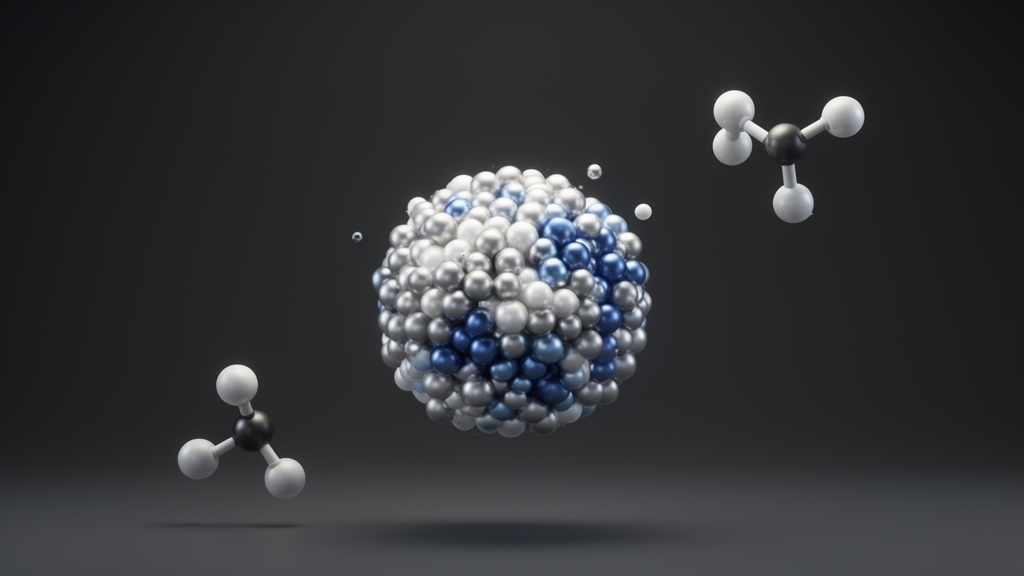
The resulting catalyst, named WBi–Pt@B/C, consists of dispersed, robust nanoparticles with a diameter of approximately 3.6 nanometres. In methanol oxidation reactions, it delivered a mass activity of 13.41 amperes per milligram of platinum, and it retained 94.1% of its activity after 5,000 cycles, indicating good durability in the reported tests.
The abstract states that the new catalyst combines chemically complementary functions within a compositionally simple nanoscale alloy, pairing the platinum seed’s active sites with the incorporated tungsten and bismuth.
The authors describe the strategy as a practical route to constructing nanoscale alloy catalysts from highly immiscible elements. By keeping the composition simple—one seed element plus the immiscible pair—the approach aims to preserve clear structure–property relationships while still accessing alloy phases that conventional synthesis would not deliver.
The reported figures come from the article’s abstract, which summarizes the thermodynamic seed selection, the structural realization of the strategy, comparative characterization against control synthesis routes, and the methanol oxidation performance and post-stability analysis of the WBi–Pt@B/C catalyst. The full study, published on 27 October 2026 in Nature Synthesis, presents these results in detail, including the mechanistic basis and design rules for thermodynamically guided seed-confined alloying.
For researchers working on fuel-cell electrocatalysts, the work suggests that carefully chosen single seeds, rather than complex multi-element compositions, may be enough to bring immiscible elements into working alloy catalysts. The reported activity and cycling stability of WBi–Pt@B/C in methanol oxidation provide a concrete demonstration of that principle as described in the published abstract.
Subject of Research: A seed-confined alloying strategy for nanoscale alloys of immiscible elements as methanol oxidation catalysts
Article Title: A seed-confined strategy to alloy immiscible systems for methanol oxidation
Article References: Hu, R., Chen, J., Cai, L., Liu, H., Rao, Y., Zeng, X., Lian, J., Lin, C., Wang, B., Yang, S., Wan, J., Xu, W., Xia, B. Y., & Yao, Y. (2026). A seed-confined strategy to alloy immiscible systems for methanol oxidation. Nature Synthesis. https://doi.org/10.1038/s44160-026-01200-7
Image Credits: AI Generated
DOI: 10.1038/s44160-026-01200-7
Keywords: seed-confined alloying, immiscible elements, WBi–Pt@B/C, methanol oxidation, platinum catalysts, nanoparticles, electrocatalysis, thermodynamics, fuel cells, Nature Synthesis, seed-confined, strategy
News Source: Alan Morgan. (October 27, 2026). Seed-confined alloying unlocks immiscible W–Bi–Pt catalysts for methanol oxidation. Scienmag.