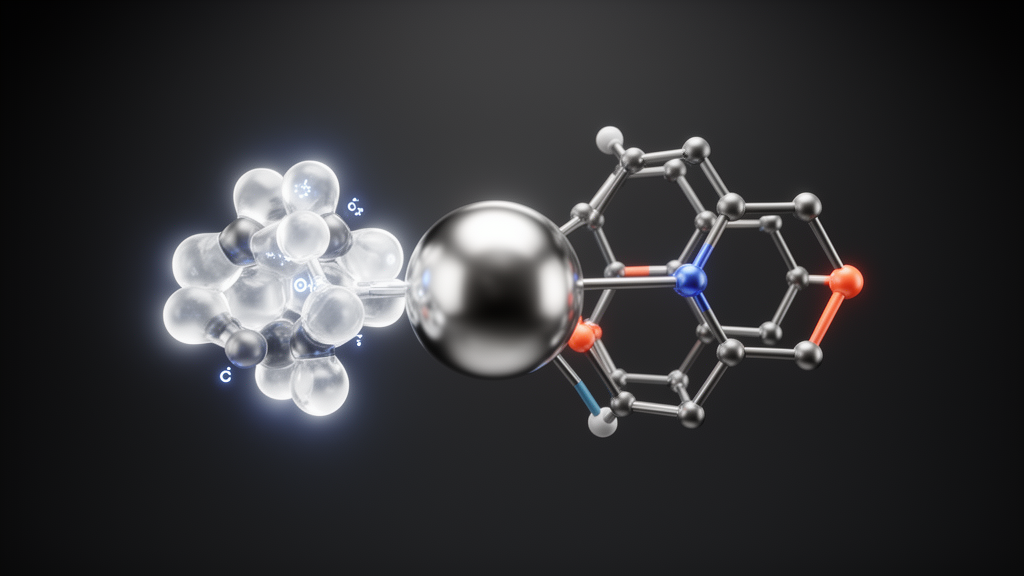
Chemists have developed a nickel-catalysed strategy that builds thermodynamically disfavoured stereoisomers of substituted cyclohexanes, a class of ring structures central to drug discovery. The method, reported in Nature Synthesis, uses a dual-ligand system in which an anionic and a neutral ligand work together to control which stereochemical product forms during the catalytic reaction.
Substituted cyclohexanes are key motifs in medicinal chemistry, because distinct stereoisomers of the same molecule can produce divergent biological activities. While established methods readily deliver the thermodynamically favoured stereoisomers, selectively synthesising their disfavoured counterparts has remained difficult. The new platform addresses this gap through nickel-catalysed three-component 1,1-arylfunctionalization of substituted methylenecyclohexanes, achieving high kinetic stereocontrol.
The reaction combines aryl and alkenyl bromides with N-sulfenyl-N-alkyl sulfonamide reagents, which the authors denote as [N–S] reagents, to form 1,2-cis, 1,3-trans and 1,4-cis isomers that are thermodynamically disfavoured. According to the study, the transformation proceeds with high efficiency and selectivity across a broad substrate scope.
Mechanistic insight came from combined experimental and computational studies. These showed that the disfavoured cyclohexane products are formed preferentially, and highlighted the critical role of the external ligand in controlling stereoselectivity during the nickel–hydride migratory insertion step.
The researchers also demonstrated the practicality of the approach through the rapid and concise synthesis of biologically relevant molecules, indicating potential utility for medicinal chemistry programmes that need access to specific, otherwise hard-to-make stereoisomers.
Subject of Research: Nickel-catalysed stereoselective synthesis of thermodynamically disfavoured substituted cyclohexanes using a dual-ligand system
Article Title: Combining anionic and neutral ligands for kinetic stereocontrol in nickel catalysis
Article References: Zhao, D., Luo, Y., Long, J., Shi, H., Qi, X., Li, Y., & Yin, G. (2026). Combining anionic and neutral ligands for kinetic stereocontrol in nickel catalysis. Nature Synthesis. https://doi.org/10.1038/s44160-026-01175-5
Image Credits: AI Generated
DOI: 10.1038/s44160-026-01175-5
Keywords: nickel catalysis, stereocontrol, cyclohexanes, dual-ligand system, 1,1-arylfunctionalization, methylenecyclohexanes, kinetic stereocontrol, drug discovery, migratory insertion, Nature Synthesis, Combining, anionic
News Source: Bethany Barker. (October 27, 2026). Nickel catalyst pairs anionic and neutral ligands to steer cyclohexane stereochemistry. Scienmag.