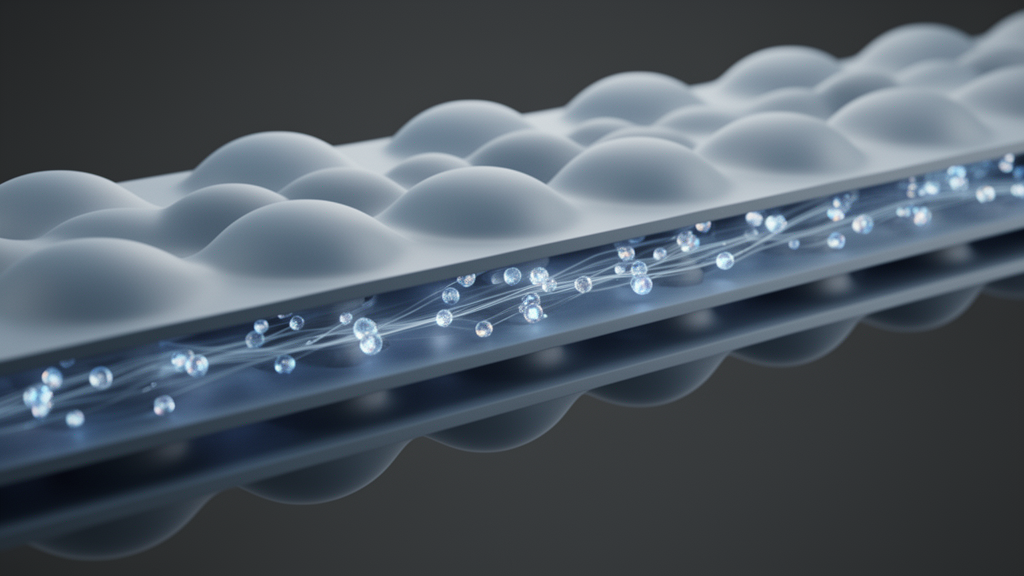
Nanofluidic memristors, devices that process information using ions rather than electrons, have long promised brain-inspired computing, but the microscopic origin of their ionic memory has remained debated. A study published in Nature Materials on 27 October 2026 now reports direct visual evidence for one mechanism: voltage-induced blistering of the walls that confine two-dimensional nanofluidic channels.
The researchers combined operando interferometric imaging with electrokinetic measurements to watch the channels as devices operated. Rather than attributing memory to ion-specific interactions, dynamic wetting, chemical reactions or mechanical deformations, as earlier proposals had done typically without direct experimental evidence, the team directly visualized the deformation of the confining walls and linked it to the memristive hysteresis that underlies nonlinear ion transport in the channels.
The imaging revealed two distinct classes of blisters. Unidirectional blisters are driven by electrostatic forces acting on surface charges, while bidirectional blisters arise from osmotic pressure generated by concentration polarization. According to the authors, this mechanistic framework explains how devices evolve during operation and why their behaviour varies from device to device, and it reframes the stochastic nature of blistering not as a nuisance but as a functional design element.
The study, led by Kalluvadi Veetil Saurav, Nathan Ronceray and colleagues including Boya Radha, is described as a direct proof of electromechanical coupling as a robust pathway to ionic memory in two-dimensional nanochannels. The authors suggest the findings open routes towards high-performance ionic memristors and electrically actuated nanofluidic valves.
Subject of Research: Microscopic origin of ionic memory in two-dimensional nanofluidic memristors
Article Title: Direct imaging elucidates ionic memory in two-dimensional nanochannels
Article References: Saurav, K. V., Ronceray, N., Coquinot, B., Pizarro, A. D., Keerthi, A., Emmerich, T., Radenovic, A., & Radha, B. (2026). Direct imaging elucidates ionic memory in two-dimensional nanochannels. Nature Materials. https://doi.org/10.1038/s41563-026-02775-4
Image Credits: AI Generated
DOI: 10.1038/s41563-026-02775-4
Keywords: nanofluidics, memristor, ionic memory, two-dimensional channels, blistering, electromechanical coupling, operando imaging, electrokinetics, osmotic pressure, concentration polarization, Nature Materials, Direct
News Source: Denise Maddox. (October 27, 2026). Blistering walls give two-dimensional nanochannels their ionic memory. Scienmag.