• HOME
  • NEWS
  • EXPLORE
    • CAREER
      • Companies
      • Jobs
    • EVENTS
    • iGEM
      • News
      • Team
    • PHOTOS
    • VIDEO
    • WIKI
  • BLOG
  • COMMUNITY
    • FACEBOOK
    • INSTAGRAM
    • TWITTER
Wednesday, May 13, 2026
BIOENGINEER.ORG
No Result
View All Result
  • Login
  • HOME
  • NEWS
  • EXPLORE
    • CAREER
      • Companies
      • Jobs
        • Lecturer
        • PhD Studentship
        • Postdoc
        • Research Assistant
    • EVENTS
    • iGEM
      • News
      • Team
    • PHOTOS
    • VIDEO
    • WIKI
  • BLOG
  • COMMUNITY
    • FACEBOOK
    • INSTAGRAM
    • TWITTER
  • HOME
  • NEWS
  • EXPLORE
    • CAREER
      • Companies
      • Jobs
        • Lecturer
        • PhD Studentship
        • Postdoc
        • Research Assistant
    • EVENTS
    • iGEM
      • News
      • Team
    • PHOTOS
    • VIDEO
    • WIKI
  • BLOG
  • COMMUNITY
    • FACEBOOK
    • INSTAGRAM
    • TWITTER
No Result
View All Result
Bioengineer.org
No Result
View All Result
Home NEWS Science News Biology

Scientists use microorganism to fabricate functional bacterial cellulose in situ

Bioengineer by Bioengineer
January 29, 2019
in Biology
Reading Time: 2 mins read
0
IMAGE
Share on FacebookShare on TwitterShare on LinkedinShare on RedditShare on Telegram

IMAGE

Credit: GAO Minghong


Bacterial cellulose (BC) is a cellulose material produced by microbial fermentation with a unique porous network structure. Functionalized BC has application prospects in many fields, such as chemical sensing, biological imaging, and oil adsorption.

At present, BC is often functionalized through physical coating or chemical modification. Physical coating can provide a mild modification condition, but functional moieties potentially suffer from shedding. Chemically modified materials are difficult to implement for industrial-scale production, due to their poor performance and serious environmental pollution.

Recently, a research team led by Prof. XIAN Mo and ZHANG Haibo from the Qingdao Institute of Bioenergy and Bioprocess Technology (QIBEBT) of the Chinese Academy of Sciences developed a new method for bacterial cellulose functionalization.

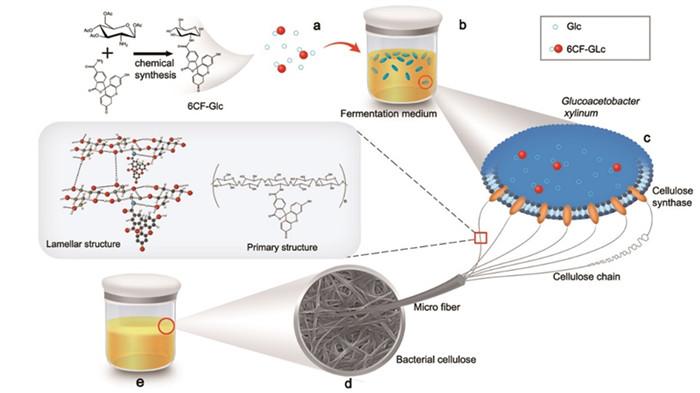
BC with unnatural fluorescent functionality was obtained through in situ fermentation of Komagataeibacter sucrofermentans (K. sucrofermentans, a microorganism that produces BC), using 6-carboxyfluorescein-modified glucose (6CF- Glc, a modified glucose molecule that has fluorescence) as a substrate (Fig. 1).

The method proved the feasibility of in situ synthesis of functional materials by microbial fermentation, achieved the microbial synthesis of fluorescent functional cellulose materials and successfully extended synthetic biology to the field of material functionalization.

The excellent properties of the functional materials were analyzed by various methods and compared with that of cellulose obtained by traditional modification methods.

The results showed that the new method had the advantages of environmental protection, low cost, controllable and uniform distribution of functional moieties, and solving the bottleneck problem in the synthesis and performance of functional materials. The new method was also expected to achieve the chiral modification of functional molecules on specific molecular sites.

This work provides not only new insights and ideas for the biosynthesis of functional BC materials, but also a new perspective for the in situ synthesis of other functional materials by microorganisms.

###

The study, published in Nature Communications, was supported by the National Natural Science Foundation of China, the Chinese Academy of Sciences Youth Promotion Association, the Hainan Provincial Key Research and Development Program and the Shandong Taishan Climbing Program.

Media Contact
CHENG Jing
[email protected]

Related Journal Article

http://dx.doi.org/10.1038/s41467-018-07879-3

Tags: BacteriologyChemistry/Physics/Materials SciencesMaterialsMicrobiology
Share12Tweet8Share2ShareShareShare2

Related Posts

Cutting-Edge Genomic Techniques Reveal Unexpected Cellular Changes in the Aging Brain — Biology

Cutting-Edge Genomic Techniques Reveal Unexpected Cellular Changes in the Aging Brain

May 12, 2026
USC Researchers Initiate Study on the Most Advanced Lab-Grown Kidney Structures — Biology

USC Researchers Initiate Study on the Most Advanced Lab-Grown Kidney Structures

May 12, 2026

Childbirth in Humans Is Not Uniquely Challenging Among Mammals, New Research Shows

May 12, 2026

From Complexity to Clarity: Unraveling the “Topological Laws” Governing Cell Death

May 11, 2026
Please login to join discussion

POPULAR NEWS

  • Research Indicates Potential Connection Between Prenatal Medication Exposure and Elevated Autism Risk

    842 shares
    Share 337 Tweet 211
  • New Study Reveals Plants Can Detect the Sound of Rain

    728 shares
    Share 290 Tweet 182
  • Salmonella Haem Blocks Macrophages, Boosts Infection

    62 shares
    Share 25 Tweet 16
  • Breastmilk Balances E. coli and Beneficial Bacteria in Infant Gut Microbiomes

    57 shares
    Share 23 Tweet 14

About

We bring you the latest biotechnology news from best research centers and universities around the world. Check our website.

Follow us

Recent News

Nanoplatform Combats Skin Inflammation via RNA, ROS

PSU-Led Team Advances Promising New Drug Candidate for Malaria Control and Eradication

Study Finds Increased Psychosis Risk in High-Risk Groups with Combined Cannabis and Tobacco Use

Subscribe to Blog via Email

Enter your email address to subscribe to this blog and receive notifications of new posts by email.

Join 82 other subscribers
  • Contact Us

Bioengineer.org © Copyright 2023 All Rights Reserved.

Welcome Back!

Login to your account below

Forgotten Password?

Retrieve your password

Please enter your username or email address to reset your password.

Log In
No Result
View All Result
  • Homepages
    • Home Page 1
    • Home Page 2
  • News
  • National
  • Business
  • Health
  • Lifestyle
  • Science

Bioengineer.org © Copyright 2023 All Rights Reserved.