• HOME
  • NEWS
  • EXPLORE
    • CAREER
      • Companies
      • Jobs
    • EVENTS
    • iGEM
      • News
      • Team
    • PHOTOS
    • VIDEO
    • WIKI
  • BLOG
  • COMMUNITY
    • FACEBOOK
    • INSTAGRAM
    • TWITTER
Sunday, May 17, 2026
BIOENGINEER.ORG
No Result
View All Result
  • Login
  • HOME
  • NEWS
  • EXPLORE
    • CAREER
      • Companies
      • Jobs
        • Lecturer
        • PhD Studentship
        • Postdoc
        • Research Assistant
    • EVENTS
    • iGEM
      • News
      • Team
    • PHOTOS
    • VIDEO
    • WIKI
  • BLOG
  • COMMUNITY
    • FACEBOOK
    • INSTAGRAM
    • TWITTER
  • HOME
  • NEWS
  • EXPLORE
    • CAREER
      • Companies
      • Jobs
        • Lecturer
        • PhD Studentship
        • Postdoc
        • Research Assistant
    • EVENTS
    • iGEM
      • News
      • Team
    • PHOTOS
    • VIDEO
    • WIKI
  • BLOG
  • COMMUNITY
    • FACEBOOK
    • INSTAGRAM
    • TWITTER
No Result
View All Result
Bioengineer.org
No Result
View All Result
Home NEWS Science News Chemistry

Scientists create ‘artificial leaf’ that turns carbon into fuel

Bioengineer by Bioengineer
November 4, 2019
in Chemistry
Reading Time: 2 mins read
0
IMAGE
Share on FacebookShare on TwitterShare on LinkedinShare on RedditShare on Telegram

Converts harmful carbon dioxide into useful alternative fuel
IMAGE

Credit: University of Waterloo

Scientists have created an “artificial leaf” to fight climate change by inexpensively converting harmful carbon dioxide (CO2) into a useful alternative fuel.

The new technology, outlined in a paper published today in the journal Nature Energy, was inspired by the way plants use energy from sunlight to turn carbon dioxide into food.

“We call it an artificial leaf because it mimics real leaves and the process of photosynthesis,” said Yimin Wu, an engineering professor at the University of Waterloo who led the research. “A leaf produces glucose and oxygen. We produce methanol and oxygen.”

Making methanol from carbon dioxide, the primary contributor to global warming, would both reduce greenhouse gas emissions and provide a substitute for the fossil fuels that create them.

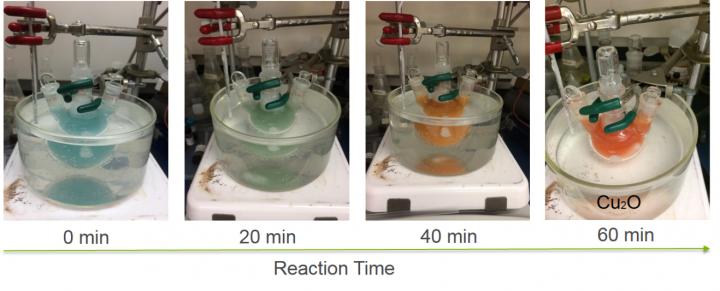
The key to the process is a cheap, optimized red powder called cuprous oxide.

Engineered to have as many eight-sided particles as possible, the powder is created by a chemical reaction when four substances – glucose, copper acetate, sodium hydroxide and sodium dodecyl sulfate – are added to water that has been heated to a particular temperature.

The powder then serves as the catalyst, or trigger, for another chemical reaction when it is mixed with water into which carbon dioxide is blown and a beam of white light is directed with a solar simulator.

“This is the chemical reaction that we discovered,” said Wu, who has worked on the project since 2015. “Nobody has done this before.”

The reaction produces oxygen, as in photosynthesis, while also converting carbon dioxide in the water-powder solution into methanol. The methanol is collected as it evaporates when the solution is heated.

Next steps in the research include increasing the methanol yield and commercializing the patented process to convert carbon dioxide collected from major greenhouse gas sources such as power plants, vehicles and oil drilling.

“I’m extremely excited about the potential of this discovery to change the game,” said Wu, a professor of mechanical and mechatronics engineering, and a member of the Waterloo Institute for Nanotechnology. “Climate change is an urgent problem and we can help reduce CO2 emissions while also creating an alternative fuel.”

###

Wu collaborated on the paper, Facet-dependent active sites of a single Cu2O particle photocatalyst for CO2 reduction to methanol, with Tijana Rajh and other researchers at the Argonne National Laboratory in Illinois, as well as scientists at California State University, Northridge, and the City University of Hong Kong.

Media Contact
Chris Wilson-Smith
[email protected]
226-338-6564

Tags: AgricultureBiologyBiomechanics/BiophysicsBiomedical/Environmental/Chemical EngineeringBiotechnologyClimate ChangeEnergy SourcesMechanical EngineeringPlant SciencesTechnology/Engineering/Computer Science
Share13Tweet8Share2ShareShareShare2

Related Posts

New Drexel Study Reveals Key to Keeping Students on Track in Physics Learning — Chemistry

New Drexel Study Reveals Key to Keeping Students on Track in Physics Learning

May 15, 2026
Reversible Glue Technology Powers Up with Electric Activation — Chemistry

Reversible Glue Technology Powers Up with Electric Activation

May 15, 2026

Sweet as Honey: Unveiling a New Heat Transport Regime in Ultrathin Semiconductors

May 15, 2026

High-Precision Boltzmann Luminescent Nanothermometry Achieved Through Predictive Rules

May 15, 2026
Please login to join discussion

POPULAR NEWS

  • Research Indicates Potential Connection Between Prenatal Medication Exposure and Elevated Autism Risk

    844 shares
    Share 338 Tweet 211
  • New Study Reveals Plants Can Detect the Sound of Rain

    730 shares
    Share 291 Tweet 182
  • Salmonella Haem Blocks Macrophages, Boosts Infection

    62 shares
    Share 25 Tweet 16
  • Breastmilk Balances E. coli and Beneficial Bacteria in Infant Gut Microbiomes

    58 shares
    Share 23 Tweet 15

About

We bring you the latest biotechnology news from best research centers and universities around the world. Check our website.

Follow us

Recent News

Detecting Illicit Bitcoin Transactions with Temporal Graph Learning

New Study Reveals the Massive Economic Impact of Tuberculosis

Age Discrimination Affects Healthcare Use in India

Subscribe to Blog via Email

Enter your email address to subscribe to this blog and receive notifications of new posts by email.

Join 82 other subscribers
  • Contact Us

Bioengineer.org © Copyright 2023 All Rights Reserved.

Welcome Back!

Login to your account below

Forgotten Password?

Retrieve your password

Please enter your username or email address to reset your password.

Log In
No Result
View All Result
  • Homepages
    • Home Page 1
    • Home Page 2
  • News
  • National
  • Business
  • Health
  • Lifestyle
  • Science

Bioengineer.org © Copyright 2023 All Rights Reserved.