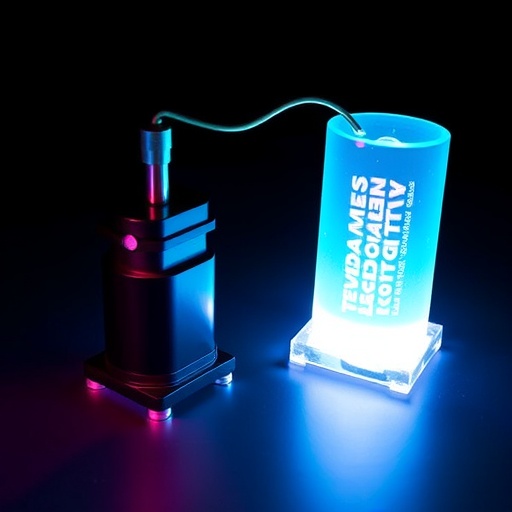
In the quest for precise temperature measurement at the microscale, a groundbreaking approach has emerged from the frontier of luminescent nanothermometry. This innovative technique harnesses the unique optical properties of lanthanide ions, converting temperature variations into detectable light emissions. Such remote optical sensing has vast implications across microelectronics, energy systems, and biomedicine, where subtle thermal shifts can dictate performance, reaction kinetics, or therapeutic efficacy.
At the core of luminescent nanothermometry lies the principle of thermally coupled energy levels (TCLs) in lanthanide ions. These paired excited states exchange populations in a manner governed by Boltzmann statistics, generating an intensity ratio of emissions correlating directly with temperature. This ratiometric readout, being self-referenced, holds the promise of robust, calibration-free thermal sensing. However, practical implementations have faced persistent deviations from ideal Boltzmann behavior, particularly within the conventional energy gap ranges of 200 to 2000 cm⁻¹. Such disparities reveal underlying complexities beyond the simplistic two-level thermodynamic model.
The root of these deviations has been traced to incomplete thermalization between the two coupled levels. In real systems, population exchange contends with competing processes: radiative decay of excited states, nonradiative multiphonon relaxation, and undesired leakage to adjacent lower energy states. These competing mechanisms erode the expected equilibrium distribution, causing the thermometric signal to stray from pure Boltzmann dependence over wide temperature spans. This insight compels a reevaluation of the assumptions underpinning TCL-based luminescent thermometry.
Addressing this challenge, recent research introduces an advanced population-dynamics framework that quantifies the onset temperature at which Boltzmann behavior truly manifests. This model juxtaposes nonradiative exchange rates against radiative decay rates, revealing a critical thermal-coupling window. A pivotal mechanistic insight arises: for a thermally coupled pair to maintain robust Boltzmannly governed population exchange, the closest lower-lying energy level must be separated by an energy exceeding twice the TCL gap. This discovery delivers an intuitive stability criterion, providing a practical metric to screen and validate candidate thermometric pairs beyond empirical selection.
This new stability rule elegantly accounts for why some nominally suitable TCL pairs fail to demonstrate clean Boltzmann thermometry in experiments. It further implies that successful design of lanthanide-based nanothermometers mandates careful electronic structure consideration, particularly the energy landscape surrounding TCLs. Consequently, this mechanistic criterion serves as a rational guide for future exploration, enabling more targeted efforts to engineer reliable luminescent thermometers at the nanoscale.
Yet, the challenge does not end at identifying TCL pairs—the surrounding host lattice chemistry profoundly influences thermometric performance. Recognizing this, the research proposes a chemical-bond parameter termed a “splitting factor,” which links the energy separation of TCLs to microscopic properties of the host crystal field. This conceptual bridge unites atomic-scale interactions with macroscopic luminescent behavior, unlocking the possibility for intentional crystal-field engineering and host material selection to systematically tune energy gaps and thereby optimize thermometric sensitivity and operational temperature windows.
Such chemically informed design strategies transcend previous trial-and-error approaches, empowering material scientists to rationally tailor nanothermometer characteristics. By manipulating doping schemes and host-lattice environments, it becomes feasible to boost sensitivity, extend dynamic range, or enhance signal-to-noise ratios—advancements crucial for real-world applications where precision and robustness are paramount.
To exemplify the utility of this framework, experimental efforts focused on dual TCL architectures that combine thermally enhanced and thermally quenched emission channels. Using fluoride host materials codoped with Er³⁺ and Nd³⁺ ions, the researchers achieved remarkable sensing performance, peaking at a relative sensitivity of 6.17% K⁻¹. Notably, the system also demonstrated sub-0.1 K thermal resolution, underscoring the potential to detect minute temperature fluctuations with unprecedented accuracy and reliability.
Complementing these materials advances, the work also delivers practical sensor prototypes: ultra-thin, flexible thermosensing patches embedded with phosphor particles dispersed in polymer films. These patches operate under near-infrared excitation and enable real-time, noncontact temperature monitoring on curved surfaces—an essential feature for integration into complex devices or biological systems. The patches’ pliable format and high brightness make them ideal for deployment in challenging geometries where conventional sensors falter.
Rigorous in situ testing of these patches under heating conditions revealed a maximum temperature readout deviation below 0.8 K, along with excellent signal repeatability. Such robust performance validates the concept’s applicability beyond laboratory settings, promising transformative impacts in microelectronic thermal management, chemical process monitoring, and biomedical diagnostics where precision thermal mapping can illuminate hidden phenomena or optimize performance.
Ultimately, this comprehensive advance in luminescent nanothermometry bridges fundamental mechanistic understanding with predictive design and practical implementation. By elucidating when Boltzmann statistics apply and how energy-level environments shape thermal sensing, the research delineates a clear path toward next-generation nanothermometers with both superior accuracy and versatility. This capability will undoubtedly catalyze progress in fields demanding high-resolution thermal characterization at unprecedented spatial scales.
Moreover, the integration of theoretical criteria, chemical insights, and demonstrative prototypes signals a paradigm shift in nanothermometer development. No longer confined to chance discoveries, researchers can now systematically engineer materials and devices to meet stringent thermal sensing requirements. In doing so, this work paves the way for widespread adoption of luminescent nanothermometry in science and technology, unlocking new possibilities in precision temperature control and diagnostics.
In closing, the synthesis of population dynamics modeling, host lattice chemistry, and device fabrication encapsulated in this research marks a milestone for optical thermometry. As temperature continues to be a fundamental parameter governing myriad processes, these innovations offer a beacon guiding future explorations toward more sensitive, reliable, and adaptable luminescent nanothermometers. The fusion of mechanistic clarity and design foresight exemplifies how interdisciplinary science can illuminate complex challenges, turning them into powerful tools that reshape technology landscapes.
Subject of Research: Luminescent nanothermometry, population dynamics of thermally coupled lanthanide ion energy levels, and predictive design of luminescent temperature sensors.
Article Title: Boltzmann luminescent nanothermometry: mechanistic criteria and predictive design of thermally coupled levels
Web References:
10.1038/s41377-026-02260-2
Image Credits: Zuoling Fu et al.
Keywords
Luminescent nanothermometry, thermally coupled levels, Boltzmann statistics, lanthanide ions, population dynamics, energy-level stability, crystal-field engineering, optical temperature sensing, Er³⁺/Nd³⁺ codoping, ratiometric thermometry, nonradiative relaxation, thermal resolution
Tags: Boltzmann luminescent temperature sensingcalibration-free thermal sensing techniqueshigh-precision luminescent nanothermometrylanthanide ion thermometrymicroscale temperature measurement methodsnonradiative multiphonon relaxation effectsoptical sensing in microelectronicspredictive modeling in nanothermometryratiometric optical temperature measurementtemperature-dependent lanthanide emissionthermalization challenges in nanothermometrythermally coupled energy levels in nanothermometry