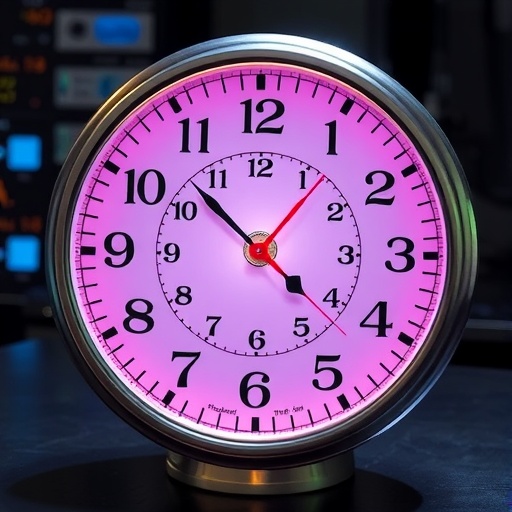
In a groundbreaking theoretical advance, a team of international physicists has devised a method to observe the elusive interplay between quantum mechanics and relativistic time dilation using optical ion atomic clocks. Published in Physical Review Letters, this work originates from Kyushu University, alongside collaborators from the Stevens Institute of Technology, University of Waterloo, the National Institute of Standards and Technology, Colorado State University, and Stockholm University. Their framework proposes that current cutting-edge trapped-ion atomic clocks are not only capable of measuring time with extraordinary precision but can also reveal the subtle “quantum superposition of times” — a phenomenon where different rates of time flow coexist simultaneously due to relativistic effects and quantum entanglement.
Atomic clocks have long been heralded as some of the most accurate measuring devices ever constructed, employing the intrinsic frequency of specific atomic transitions to define the flow of time. These clocks underpin global positioning systems, telecommunications networks, and fundamental scientific research. The latest generation of optical ion clocks, which trap individual ions using electromagnetic fields and interrogate their electronic states with lasers, achieve fractional uncertainties below the 10^-18 level. This unprecedented sensitivity enables them to detect tiny relativistic time dilations induced by differences in height of mere millimeters, affirming Einstein’s theory of general relativity with exquisite precision.
However, when quantum principles are introduced to the concept of time measurement, the notion of time itself takes on a far more nuanced character. Quantum mechanics allows systems to exist in superpositions of states — which in this context means a clock can effectively experience multiple possible flows of time simultaneously. This leads to a scenario where the clock’s internal quantum state becomes entangled with its external motion, and the distinct temporal evolutions are intertwined in a way that defies classical intuition. Until now, these effects had only been predicted theoretically and remained inaccessible to direct experimental observation.
The research team’s innovative approach centers on the controlled entanglement between the atomic clock’s internal energy levels and its relativistic motion. By delicately manipulating the ion’s motion within the trap, the scientists demonstrated how this entanglement manifests as measurable quantum decoherence, where the clock loses some of its pristine quantum coherence due to relativistic time dilation acting differently on its superposed motional states. This subtle signal serves as a direct signature of the quantum nature of proper time — time measured by a clock traveling along its own path in spacetime.
Associate Professor Joshua Foo of Kyushu University’s Institute for Advanced Studies, one of the lead authors, highlights the novelty of the technique: “We introduced a new method to control the motional degrees of freedom of the ion clock, improving the sensitivity to these relativistic quantum effects by factors of 100 to 1000 compared to previous proposals.” This enhancement opens promising experimental possibilities, as contemporary optical ion clocks, with their unparalleled stability and control, can realistically implement this protocol in the near future.
This theoretical milestone not only advances our understanding of time at the intersection of quantum mechanics and relativity but also positions atomic clocks as experimental platforms at the frontier of fundamental physics. By harnessing quantum entanglement properties, researchers can now explore questions about the nature of time that were previously confined to philosophical or highly speculative theoretical domains. The potential to experimentally verify these complex effects paves the way toward reconciling the disparities between quantum theory and general relativity, one of the grand challenges in modern physics.
Moreover, the implications for metrology are profound. As atomic clocks become increasingly sensitive to previously negligible influences, understanding the quantum-relativistic interplays will be invaluable for developing next-generation clocks with unprecedented precision. Such advancements could revolutionize timekeeping standards, navigation, and tests of fundamental symmetries in nature. The insights gained from these studies might also inform the design of quantum sensors and technologies that exploit the interplay between motion, gravity, and quantum coherence.
Looking ahead, the researchers express exciting ambitions to translate their theoretical scheme into practical experiments. These will require addressing real-world imperfections such as environmental noise, technical limitations in ion trap control, and mitigating decoherence sources unrelated to gravitational effects. Successfully executing these complex experiments will not only validate the theoretical predictions but also deepen our grasp of quantum gravitational phenomena at accessible laboratory scales.
The study also invites questions about whether optical atomic clocks could serve as probes for the quantum nature of gravity itself. By observing how gravity influences quantum systems in superposition, scientists might uncover new physics that could complement or extend existing theories. Such experiments could contribute valuable data to efforts aimed at formulating a quantum theory of gravity, bridging the conceptual gap between Einstein’s geometric picture of spacetime and the quantum field theories governing matter and energy.
Ultimately, this research represents a rare convergence of ultra-high precision experimental technology and foundational questions in physics. Atomic clocks, once tools for practical timekeeping, are now revealing themselves as windows into the fabric of reality, exposing the subtle dance of time, motion, and quantum phenomena. As we refine our instruments and theoretical frameworks, the boundary between practical measurement and profound discovery continues to blur, promising a new era of insights into the workings of the universe.
This work was made possible through interdisciplinary collaboration across institutions and countries, underscoring the global nature of cutting-edge physics research. The combination of theoretical physics, experimental atomic clock design, and quantum information science exemplifies how modern breakthroughs emerge from the synergy of diverse expertise and advanced technology.
For more technical details, see the publication titled “Quantum Signatures of Proper Time in Optical Ion Clocks” by Gabriel Sorci, Joshua Foo, Dietrich Leibfried, Christian Sanner, and Igor Pikovski, published in Physical Review Letters. Their findings invite the scientific community to push forward the experimental frontiers where quantum mechanics and relativity intersect, ultimately deepening humanity’s understanding of time itself.
Subject of Research: Not applicable
Article Title: Quantum Signatures of Proper Time in Optical Ion Clocks
News Publication Date: 20-Apr-2026
References: Sorci, G., Foo, J., Leibfried, D., Sanner, C., & Pikovski, I. Quantum Signatures of Proper Time in Optical Ion Clocks. Physical Review Letters.
Image Credits: Kyushu University / Colorado State University / Christian Sanner
Keywords
Quantum superposition, atomic clocks, trapped ions, time dilation, quantum entanglement, relativity, precision measurement, quantum mechanics, optical ion clocks, fundamental physics, quantum gravity, decoherence
Tags: advancements in timekeeping technologyatomic clock applications in GPSfractional uncertainties in atomic clocksinternational collaboration in quantum physicslaser interrogation of trapped ionsoptical ion atomic clocksquantum entanglement in time measurementquantum mechanics and relativistic time dilationquantum nature of time observationquantum superposition of timesrelativistic effects on time flowtrapped-ion atomic clocks precision