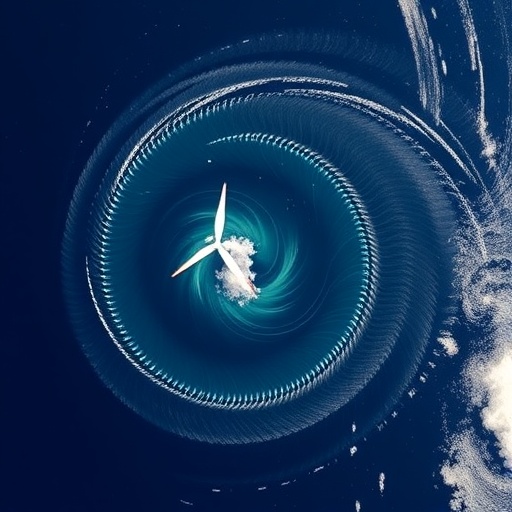
In recent years, the expansion of offshore wind farms has emerged as a cornerstone in the global transition toward sustainable energy. These massive arrays of turbines harness the relentless power of ocean winds, generating clean electricity on a scale previously unimaginable. However, as these installations grow in size and density, understanding their environmental and meteorological impacts becomes increasingly crucial. Groundbreaking research by Li, Zhang, and Zhao, published in Communications Engineering, now sheds new light on the long-range near-surface wake effects produced by clustered offshore wind farms, utilizing state-of-the-art satellite observations to unveil complex atmospheric interactions once hidden from view.
Near-surface wakes are essentially zones of altered wind patterns and turbulence that extend downstream from a wind turbine or group of turbines. While wake effects have been studied extensively at a local scale, the dynamics of wake interactions over extended distances remain poorly understood, mainly due to the challenges of acquiring comprehensive observational data over vast oceanic expanses. This limitation has constrained the ability of scientists and engineers to optimize wind farm layouts and forecast impacts on both energy yield and marine weather systems.
Traditional wake models have primarily relied on in-situ measurements from localized weather stations, lidar, or drones, offering valuable but ultimately piecemeal views. The innovation of Li and colleagues lies in leveraging high-resolution satellite data capable of capturing atmospheric flow patterns at unprecedented spatial and temporal scales. By analyzing this global perspective, the researchers identified distinctive wake signatures extending tens of kilometers downstream from clusters of offshore turbines – a phenomenon previously only hypothesized through computational simulations.
The study employed advanced remote sensing techniques, integrating scatterometer data with cutting-edge algorithms to isolate wake effects from the complex background variability of ocean-atmosphere interactions. Uniquely, the approach allowed for the quantification of near-surface wind speed deficits, turbulence intensity, and wake recovery rates, capturing spatial gradients with fine granularity. These findings not only confirm but also elaborate on the substantial reach of wake disturbances, revealing interconnected wakes that blend and amplify as wind farms increase in density.
Understanding these extended wakes is critical, as they affect more than just the immediate vicinity of turbines. Clusters of offshore wind farms can alter atmospheric boundary layer dynamics in ways that influence weather patterns, ocean currents, and even marine ecosystems over broader regions. The satellite-based evidence presented by Li et al. underlines the potential for cumulative wake effects to decrease the efficiency of downwind turbines and modify local microclimates, posing challenges for both energy production forecasting and environmental stewardship.
The implications for wind farm design are profound. Deploying turbines without accounting for these long-range wake interactions risks suboptimal performance and unintended ecological consequences. The researchers advocate for integrating satellite-derived wake data into engineering models to refine turbine spacing, arrangement, and control strategies. This holistic strategy promises to enhance power output, extend turbine lifespan by reducing mechanical fatigue, and strike a more sustainable balance between energy development and environmental conservation.
Moreover, the study’s methodology sets a precedent for global monitoring of wind energy infrastructures. As offshore wind installations proliferate across coastal regions worldwide, a satellite-enabled framework offers a scalable solution to continuously assess wake dynamics. Real-time monitoring could inform adaptive management, such as dynamic turbine control or coordinated farm operation, optimizing energy extraction in response to varying meteorological conditions.
From a scientific perspective, the detailed characterization of wake signatures advances our understanding of atmospheric boundary layer physics over marine environments. The interaction between turbine-induced turbulence and natural atmospheric processes, such as thermal stratification and large-scale wind flows, becomes more tangible. These insights open pathways for interdisciplinary research bridging renewable energy engineering, meteorology, and oceanography, fostering innovations that could improve climate modeling accuracy.
Environmental concerns also come sharply into focus. Prolonged wake effects may influence sea surface temperatures, humidity profiles, and aerosol distributions, with cascading impacts on marine life and weather systems. By quantifying the spatial extent and intensity of wakes, the authors provide critical data to assess potential ecosystem disruptions, guiding regulatory frameworks to ensure that offshore wind developments align with biodiversity protection goals.
The findings also resonate with broader sustainability agendas. Offshore wind is a leading candidate for net-zero energy systems due to its high capacity factors and environmental advantages. Yet, maximizing these benefits hinges on resolving challenges like wake effects that undermine efficiency. The satellite-based observations foreground a new era where remote sensing not only maps resources but actively informs the design and operational policies of renewable energy infrastructures.
Technical challenges remain, of course. Accurately separating wake signals from confounding meteorological phenomena requires sophisticated data processing and validation against ground-truth measurements. Future research must aim to enhance the temporal resolution of satellite sensors and incorporate machine learning algorithms to further isolate turbine influences. These advancements will help establish robust operational frameworks capable of supporting dynamic offshore wind farm management.
Crucially, the integration of satellite data with numerical weather prediction models could revolutionize forecasting accuracy for offshore wind energy production. By assimilating real-time wake information, models can better capture turbulence-induced variability, reducing uncertainties in power generation estimates. Such predictive enhancements are vital as power grids increasingly depend on renewable sources with variable outputs.
The research presented by Li, Zhang, and Zhao resonates as a clarion call for a global reassessment of how offshore wind clusters are planned and managed. With the world’s coastal nations accelerating their renewable portfolios, incorporating long-range wake signatures into decision-making processes will be essential to unlocking the full potential of offshore wind while safeguarding environmental integrity.
In summary, the study’s novel use of satellite observations to reveal extended near-surface wake effects uncovers an intricate dimension of offshore wind farm impacts. By transcending the limitations of localized measurements, the work opens a new frontier in renewable energy science—one where comprehensive atmospheric insights drive smarter, greener energy futures. As offshore wind capacity continues to soar, embracing satellite-enabled monitoring and modeling will be pivotal in shaping resilient, efficient, and eco-compatible energy landscapes for decades to come.
Subject of Research: Long-range near-surface wake effects generated by clusters of offshore wind farms, analyzed through satellite observations.
Article Title: Long-range near-surface wake signatures of offshore wind farm clusters revealed by satellite observations
Article References:
Li, R., Zhang, J. & Zhao, X. Long-range near-surface wake signatures of offshore wind farm clusters revealed by satellite observations. Commun Eng (2026). https://doi.org/10.1038/s44172-026-00684-7
Image Credits: AI Generated
Tags: environmental impact of offshore wind farmslarge-scale wind farm interactionslong-range wind turbine wakesmarine weather impact of wind farmsmeteorological effects of wind turbinesnear-surface atmospheric wake effectsoffshore wind energy expansionoffshore wind farm wake patternssatellite observation of wind farmssatellite technology in renewable energywind farm layout optimizationwind turbine wake turbulence