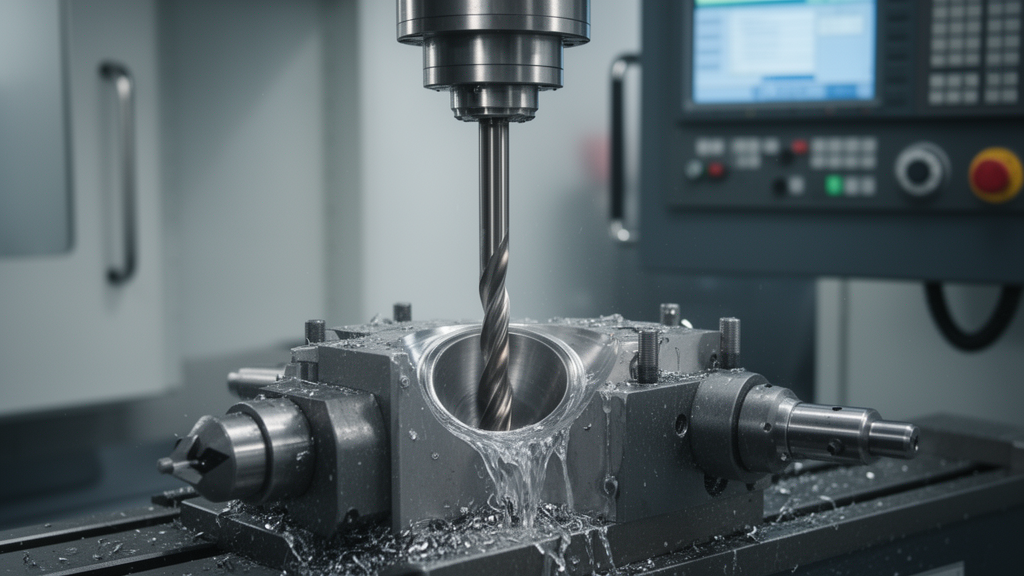
Deep-hole drilling is one of the most demanding operations in metalworking: a long, slender drill must reach hundreds of millimetres into a workpiece while remaining continuously engaged with the material, with restricted chip evacuation and limited access to the cutting zone. A new open-access study published in Discover Mechanical Engineering reports that changing only the programmed feed motion, without touching the CNC controller itself, can measurably reduce vibration and substantially improve the quality of the drilled bore. The researchers implemented a third-order, jerk-limited S-curve feed strategy through direct G-code modification and tested it on an industrial Gundrill machine.
The team, led by Van Binh Nguyen and Thanh Luan Bui, developed a customised G-code converter to generate the feedrate and displacement commands for each phase of the S-curve profile. They validated the approach experimentally on a MIROKU MEG-600 Gundrill machine using a D8 × 800 mm carbide drill from CHUNG JIN and a C45 steel workpiece. Two different S-curve feed-transition strategies were investigated and compared against conventional G-code under identical machining conditions, with the spindle held at a constant 1000 rpm and the same drill bit used throughout the entire experiment.
The S-curve concept comes from motion-control engineering, where velocity, acceleration and jerk—the rate of change of acceleration—can all be explicitly constrained. In a conventional trapezoidal velocity profile, acceleration changes abruptly at the transitions between acceleration, constant-velocity and deceleration phases, producing theoretically very large jerk at those switching points. A third-order S-curve instead ramps acceleration up and down gradually through bounded jerk, smoothing the commanded feed motion. This matters particularly in Gundrill machining, where the low bending stiffness of the long drill shank makes the system sensitive to deflection and vibration, especially as drilling depth increases.
The mathematical model divides the motion into seven phases: acceleration increase, constant acceleration, acceleration decrease, constant velocity, deceleration increase, constant deceleration and deceleration decrease. Because manually calculating velocity and travel-distance parameters for every phase is complex and time-consuming, the authors built a C#-based conversion program with a trajectory-simulation module. The software scans each line of the original G-code, identifies G01 commands, determines the machining distance, and replaces each original command with seven new G01 blocks representing the S-curve phases. Only feed rate and coordinates are modified; all other control commands are preserved. The simulation module plots the predicted position, velocity, acceleration and jerk profiles before machining, preventing operators from selecting aggressive parameters that could cause servo tracking errors or incomplete acceleration profiles.
The first drilling operation applied a reduced feed rate during the initial tool-entry region: a maximum acceleration of 1.291 mm/s², a maximum jerk of 10 mm/s³, a maximum velocity of 0.25 mm/s corresponding to a feed rate of 15 mm/min, an S-curve segment length of 2.5 mm, and a total drilling length of 10 mm. After the initial segment, the remaining 192 mm of the 202 mm hole used a second parameter set with a maximum acceleration of 1.602 mm/s², a maximum jerk of 11 mm/s³, a maximum velocity of 0.5 mm/s and a 12 mm segment length. The second strategy instead used a single parameter set over the whole drilling distance—maximum acceleration of 2.582 mm/s², maximum jerk of 20 mm/s³, maximum velocity of 0.5 mm/s and 20 mm segments—with no separate low-speed entry region. The third operation used conventional G-code with no S-curve adjustments.
Vibration was measured with an ACOEM ASH205-B IEPE accelerometer mounted rigidly on the workpiece, connected to an ACOEM FALCON vibration analyzer with an analysis range of 0–100 Hz. The measurements, taken at drilling depths of 10, 60, 110 and 190 mm, showed that both S-curve strategies generally produced lower vibration amplitudes than conventional G-code, with the most pronounced reduction occurring in the 0–30 Hz low-frequency range. The authors note that the accelerometer captured structural vibration transmitted through the workpiece, and that because cutting forces were not measured directly, the observed reduction cannot be uniquely attributed to reduced cutting-force excitation or to changes in the dynamic response of the tool–workpiece system. The frequency-domain analysis served for comparative evaluation; individual spectral peaks were not assigned to specific excitation sources or structural modes.
The surface-quality results were striking. After drilling, the specimens were longitudinally sectioned to expose the internal bore surface, and roughness was measured with an ACCRETECH SURFCOM NEX stylus profilometer traversed parallel to the hole axis. The first S-curve strategy achieved Ra = 1.1096 µm, Rz = 7.0540 µm and Rt = 9.6292 µm, compared with Ra = 2.2915 µm, Rz = 14.8393 µm and Rt = 22.9306 µm for conventional G-code—reductions of approximately 51.6%, 52.5% and 58.0%, respectively. The second S-curve strategy also improved the overall surface, achieving Ra = 1.2514 µm, Rz = 7.7881 µm and Rt = 10.1681 µm, corresponding to reductions of approximately 45.4%, 47.5% and 55.7%. Visual inspection of the bore surfaces at the entry, middle and final stages consistently showed smoother surfaces with fewer scratches for the S-curve operations, while the conventional G-code hole displayed prominent scratches and defects.
The difference between the two strategies is instructive. The first, with its reduced feed during tool entry followed by a gradual transition to the nominal feed, reduced the dynamic disturbance generated during initial tool–workpiece engagement and delivered the most favourable surface characteristics. The second, applying one parameter set throughout, still improved overall roughness but with less consistent effectiveness as drilling depth increased, since the cutting and structural conditions of the long, slender drill change during the process. The authors also analysed three S-curve motion scenarios: when the travel distance accommodates full acceleration, constant-velocity and deceleration phases; when a phase is missing because the distance is too short; and when there is no constant-velocity phase. In deep-hole gun drilling, where low feed rates are typical, they found it can be more advantageous to apply shorter S-curve segments repeatedly during the initial entry rather than a single long segment, since overly extended ramps approximate a standard trapezoidal profile and undermine the smoothing effect.
The practical significance of the approach lies in its accessibility. Commercial CNC controllers generally do not expose their internal interpolation and servo-control functions to users, making direct implementation of smooth feed scheduling difficult in industrial settings. Modifying the commanded trajectory at the G-code level offers an alternative that requires no changes to the existing controller. The authors also point out that reduced vibration decreases dynamic loading on the long and slender Gundrill, lowering the risk of drill breakage during machining—a meaningful consideration in aerospace, automotive, energy and medical applications where deep holes with demanding dimensional accuracy and surface integrity are required.
The researchers are careful to frame the scope of their findings. The experimental validation is limited to C45 steel at approximately 23 HRC, the D8 × 800 mm carbide Gundrill and the MIROKU MEG-600 machine, so the results should not be directly generalised to other materials, tool geometries or machine configurations. The S-curve parameters were selected to satisfy the kinematic requirements of a complete seven-phase profile and the machine’s operating limits, and should be regarded as experimentally evaluated feasible values rather than universally optimal ones; systematic optimisation through Design of Experiments remains future work. The campaign was a comparative evaluation rather than a comprehensive statistical assessment, with repeatability tests and statistical analyses planned for the future. Other bore-quality indicators such as diameter deviation, roundness, straightness and coaxiality were not quantitatively evaluated. Even so, the study demonstrates that a software-only change to the part program can deliver measurable gains in vibration behaviour and bore-surface quality under the investigated conditions.
Subject of Research: Experimental application of a third-order jerk-limited S-curve feed profile via G-code modification to reduce vibration and improve bore surface quality in Gundrill deep-hole drilling.
Article Title: Application of the S-curve algorithm to modify drill bit movement speed on Gundrill machines
Article References: Nguyen, V. B., Do, K. A., Le, T. A. K., Tran, V. D. H., Hoang, G., & Bui, T. L. (2026). Application of the S-curve algorithm to modify drill bit movement speed on Gundrill machines. Discover Mechanical Engineering, 5(1), Article 202. https://doi.org/10.1007/s44245-026-00377-7
Image Credits: AI Generated
DOI: 10.1007/s44245-026-00377-7
Keywords: Gundrill machining, deep-hole drilling, S-curve motion profile, jerk-limited feedrate, G-code modification, vibration reduction, surface roughness, CNC machining, C45 steel, carbide drill, feedrate scheduling, MIROKU MEG-600
News Source: Denise Maddox. (October 28, 2026). S-Curve G-Code Cuts Vibration and Roughness in Deep-Hole Gundrilling. Scienmag.