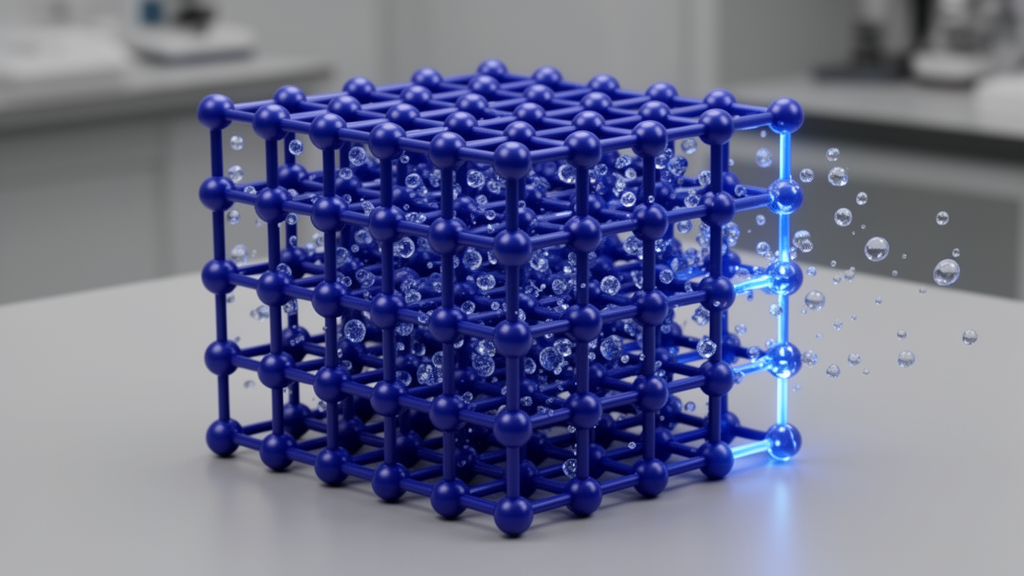
Prussian blue analogues have long been viewed as promising cathode materials for sodium-ion batteries because their open-framework structures offer high theoretical capacities, cheap and abundant ingredients, and straightforward aqueous synthesis. Yet these same open frameworks inevitably trap crystalline water during the standard co-precipitation manufacturing route, and that water has been a persistent source of trouble: it degrades sodium-ion transport, destabilizes the lattice, and undermines long-term cycling. A new study published in the journal Carbon Neutrality argues that the answer is not simply to strip every water molecule out of the crystal, but to teach the material to manage its own water dynamically during battery operation.
The research team, led by corresponding author Zi-Feng Ma with colleagues including Hangda Chen, Huailing Jiang, Xuan Wang, Chuying Ouyang and others, prepared three carefully related versions of a manganese-substituted Prussian blue cathode. The pristine material, PB-1, was synthesized by co-precipitation with sodium citrate as a chelating agent that regulates crystal growth into quasi-spherical secondary particles of aggregated cubic primary grains. Inductively coupled plasma and elemental analysis fixed its composition as Na1.8(Fe0.6Mn0.4)[Fe(CN)6]·2.1H2O, with the manganese substitution serving to raise the discharge voltage plateau. Vacuum dehydration at reduced temperature, chosen to minimize oxidation, produced the anhydrous PB-2, which retained the particle morphology but developed distinct surface cracks. Finally, deliberate re-exposure to ambient moisture produced PB-3, a partially rehydrated sample with the composition Na1.8(Fe0.6Mn0.4)[Fe(CN)5.3]·0.9H2O, in which the sub-stoichiometric cyanide count already hints at the central discovery of the work.
That discovery is that dehydration does not simply remove water; it irreversibly fractures the one-dimensional cyanide framework of the crystal. X-ray diffraction showed that pristine PB-1 is a highly crystalline monoclinic phase, that dehydration converts it to a rhombohedral anhydrous phase with broadened peaks signaling lost long-range order, and that rehydration restores the monoclinic structure while the peak broadening persists. In other words, the phase change driven by water moving in and out is reversible, but the lattice distortions and defects created during the first dehydration are not. In situ XRD cycling through dehydration and rehydration confirmed this: PB-3 converted back to the anhydrous phase roughly 20 degrees Celsius lower than the original PB-1 did, evidence of weakened water binding, yet it never recovered the original PB-1 structure even after prolonged air exposure.
Multiple independent probes converged on the same defect picture. Thermogravimetric analysis quantified the water contents, roughly 10.6 weight percent in PB-1 and about 5.4 weight percent in PB-3, and showed that PB-3 releases its water below 200 degrees Celsius, far below the coordinated-water loss window of 170 to 250 degrees Celsius seen in PB-1. Infrared spectroscopy revealed a significantly attenuated carbon-nitrogen stretching peak in both dehydrated and rehydrated samples, pointing to cyanide ligand cleavage. Thermogravimetry-infrared measurements during the initial dehydration detected cyanide signals emerging in the same 170 to 250 degrees Celsius window as the water release, intensifying with temperature, which directly indicates partial carbon-nitrogen bond dissociation as water leaves. High-resolution transmission electron microscopy with geometric phase analysis showed ordered lattice fringes in PB-1 but significant lattice distortions, dislocations and crack initiation at both surface and interior in PB-3. Positron annihilation spectroscopy sealed the case: the shortest lifetime component, associated with monovacancies, rose from 0.111 nanoseconds in PB-1 to 0.218 nanoseconds in PB-3, indicating a much greater vacancy concentration generated by cyanide decomposition.
The defects matter because they change how water binds to the framework. X-ray photoelectron spectroscopy found that the core-level spectra of sodium, iron, manganese, carbon and nitrogen barely shifted across the three samples, but the oxygen 1s spectra told a different story. In PB-1, coordinated and interstitial water appeared at 533.5 and 532.0 electronvolts. In PB-3, the interstitial water peak red-shifted to lower binding energy, and two new peaks emerged at 532.4 and 530.3 electronvolts, assigned to defect-affected coordinated water and defect-affected interstitial water. The lowest binding energy peak, at 529.6 electronvolts, was attributed to adsorbed water, since no iron-oxygen vibration was detected in the infrared spectrum. The authors attribute this unusually low binding energy to strong electronic interactions between water molecules and exposed divalent iron and manganese ions at the cyanide defect sites, where charge redistribution toward the coordinated water pulls the oxygen core level down. Dehydration, in short, manufactures an entirely new population of weakly bound, defect-associated water.
Density functional theory calculations corroborated the experiments and added mechanistic depth. The calculated water adsorption energy was minus 0.93 electronvolts for PB-1 but only minus 0.30 electronvolts for PB-3, confirming the dramatically weakened binding after dehydration. The calculations indicated that dehydration drives the metal ions toward a high-spin state, which strengthens the carbon-nitrogen coordination while weakening metal-water interactions. In a defective PB-3 model, water sitting at exposed metal sites bound more strongly and was more stable than water occupying defect channels, matching the XPS ordering. Crucially, the computed sodium-ion migration energy barriers were lower for pathways passing through the cyanide defects, meaning the very defects born of structural damage double as fast diffusion channels for sodium ions. Density of states analysis reinforced the kinetic picture: PB-3 showed a markedly higher total density of states near the Fermi level, dominated by iron and manganese 3d orbitals, and a narrower band gap that enhances electronic conductivity.
The electrochemical consequences were striking. Across coin cells with water contents of 0.2, 2.1, 6.1 and 11.8 weight percent, discharge capacities at 1 C rose from 91 to 120, 139 and 150 milliampere-hours per gram as water was removed, with an approximately linear gain of about 0.59 milliampere-hours per gram for every one percent reduction in water content. But the trend has a cliff at its end: excessive dehydration triggers severe structural collapse and rapid degradation. Fully dehydrated PB-2 delivered the highest initial capacity, 150 milliampere-hours per gram, yet faded continuously because dehydration-induced structural degradation accumulates. The highly hydrated PB-1 started at only 80 milliampere-hours per gram but cycled with excellent structural stability, its two plateaus at 3.5 volts from manganese-nitrogen and 2.8 volts from iron-nitrogen redox couples overlapping cleanly across successive cycles. Water, it turns out, also acts as a molecular pillar: single-particle compression tests gave average crushing strengths of 41.05 megapascals for PB-1, 33.59 for PB-3 and 31.20 for PB-2, and hydrated PB-1 and PB-3 resisted thermal decomposition above 350 degrees Celsius far better than the brittle anhydrous PB-2.
The pivotal behavior belongs to PB-3, which exhibits what the authors call adaptive dehydration during electrochemical cycling. As PB-3 cycles, its charge plateau flattens, its discharge plateau shifts upward, and its capacity climbs, reaching a maximum of 140 milliampere-hours per gram, a gain of 12 milliampere-hours per gram, as water is co-extracted with sodium ions in the 3.4 to 4.0 volt charging window. The authors estimate that roughly 20 percent of the water in PB-3, specifically the defect-affected interstitial and adsorbed populations, is expelled during cycling while the remainder stays in the lattice as structural pillars. In situ XRD captured this directly: PB-3 combines the intensity-modulated, low-strain diffraction behavior of the anhydrous material with the angle-shifting, strain-bearing behavior of the hydrated one, and the strain signature attenuates with cycling. X-ray absorption spectroscopy added independent confirmation, with a new manganese-oxygen coordination shell at about 1.1 angstroms in pristine PB-3, attributed to water adsorbed at cyanide defect sites, weakening or disappearing after charge-discharge cycling.
Tunability is the practical payoff. By controlling atmospheric exposure time, the team prepared a high-capacity PB-3(H) and a low-capacity PB-3(L). At 1 C, PB-3(H) delivered an initial capacity of 147 milliampere-hours per gram with a median voltage of 3.07 volts, and during the first 40 cycles adaptive dehydration raised these to 151 milliampere-hours per gram and 3.29 volts, with 85.6 percent of initial capacity retained after 400 cycles. PB-3(L) showed the same electrochemical dehydration effect at both rates, with capacity rising from 125 to 131 milliampere-hours per gram at 1 C and from 107 to 126 at 3 C, and median voltage climbing from 3.06 to 3.26 volts. Over the long haul it retained 86 percent of initial capacity after 1500 cycles at 1 C and 76 percent after 3000 cycles at 3 C, while maintaining 47 percent of its capacity at a demanding 10 C rate, where galvanostatic intermittent titration technique measurements confirmed a higher sodium diffusion coefficient and lower interfacial impedance. The authors frame the result as a design principle: dehydration-induced one-dimensional cyanide defects preserve mechanical integrity, open fast ion pathways and host weakly bound water that can be vented on demand, while the surviving coordinated and interstitial water hold the framework together. Because the final performance can be preset through the rehydration degree, the strategy points toward scalable, additive-free Prussian blue cathodes that pair high capacity with genuine long-cycle stability for grid-scale sodium-ion storage.
Subject of Research: Dehydration-induced cyanide defects and adaptive water regulation in Prussian blue cathodes for sodium-ion batteries
Article Title: Dehydration-induced CN- defects enable adaptive water regulation in Prussian blue cathodes for high-performance sodium-ion batteries
Article References: Chen, H., Jiang, H., Wang, X., Ouyang, C., Che, H., Mei, Y., Ishaq, M., Luo, P., Zhang, Y., & Ma, Z.-F. (2026). Dehydration-induced CN- defects enable adaptive water regulation in Prussian blue cathodes for high-performance sodium-ion batteries. Carbon Neutrality, 5(1), Article 26. https://doi.org/10.1007/s43979-026-00180-z
Image Credits: AI Generated
DOI: 10.1007/s43979-026-00180-z
Keywords: sodium-ion batteries, Prussian blue, cathode materials, crystalline water, cyanide defects, dehydration, rehydration, density functional theory, electrochemical cycling, energy storage, Dehydration-induced, defects
News Source: Denise Maddox. (October 28, 2026). Dehydration Creates Cyanide Defects That Let Prussian Blue Cathodes Manage Their Own Water. Scienmag.