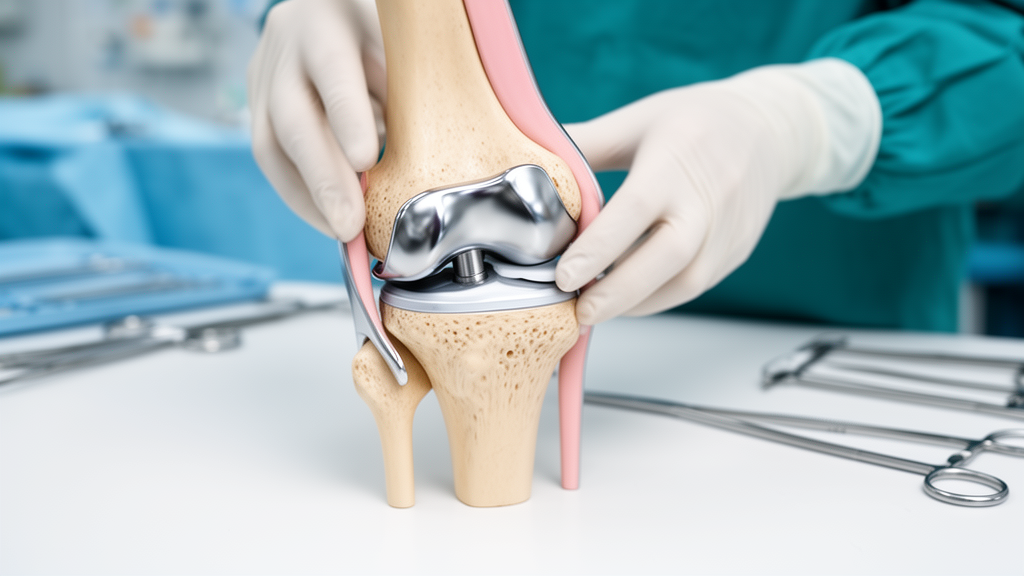
When a high tibial osteotomy fails and the knee finally needs a replacement, surgeons have long reached for a total knee arthroplasty. A new systematic review and meta-analysis, published on 5 October 2026 in the journal Arthroplasty, argues that this habit deserves scrutiny. The analysis of 41 studies covering 6,948 knees suggests that medial unicompartmental knee arthroplasty, or UKA, should not be considered an absolute contraindication after a failed high tibial osteotomy, and may have a role in a carefully selected subset of patients with isolated medial osteoarthritis, sufficient medial collateral ligament function, and acceptable residual alignment. The authors, led by Fardis Vosoughi and Iman Menbari Oskouie, are careful to frame their findings as hypothesis-generating rather than as proof that one procedure outperforms the other.
High tibial osteotomy is an established treatment for medial knee osteoarthritis caused by varus alignment in younger or more active patients, typically those aged 40 to 60, who are not typical arthroplasty candidates. Short- and mid-term survival of the procedure is generally satisfactory, with reported survival of 91 to 98 percent and high patient satisfaction. Long-term durability, however, is limited: one cited figure puts the conversion rate to arthroplasty at 11.1 percent after ten years. When conversion becomes necessary, total knee arthroplasty has traditionally been the preferred solution, because a prior osteotomy raises concerns about overcorrection of the knee, altered tibial anatomy and bone stock, changes in tibial slope, disturbed ligament balance, difficult component positioning, and retained hardware.
The research team searched MEDLINE, Embase, Scopus, and Web of Science until 14 August 2025, following PRISMA 2020 guidelines and registering the protocol prospectively in PROSPERO. From 4,200 initial records, they ultimately included 41 studies published between 1987 and 2025: six reporting UKA only, 33 reporting TKA only, and two comparative studies contributing to both groups. The UKA arm comprised 226 knees in 218 patients with a mean age of 61.7 years and a mean body mass index of 26.8, followed for an average of 64.2 months. The TKA arm covered 6,722 knees in 6,632 patients with a mean age of 63.6 years, a mean body mass index of 30.7, and an average follow-up of 102.4 months.
The pooled numbers tell a nuanced story. After failed high tibial osteotomy, UKA showed a pooled revision rate of 10.2 percent (95 percent confidence interval 4.5 to 21.6 percent, with substantial heterogeneity) and a pooled reoperation rate of 14.4 percent (95 percent confidence interval 9.1 to 21.9 percent), each based on 226 knees. Periprosthetic joint infection rates in the UKA group ranged from 0 to 3.3 percent across the studies reporting them. For TKA, the pooled revision rate was 5.0 percent (95 percent confidence interval 3.5 to 7.2 percent) in 6,208 knees, the pooled reoperation rate was 11.1 percent (95 percent confidence interval 7.3 to 16.3 percent, with high heterogeneity) in 6,236 knees, and the pooled infection rate was 2.9 percent (95 percent confidence interval 2.0 to 4.0 percent) in 2,107 knees. The authors stress that these are single-arm pooled estimates from separate groups, not direct comparisons, and that revision rates could not be directly compared because follow-up durations differed substantially between the two bodies of literature.
Functional outcomes were encouraging in both groups. In the UKA group, the mean improvement in the Knee Society Score ranged from 34.0 to 38.8 points across two studies, and the mean improvement in the Oxford Knee Score ranged from 17.3 to 21.4 points in two studies. In the TKA group, the pooled KSS improvement was 40.8 points (95 percent confidence interval 36.0 to 45.6), the pooled Hospital for Special Surgery score improvement was 40.1 (95 percent confidence interval 29.2 to 51.0), and the Oxford Knee Score improved by a pooled 16.9 points. The authors caution that pooled point estimates for high-heterogeneity outcomes, such as the TKA reoperation rate and KSS score, should be read only as summaries of a wide underlying distribution rather than precise single values.
Perhaps the most striking finding concerns time. Early UKA series in patients with failed osteotomies documented revision rates as high as 28 and 50 percent, leading those authors to advise against the procedure altogether. Contemporary studies report outcomes approaching those of primary UKA, with one 2025 study reporting a revision rate of 3 percent compared with 28 percent in a 2001 study. In an exploratory, post hoc analysis of studies published from January 2020 onwards, the revision rate was 6.3 percent for UKA and 3.9 percent for TKA, although the between-period differences were not statistically significant. The authors attribute the improvement to advances in implant design, better understanding of UKA biomechanics, greater surgical experience, more rigorous patient selection, refined alignment and ligament-balancing strategies, and possibly technologies such as computer-assisted navigation and robotic-assisted implantation. They also note that shorter follow-up in recent studies may partly explain the lower revision rates, so the trend should not be read solely as evidence of better surgery.
Why does UKA fail after a prior osteotomy? The most common cause of revision was lateral progression of osteoarthritis, accounting for 55 percent of the 22 revision events extracted from the eight included UKA studies. Other reported indications included progression of patellofemoral osteoarthritis, periprosthetic joint infection, bearing dislocation, persistent pain, and loosening. Early failures were often linked to overcorrected osteotomies leaving the knee in residual valgus. The authors advise surgeons converting an osteotomy to UKA to avoid overstuffing the medial compartment, using excessively thick inserts, or creating valgus overcorrection, all of which raise the risk of lateral compartment degeneration. They also highlight the altered posterior tibial slope that follows opening-wedge osteotomies, which can affect kinematics, ligament tension, and contact mechanics, and may be particularly relevant for mobile-bearing designs, where excessive slope has been associated with bearing instability. Several authors cited in the review recommend fixed-bearing implants, which better tolerate minor residual medial laxity.
Only two studies directly compared UKA and TKA after failed high tibial osteotomy, and both reported comparable results regarding functional scores, revision rates, and surgical complications. Given the small number of comparative studies, the review team judged a formal head-to-head meta-analysis methodologically inappropriate and presented those findings descriptively instead. On patient selection, the review suggests that indications similar to those for primary UKA may apply: patients with medial bone-on-bone osteoarthritis and a history of osteotomy can be considered for UKA if there are no signs of bone-on-bone lateral osteoarthritis, anterior or medial collateral ligament insufficiency, or patellofemoral bone loss, grooving, or subluxation. Conversely, patients with overcorrection into valgus, advanced tricompartmental degeneration, or ligament insufficiency remain better suited to total knee replacement.
The authors are candid about the caveats. Sixteen of the included studies carried a serious risk of bias, mostly from inadequate control of confounding, 23 had moderate risk, and only two had low risk. The evidence base consists predominantly of retrospective observational studies, and the UKA series largely originate from specialized, high-volume centers with established expertise in both osteotomy and unicompartmental arthroplasty, a concentration of skill that may not be reproducible in lower-volume settings. The marked size difference between the UKA and TKA cohorts limits the stability of any comparison, because rare events weigh more heavily in the smaller group. The search strategy included the abbreviation UKA but not the full terms unicompartmental or unicondylar, which may have missed some studies. No study reported mortality, and only a few studies exceeded ten years of follow-up, limiting long-term survivorship conclusions.
The practical message is deliberately measured. The review suggests that in the modern surgical era, UKA represents a technically feasible option for arthroplasty following failed high tibial osteotomy in appropriately selected patients, but that treatment decisions should continue to be individualized based on patient characteristics, residual deformity, and surgeon experience, and that the procedure is best performed by surgeons with substantial UKA expertise. The findings should not be interpreted as a recommendation to perform UKA in every patient with a failed osteotomy, nor as evidence establishing equivalence or comparative effectiveness between the two procedures. The authors call for prospective comparative cohorts and registry-based matched analyses with standardized definitions of revision, reoperation, and complications, consistent reporting of osteotomy technique and alignment parameters, and sufficient follow-up to evaluate mid- and long-term implant survivorship.
Subject of Research: Outcomes of unicompartmental versus total knee arthroplasty after failed high tibial osteotomy
Article Title: Unicompartmental knee arthroplasty after failed high tibial osteotomy in appropriately selected patients: a systematic review and meta-analysis
Article References: Vosoughi, F., Taghva Nakhjiri, M., Saghafi, A. A., Koolinia, F., Nikeghbali, G., & Menbari Oskouie, I. (2026). Unicompartmental knee arthroplasty after failed high tibial osteotomy in appropriately selected patients: a systematic review and meta-analysis. Arthroplasty, 8(1), Article 74. https://doi.org/10.1186/s42836-026-00434-2
Image Credits: AI Generated
DOI: 10.1186/s42836-026-00434-2
Keywords: high tibial osteotomy, unicompartmental knee arthroplasty, total knee arthroplasty, knee osteoarthritis, systematic review, meta-analysis, revision rate, periprosthetic joint infection, patient selection, knee surgery, arthroplasty outcomes, Unicompartmental
News Source: Ophelia Keating. (October 28, 2026). Knee replacement after failed osteotomy: review finds unicompartmental implants may deserve a second look. Scienmag.